Cartier Tank Must SolarBeat: The Dress Watch That Actually Makes Sense
Cartier's solar-powered Tank solves the one real problem with quartz dress watches: the battery. Here's why the SolarBeat is the version of the Tank that makes the most sense.
About this article: this is an informational article based on public sources: manufacturer specifications, published hands-on reviews by other outlets, owner feedback and current prices. We have not tested the watch ourselves, we are watch enthusiasts rather than professional journalists, and nothing here is buying advice. No brand paid for it. Our method

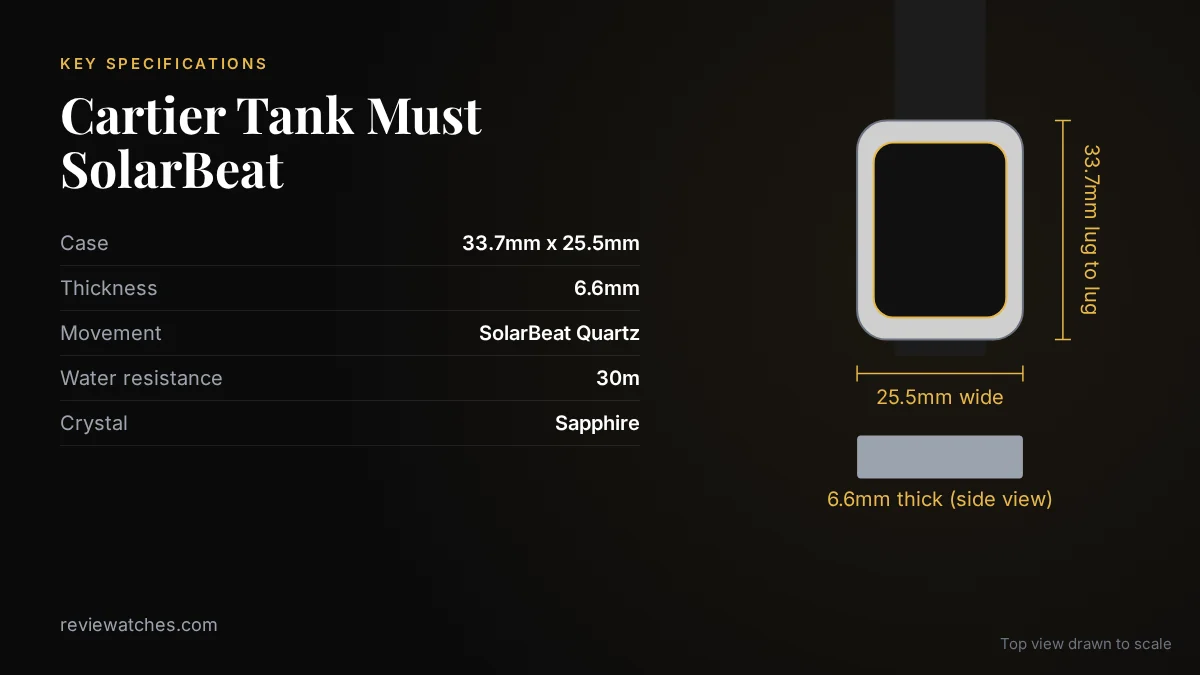
At a glance
- Case
- 33.7mm x 25.5mm
- Thickness
- 6.6mm
- Movement
- SolarBeat Quartz
- Water resistance
- 30m
- Often praised
- Solar movement means no battery changes for 16+ years
- Common criticism
- Only 30m water resistance, not suitable for swimming or showers
📑 Table of Contents
The Tank has a well-documented problem, at least in its standard quartz form, as this article on the Cartier Tank Must SolarBeat explains. It's a design from 1917 running on a battery that needs replacing every couple of years by whoever happens to work at your local jeweller. Every battery change means handing the watch over and hoping the case back doesn't come back scratched. That's not elegant. That's just annoying with better fonts.
So when Cartier announced the Tank Must SolarBeat, it looked, at first glance, like a strange fit. Solar quartz feels like Casio territory, not Cartier. But looking closely at what the SolarBeat actually changes, this may be the version of the Tank that makes the most practical sense for most buyers. Not despite the solar movement. Because of it.
What Makes This Different
The SolarBeat uses a solar cell hidden under the dial, invisible to the eye. The watch looks identical to any other Tank Must: Roman numerals on a cream guilloché dial, blue spinel cabochon crown, the whole aristocratic package. The difference is that the battery is never replaced. Cartier states the movement can run for up to 16 years in complete darkness once fully charged, and with normal daylight exposure it should simply keep going indefinitely.
The traditional quartz Tank is already something of a compromise: a design from 1917, powered by 1970s battery technology, serviced periodically at whatever cost your jeweller sets. The SolarBeat removes that friction. It's still quartz, still accurate to within seconds a month according to the specification, but it's also genuinely low-maintenance in a way the standard Tank Must isn't. It's the sort of watch that can sit in a drawer for months, get pulled out for a wedding, and still be running. That's arguably the entire point of a dress watch: to be there when needed and invisible the rest of the time.
Size and Wearability
The case measures 33.7mm wide by 25.5mm tall, smaller than many buyers coming from sports watches will expect. That's the point. The Tank was never designed to dominate the wrist. It's designed to disappear under a cuff and reappear only when you check the time.
At 6.6mm thick including the crystal, the case is thin enough by any measure to sit comfortably under a shirt cuff, French or button. The steel case has polished flanks and a brushed case back. The finishing, based on published detail shots and widely echoed reviewer commentary, is good rather than exceptional: minor tooling marks are visible under close inspection, though not in ordinary wear. In practice, it reads as expensive because the design itself is doing the work, with the execution simply not undermining it.
The stock calfskin strap is unremarkable by most accounts: black, minimally stitched, with a Cartier-stamped buckle. It's serviceable rather than special, though generally considered better than the strap options that come with comparably priced Longines or Tissot dress watches. Owners commonly swap it for an aftermarket alligator strap, which the design accommodates easily given its simple lug construction.
The Design That Refuses to Age
Louis Cartier designed the Tank in 1917, reportedly inspired by the aerial silhouette of Renault FT tanks. The two vertical brancards represent the treads, the case the hull. It's reductive design in the best sense: reduce the watch to its essential geometry, then stop.
Later reinterpretations have generally been judged less successful. The rounded-corner Tank Anglaise and the enlarged Tank Américaine both moved away from the original proportions, and neither has displaced the classic Tank silhouette in reputation. The case proportions of the original are widely regarded as correct, which is presumably why Cartier keeps returning to them rather than reworking them.
The dial on the SolarBeat is cream with a subtle guilloché pattern radiating from the centre, Roman numerals at 12, 3, 6 and 9 with stick indices between them, a chemin de fer minute track and blued steel sword hands. It's the same dial layout Cartier has used for decades, and it remains legible without being showy, readable in a glance without demanding attention.
The blue spinel cabochon on the crown is the detail most associated with Cartier's design language. It's a small, inexpensive stone in material terms, but it's widely cited as the sort of detail that makes people notice the watch without quite knowing why, a signature touch rather than a functional one.
Where It Falls Short
Water resistance is rated at 30 metres, which in practical terms means splash resistance only. It's not suitable for swimming, showering or heavy rain exposure. The Longines Master Collection offers the same rating, but with a mechanical movement to justify some of that limitation. Here, on a quartz watch, there's no obvious technical reason the rating couldn't be higher. Cartier appears to have simply not prioritised it.
The absence of a date function will read as either a strength or a weakness depending on the buyer. Dress watches have traditionally avoided date complications on the basis that the occasions they're worn for rarely require checking the date. Those who wear a dress watch daily may see it differently, but it isn't offered here regardless.
There's no bracelet option. The SolarBeat is strap-only, which suits formal wear but limits its usefulness as a daily watch for buyers who prefer metal on the wrist. Cartier reserves bracelet options for its more expensive Tank models, a segmentation choice that feels more commercial than practical.
Tank Must vs. Tank Solo vs. Tank Louis Cartier
Cartier's Tank lineup is deliberately layered. The Tank Must is the entry point, starting at £2,500 for standard quartz and £3,300 for this SolarBeat. The Tank Solo sits in the middle, offering both mechanical and quartz options in steel and gold. The Tank Louis Cartier is gold-only, hand-wound mechanical, and starts at around £14,500.
For buyers who want the Tank design without needing a mechanical movement, the SolarBeat looks like the strongest option in the range: same design, more practical movement, and a lower price than the alternatives. For buyers who specifically want mechanical watchmaking, the Louis Cartier is the obvious step. The Solo occupies an awkward middle ground, costing more than the Must while offering less distinction than the Louis.
The SolarBeat is arguably the most honest version of the Tank currently on offer. It's a quartz watch that doesn't disguise what it is, and instead turns that into a genuine advantage rather than a compromise buyers have to accept.
Versus the Competition
The Jaeger-LeCoultre Reverso is the closest comparison in this segment. It's more mechanically complex given its reversible case, more expensive at around £4,500 for a quartz version, and arguably more overtly elegant. It was originally designed for polo players in 1931, though today it's generally treated as jewellery rather than a working watch, whereas the Tank still reads as a watch first.
The Patek Philippe Calatrava represents the upper end of the dress watch category, but at around £30,000 for an entry-level Calatrava it isn't really competing in the same market. Anyone cross-shopping a Tank against a Calatrava has likely already decided in favour of the Calatrava.
At £3,300, the SolarBeat doesn't have much direct competition. There's no other solar-powered dress watch operating at this level of design pedigree. Citizen's Eco-Drive range covers similar technology at a very different price and design tier, and Seiko's Presage line, while well regarded, doesn't carry the same design history. The Tank's advantage here is largely that nothing else occupies quite the same space.
Who This Is For
This suits buyers who need a reliable dress watch without wanting to think about it: weddings, funerals, christenings, and the kind of dinners where looking like you made an effort matters. It's also a sensible option for people who already own sports watches but want something that doesn't look out of place with a suit, a combination reviewers and owners frequently mention as a common reason for adding a Tank to a collection.
It's less suited to buyers who care primarily about mechanical watchmaking. The SolarBeat has no exhibition case back and nothing to inspect mechanically. Those buyers are better served by the Tank Louis Cartier. This is a watch for matching the occasion, not for admiring the movement.
The Bottom Line
Solar quartz sounds like a gimmick until you consider what it actually solves. Removing the recurring battery-replacement problem, generally cited as the biggest practical annoyance with quartz Tanks, makes this the version of the design that's easiest to actually recommend. The size and proportions are right, the design has held up since 1917, and now the movement suits what the watch is meant to do.
The Tank has arguably been right since 1917. The SolarBeat just makes it practical too, and that's a meaningful improvement rather than a small one.
⚙️ Specifications
✅ Pros
- +Solar movement means no battery changes for 16+ years
- +Perfect proportions at 33.7mm x 6.6mm, slides under any cuff
- +Timeless design that has worked since 1917
- +Blue spinel cabochon adds subtle luxury detail
- +Excellent value for an iconic dress watch at £3,300
❌ Cons
- −Only 30m water resistance, not suitable for swimming or showers
- −No bracelet option available, strap only
- −Stock calfskin strap is unremarkable
- −No mechanical movement option at this price point
- −Case finishing is competent but not exceptional
Written by
RevieWatches Editorial Team
RevieWatches is an independent, informational watch site. We research specifications, track pricing across retail and grey markets, and summarise what published...
More in Dress Watches
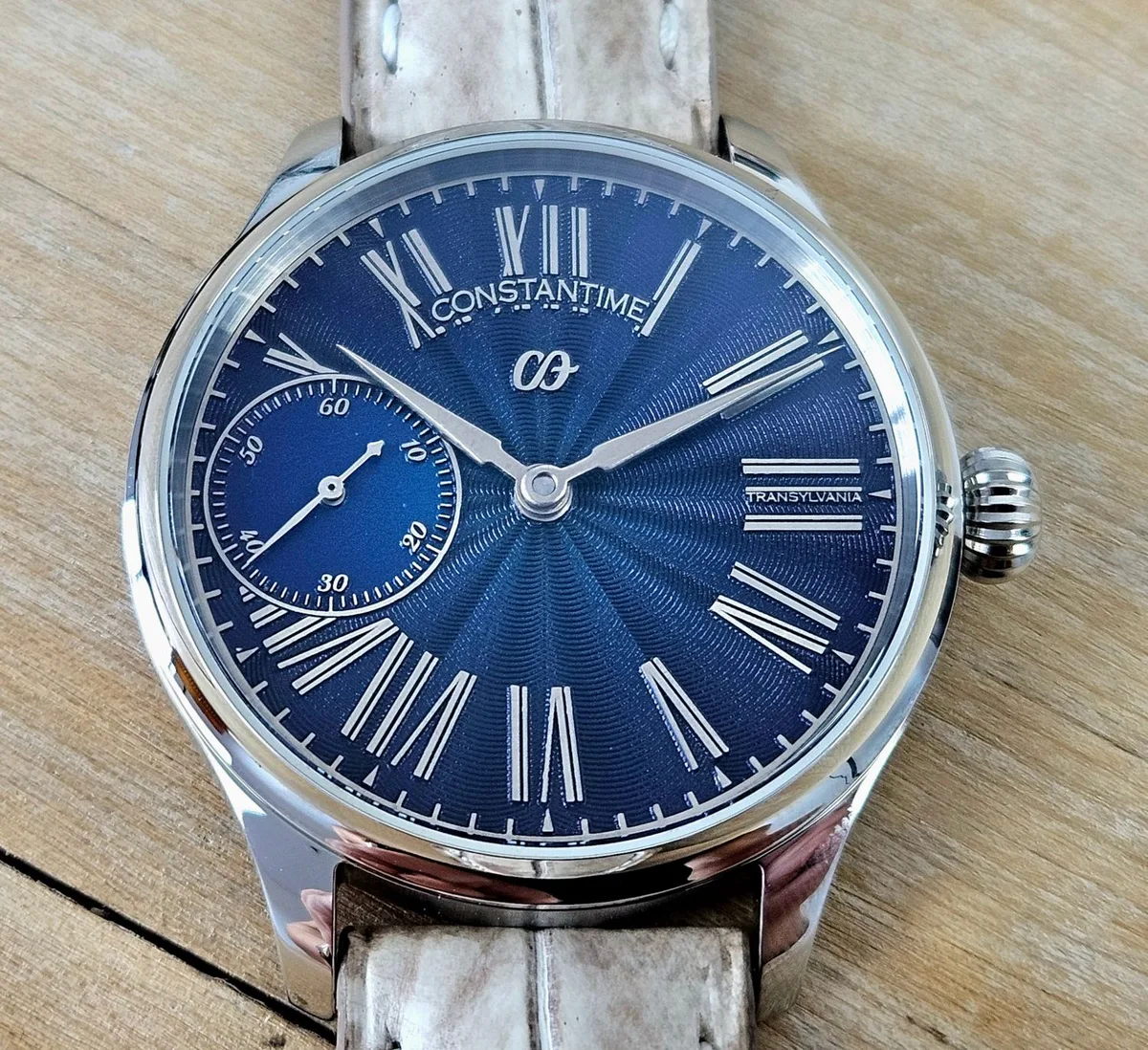
CONSTANTIME Genesis: A 25-Piece Hand-Wound Watch From Transylvania
The CONSTANTIME Genesis is a 41mm hand-wound dress watch with a dial and hands made in a small Transylvanian workshop, limited to 25 pieces. Specs, fit, price and what is made locally.

Jaeger-LeCoultre Reverso Buying Guide: Which Model to Choose
The Reverso family has grown into a proper maze of sizes, complications and dial layouts. Here's how to work out which version actually suits how you'd wear it.

Aerowatch: Is This Small Swiss Watchmaker Any Good?
Aerowatch is a small, family-owned Swiss brand best known for pocket watches, skeleton dials and classical designs. We looked at its history, movements, prices and warranty.