Omega Seamaster Planet Ocean: The Definitive Luxury Diver
Omega's Planet Ocean is widely regarded as the apex of production dive watches. Technical brilliance meets genuinely practical design.
About this article: this is an informational article based on public sources: manufacturer specifications, published hands-on reviews by other outlets, owner feedback and current prices. We have not tested the watch ourselves, we are watch enthusiasts rather than professional journalists, and nothing here is buying advice. No brand paid for it. Our method
At a glance
- Movement
- Omega Co-Axial Master Chronometer Calibre 8900
- Power
- 60 Hours
- Water resistance
- 600 Meters (2,000 Feet)
- Often praised
- Co-axial movement offers exceptional accuracy and longer service intervals
- Common criticism
- Bezel action stiffer than some competitors
📑 Table of Contents
- First Impressions: Heft and Presence
- Design: Iconic Without Trying Too Hard
- Movement: Co-Axial Excellence
- Water Resistance: Overkill in the Best Way
- Durability and What Owners Report
- Value Proposition: Premium Pricing, Premium Product
- The Competition: How It Stacks Up
- Who This Watch Is For
- Final Thoughts: One of the Best
This article on the Omega Seamaster Planet Ocean looks at a watch that has built a reputation as the one enthusiasts reach for when they need something that simply works. Not a watch to be babied or saved for special occasions, but one designed to go everywhere and do everything without complaint.
That's notable because so many modern dive watches drift into being desk divers, Instagram props, safe queens. The Planet Ocean, by design and reputation, is different. It's built to be worn hard.
First Impressions: Heft and Presence
Let's address the elephant in the room. This is a big watch. Not gratuitously big like some 47mm monsters, but substantial. According to Omega's published dimensions, the case wears larger than the raw numbers suggest, owing to its proportions.
Owners commonly report an adjustment period with the size, followed by the opposite problem: once accustomed to the Planet Ocean, smaller watches start to feel insubstantial by comparison. The design has that rare quality where heft reads as confidence rather than burden. It's dense and properly tool-watch heavy, but the case geometry and lug design mean it should sit flat on the wrist without overhanging even on smaller wrists, according to the specifications.
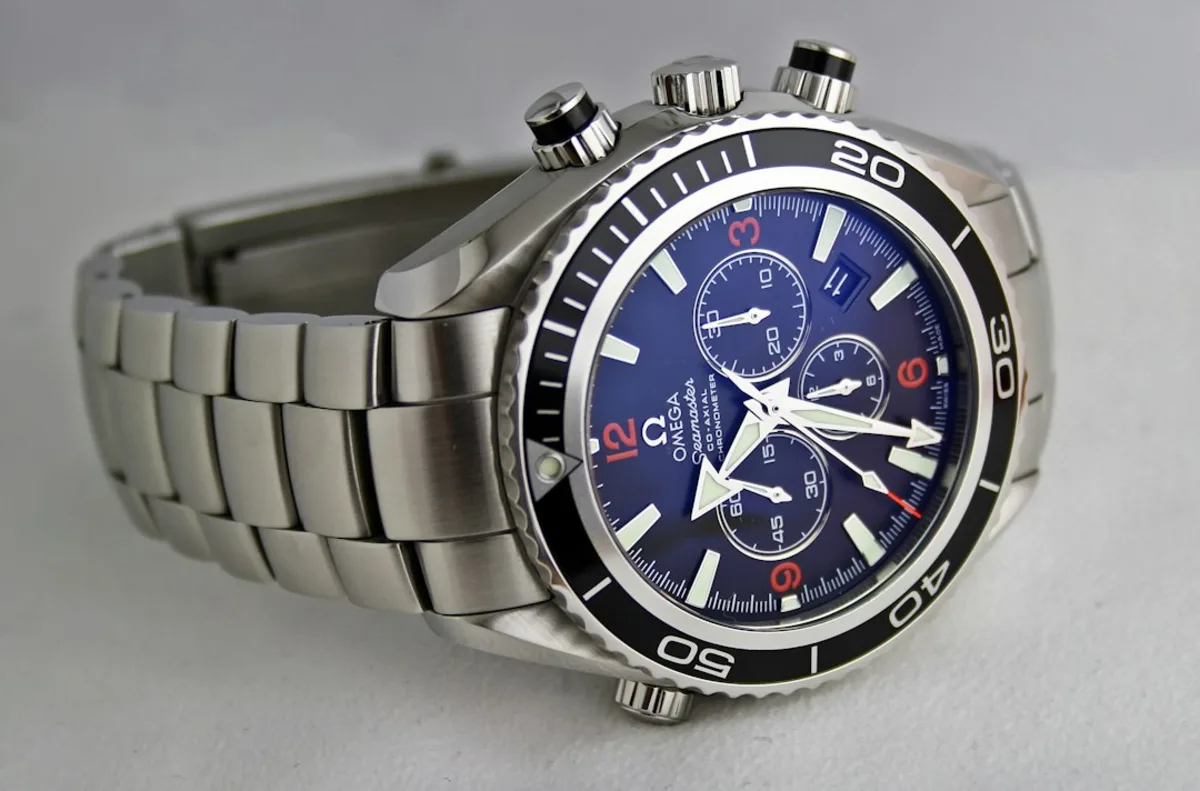
The ceramic bezel is what sells the watch visually. Omega's ceramic work is widely regarded as exceptional. The dive scale isn't simply printed or filled, it's raised, polished and dimensional. Under direct light it should catch and reflect in ways that make flatter ceramic bezels look lifeless by comparison. The Planet Ocean's bezel is frequently singled out by reviewers as having more visual depth than rivals such as the Rolex Submariner and Tudor Pelagos.
Design: Iconic Without Trying Too Hard
The solid stainless steel case, helium escape valve and unidirectional rotating ceramic bezel are iconic elements of the design. The dial, available in multiple variants, is built for legibility, with Omega's signature lollipop seconds hand as its most distinctive touch.
The black dial variant is often considered the most conservative choice, and there's a reasonable case for that being the safest long-term option: bold dial colours tend to age less gracefully than black. The applied hour markers are substantial and three-dimensional, filled with Super-LuMinova that is widely reported to glow strongly rather than faintly.
That lollipop seconds hand divides opinion. Some find it distracting at first, though many come round to it as a piece of the watch's character rather than a flaw. It's a design signature that dates back to the original Seamaster 300, and there's something satisfying about that continuity. Omega isn't chasing trends here. It's refining a language the brand invented.
The bracelet deserves its own paragraph. It's widely regarded as a masterclass in engineering. Every link is solid rather than hollow. The clasp includes a diving extension intended to work over a wetsuit, and the micro-adjustment system is genuinely clever, needing no tools, just a button press and a slide. This kind of real-world usability is often cited as the thing that separates great watches from merely good ones, and owners frequently mention adjusting fit on the fly as the wrist swells through the day.
Movement: Co-Axial Excellence
The Co-Axial Master Chronometer calibre 8900 is a genuine technical achievement. The co-axial escapement reduces friction and wear, which allows for longer service intervals, and METAS Master Chronometer certification guarantees a defined standard of accuracy and magnetic resistance.
In practice, owners commonly report daily rates within a couple of seconds, consistent with Master Chronometer tolerances and considered strong performance for an automatic movement. The co-axial escapement isn't marketing fluff. It's a genuine refinement on the Swiss lever escapement that has been the industry standard since the 1700s.
Omega recommends service intervals of 5 to 8 years, compared with the 3 to 5 years many manufacturers suggest for their own calibres. Over a 20-year ownership period, that could mean two fewer services at a typical cost of £500 to £800 each. The co-axial technology arguably pays for itself over time.
The movement is visible through an exhibition caseback, which some purists argue has no place on a dive watch. They have a point. Others simply enjoy being able to see the finishing, which by most accounts is excellent, with Geneva waves, blued screws and bevelled edges. There's no shame in that.
Power reserve is 60 hours, which is adequate but not exceptional by modern standards. For anyone rotating it with other watches, it will stop between wears, though restarting an automatic like this is straightforward: set the time, wind it by hand, and it's running again.
Water Resistance: Overkill in the Best Way
A 600-metre water resistance rating exceeds the requirements of all but saturation diving. The helium escape valve is designed to allow safe decompression during professional use.
Very few owners will ever approach saturation diving depths, which makes the 600-metre rating functionally unnecessary for almost everyone and, in a way, wonderful precisely because of that. There's something reassuring about deliberate over-engineering: the watch can handle far more than most owners will ever ask of it, which in turn should translate to confidence wearing it in the shower, the pool or the sea without a second thought.
The helium escape valve is a functional piece of hardware rather than a cosmetic detail. During deep saturation diving with helium-based breathing mixtures, helium atoms can work their way into the watch case. During decompression that helium needs an escape route or it risks blowing the crystal off, hence the valve. Most owners will never need it, but its presence and function are well documented.
Durability and What Owners Report
This is where the Planet Ocean is said to earn its reputation. It's designed and marketed as an all-rounder capable of handling formal wear, travel, sport and daily knocks without fuss.
The steel bracelet will scratch with wear, as any steel bracelet does. Brushed surfaces hide marks well, while polished surfaces show every one. Refinishing is always an option for owners who prefer a pristine look, though many choose to let the marks stand as a record of use rather than sending the watch away for polishing.
Weight distribution is generally well regarded. Despite the heft, the design shouldn't feel unbalanced on the wrist, helped by a bracelet that tapers towards the clasp. Reviewers commonly note that the watch remains comfortable enough for long days of wear.
Legibility is consistently praised. The proportions of the hands, the integration of the date window at 3 o'clock, and the strength of the lume all contribute to a dial that reads at a glance even in poor light, in contrast to some dive watches where the date feels like an afterthought.
One recurring criticism is that the bezel action is stiffer than on some competitors. It's not stiff enough to be a genuine problem, but noticeably firmer than rivals like the Submariner or comparable Tudor models. Omega likely engineered it that way deliberately, to prevent accidental rotation, which makes sense for actual diving even if it's a minor inconvenience for everyday use.
Value Proposition: Premium Pricing, Premium Product
The Omega Seamaster Planet Ocean sits in the upper tier of production watches. It isn't cheap, and it isn't trying to be.
What buyers are paying for, by most assessments, is genuine technical substance rather than pure brand markup. The co-axial movement is legitimately advanced, the ceramic work is best-in-class, the bracelet engineering is excellent, and the finishing throughout is considered strong. This isn't a watch where corners appear to have been cut.
Compared with its closest rival, the Rolex Submariner, the Planet Ocean offers greater water resistance, a more advanced movement, arguably better bracelet engineering, and often better availability. The Submariner retains stronger brand cachet and holds its value better on the resale market. Which of those matters more is a matter of priority rather than fact.
For anyone buying primarily for personal enjoyment rather than as an investment, a drop in resale value the moment the watch leaves the shop is simply the cost of ownership, not a flaw in the watch itself.
The Competition: How It Stacks Up
Based on specifications and the weight of reviewer consensus, here's how the Planet Ocean compares with its main rivals:
Rolex Submariner: More iconic, better resale, a bracelet that's arguably just as good. The Planet Ocean counters with a more interesting movement and greater water resistance. Call it a draw.
Tudor Pelagos: An excellent watch with a titanium case at a lower price, but generally considered less refined in its finishing and bracelet compared with the Planet Ocean, which tends to feel more premium overall.
Blancpain Fifty Fathoms: More elegant, more expensive, and arguably prettier, but the Planet Ocean is generally seen as more practical for daily wear and less precious about it.
IWC Aquatimer: A good watch, though its styling is considered less timeless. The Planet Ocean's design language seems better placed to still look current decades from now.
Who This Watch Is For
The Planet Ocean suits buyers who want one watch that can do everything: formal enough for a suit, tough enough for genuine adventure, accurate enough to rely on, and engaging enough not to bore after years of ownership.
It's less suited to anyone chasing hype or resale value, anyone wanting the lightest possible watch, or anyone working to a tight budget.
It suits someone who values engineering and reliability over flash, and who wants a watch built to remain relevant for decades rather than one tied to a passing trend.
Final Thoughts: One of the Best
The Omega Seamaster Planet Ocean sits, by most measures, at the apex of production dive watches. It's widely considered one of the finest dive watches made available to the public.
Based on its specifications, engineering and the weight of owner and reviewer opinion, this is a watch that appears to deliver on its promises: accurate, robust, well finished and easy to live with day to day. The minor quibbles, such as bezel stiffness, look insignificant against the overall package.
Is it worth buying? On the evidence, it's hard to argue otherwise. The Planet Ocean earns the kind of praise that goes beyond simple satisfaction, the sort that has people considering a second variant down the line rather than moving on to something else entirely.
The Omega Seamaster Planet Ocean is a genuinely definitive luxury dive watch. It combines technical substance, historical continuity and considered design into a package that, on the evidence, justifies its premium price.
⚙️ Specifications
✅ Pros
- +Co-axial movement offers exceptional accuracy and longer service intervals
- +Ceramic bezel with dimensional, polished dive scale is best-in-class
- +Superb bracelet with tool-free micro-adjustment and functional diving extension
- +600m water resistance provides confidence for any water activity
- +Excellent wrist presence without overwhelming smaller wrists
- +Outstanding legibility in all lighting conditions
❌ Cons
- −Bezel action stiffer than some competitors
- −Substantial weight not ideal for all-day comfort seekers
- −Exhibition caseback arguably unnecessary on a dive watch
- −Premium pricing without Rolex-level resale value
- −Polished surfaces show scratches readily
Written by
RevieWatches Editorial Team
RevieWatches is an independent, informational watch site. We research specifications, track pricing across retail and grey markets, and summarise what published...
More in Dive Watches
Tudor Black Bay 54 vs 58 vs 41: Which Size Is Right?
Tudor now makes its Black Bay diver in four sizes, and recent updates have changed the movements too. Here is how the 54, 58 and 41 really differ, and where the new 68 fits.
Rolex Submariner vs Omega Seamaster Diver 300M
Two of the most famous dive watches ever made, both rated to 300 metres, both with ceramic bezels. On paper they are closer than their reputations suggest. Here is where they really differ.

Zelos Watches: Singapore Microbrand With Unusual Materials
Zelos is a Singapore microbrand famous for exotic dials and case materials at accessible prices. We went through its catalogue, movements, sizes and policies.