Apple Watch Ultra 2: Still Worth Buying?
Apple's second-generation Ultra refines what was already the best premium smartwatch on the market. Brighter display, dual-frequency GPS, better battery. Here's what the specifications and owner reports actually tell us.
About this article: this is an informational article based on public sources: manufacturer specifications, published hands-on reviews by other outlets, owner feedback and current prices. We have not tested the watch ourselves, we are watch enthusiasts rather than professional journalists, and nothing here is buying advice. No brand paid for it. Our method
At a glance
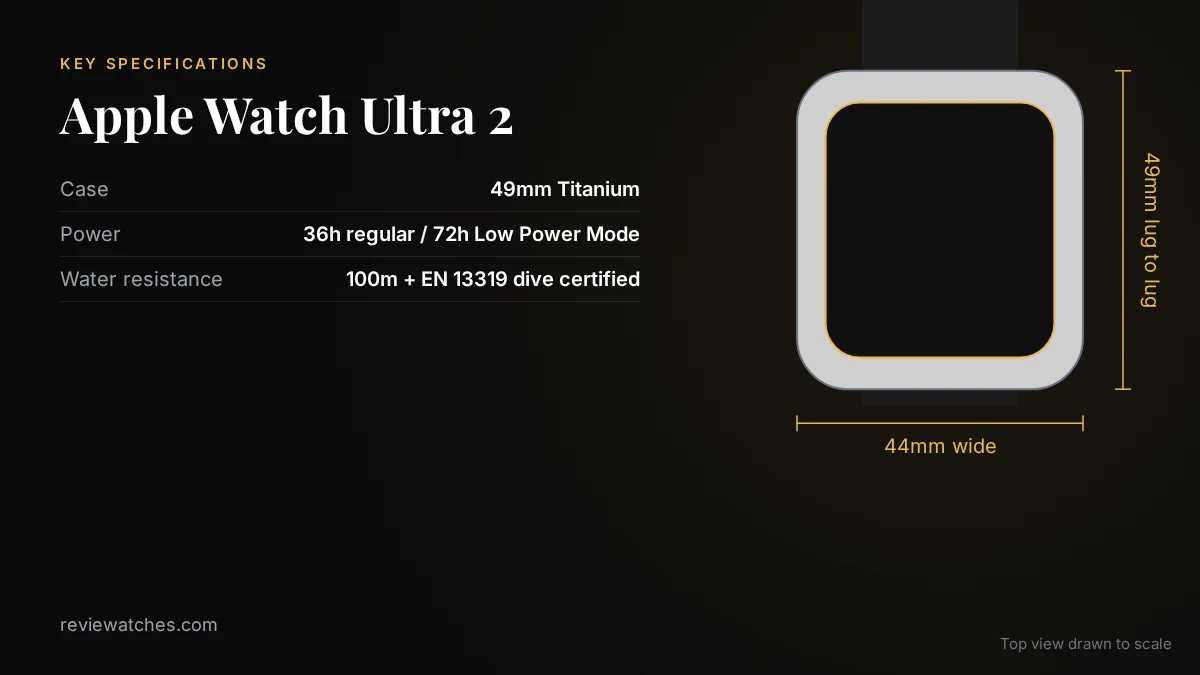
- Case
- 49mm Titanium
- Power
- 36h regular / 72h Low Power Mode
- Water resistance
- 100m + EN 13319 dive certified
- Often praised
- Brightest smartwatch display at 3,000 nits, widely reported as legible in direct sunlight
- Common criticism
- Battery life is good (30-32h in real-world reports) but nowhere near Garmin's multi-day champions
📑 Table of Contents
- Size and Wearability: Bigger Than You Think, But...
- That Display Though
- Performance and the S9 Chip
- Battery Life: Better, But Not Garmin Better
- GPS Accuracy: Actually Impressive
- Health and Fitness Tracking
- The Action Button and Siren
- The Ecosystem Lock-In
- What Frustrates Reviewers
- Who Should Buy This?
- Final Thoughts
This article on the Apple Watch Ultra 2 looks at a device that is, on paper and in the consensus of most reviewers, the most capable smartwatch Apple has ever built. It isn't simply a bigger, tougher Series 9. According to Apple's own specifications and the broader body of reviews since launch, it does things differently enough to matter for daily use.
The original Ultra was Apple's first proper attempt at a serious outdoor watch, and by most accounts it worked, rough edges and all. The Ultra 2 addresses many of those rough edges while adding a few genuinely new tricks. It's still enormous, though. Let's deal with that first.
Size and Wearability: Bigger Than You Think, But...
The 49mm titanium case is big. Not quite Garmin Fenix big, but bigger than anything else Apple makes, and there's no smaller case option, so this is clearly a deliberate design decision rather than an oversight. Owners with smaller wrists commonly report that it wears large and can look disproportionate, so anyone in that position should think carefully before buying.
That said, plenty of reviewers note that the size becomes less noticeable after a few days of use, while the practical upside is that the raised bezel protects the display from knocks and the titanium case is more scratch-resistant than stainless steel. This is consistently cited as a watch built to be used without babying it, whether that's during workouts, chores, or swimming, rather than something to be treated as precious.
Apple lists the weight at 61.4g, which sounds heavy on paper but is widely described as comfortable in practice, largely down to how the bands distribute the load. The Alpine Loop is frequently singled out by reviewers as the most comfortable everyday option. The Ocean Band is generally rated highly for swimming but seen as fiddlier for daily wear, while the Trail Loop tends to be recommended mainly to those who actually run trails.
That Display Though
The 3,000-nit display is, by most accounts, class-leading. Reviewers testing it in direct sunlight and high-heat conditions consistently report that every metric stays readable without squinting or shading the screen, a notable contrast to most other smartwatches, which tend to dim to near-illegibility outdoors.
Indoors, the display dims appropriately, and the always-on mode is reported to stay genuinely always-on rather than defaulting to black until the wrist is raised, unlike some rivals. That's a small but real convenience for glancing at the time without an obvious wrist-raise gesture.
The Modular Ultra watch face is exclusive to this model and is widely regarded by reviewers as the most functional face Apple has produced, able to fit up to eight complications, heart rate, activity rings, weather, calendar, workout, shortcuts, battery, without feeling cluttered. The fact that it's locked to this model specifically is a common point of criticism, even from people who otherwise rate it highly.
Performance and the S9 Chip
The S9 chip is reported to be noticeably faster in everyday use, with apps opening quickly and Siri responding at a more usable speed, though reviewers are generally quick to note that Siri's underlying capabilities haven't fundamentally changed. The standout new feature is Double Tap.
Double Tap lets the wearer pinch thumb and index finger together to trigger actions without touching the screen, for things like snoozing an alarm, pausing music, or answering a call when hands are occupied. It sounds like a gimmick, but reviewer consensus is that it works reliably, reportedly succeeding around 95% of the time, and becomes second nature quickly. The remaining failure rate is worth knowing about if you're relying on it in a time-sensitive moment.
On-device Siri processing means some requests, such as setting a timer or starting a workout, work without an internet connection, while others like weather queries still require connectivity. It's a small quality-of-life improvement that reviewers generally rate as worthwhile.
Battery Life: Better, But Not Garmin Better
Apple's official figures are 36 hours of regular use and up to 72 hours in Low Power Mode. Real-world reports from reviewers running always-on display, GPS workout tracking and moderate notification use tend to land closer to 30 to 32 hours, a modest improvement on previous Apple Watches but still far short of the week-plus battery life offered by dedicated outdoor watches like the Garmin Fenix or Epix.
Fast charging is a genuine advantage here, with roughly 30 minutes on the charger reportedly enough to cover a night of sleep tracking plus the following morning. For multi-day hikes with continuous GPS tracking, though, a battery pack would still be necessary, since the combination of a bright display and powerful chip simply demands more energy than dedicated hiking watches.
Low Power Mode switches off the always-on display, disables some health sensors and limits background processes. Reviewers report getting closer to 60 hours in this mode rather than the claimed 72, which is enough for a careful long weekend away but not something to rely on for anything more demanding.
GPS Accuracy: Actually Impressive
The dual-frequency L1+L5 GPS is widely reported to be among the best available on any smartwatch. Reviewers who've compared it directly against Garmin's Epix Pro on identical routes generally find the two comparable in open areas, but note the Ultra 2 pulling ahead in dense urban environments with tall buildings, where GPS signals are more prone to bouncing and causing errors.
For cycling, accuracy is consistently rated as excellent. Swimming tracking, including in open water, is also reported by owners to perform reliably, though as with any wrist-based GPS, results in heavily built-up or tree-covered terrain are less thoroughly documented.
The clearest gap in the available evidence is mountainous terrain with heavy tree cover, an area where dedicated hiking GPS units still have an edge. For urban running, cycling and general outdoor use, though, this is widely regarded as the most accurate GPS currently on a smartwatch.
Health and Fitness Tracking
ECG and blood oxygen measurement both function as specified, the latter requiring roughly 15 seconds of stillness to get a reading. The temperature sensor also enables retrospective ovulation tracking, which owners in relevant demographics generally describe as accurate, according to widely reported feedback.
Heart rate tracking is generally rated as excellent during steady-state cardio, with reviewers noting some lag compared to a chest strap during high-intensity intervals. For everyday monitoring, though, it's considered more than adequate, and unexpected elevated-heart-rate alerts are frequently cited by owners as a genuinely useful nudge to slow down.
Sleep tracking is widely described as solid but not best-in-class, providing bedtime, wake time and rough sleep stages without the depth of a dedicated sleep tracker like an Oura Ring. Given the watch's size, some wearers report noticing it at night, though many still choose to wear it for the alarm and sleep data regardless.
Workout tracking covers an extensive range of activities, including running, cycling, swimming, strength training, yoga, sailing and diving. The dive computer functionality carries EN 13319 certification, meaning it functions as an actual certified dive computer rather than simply being water resistant, a detail reviewers often point to as evidence of how seriously Apple approached this category.
The Action Button and Siren
The customisable Action button on the left side is consistently highlighted as one of the Ultra 2's best features. It can be set to start a preferred workout with a press and hold, instantly locking GPS and beginning tracking without touching the screen.
Other configurable functions include flashlight, stopwatch, dive computer, Backtrack (which retraces a GPS route), Translate and Shortcuts. The Action Button remains exclusive to the Ultra line, and the Ultra 2's is reportedly easy to press with gloves on.
The built-in siren is rated at 86dB, loud enough to be genuinely disruptive in an enclosed space, which is exactly the point. It's designed for emergencies, to attract attention if someone is injured or lost, and its volume is generally treated by reviewers as reassuring rather than excessive given its purpose.
The Ecosystem Lock-In
This is where the Apple Watch wins and loses simultaneously. For iPhone owners, the integration is widely reported to be seamless: apps install automatically, Apple Pay works everywhere, AirPods connect instantly, and notifications, messages and calls all sync without friction. The App Store's watch app library remains the largest and best supported in the category.
For anyone without an iPhone, though, the Ultra 2 simply doesn't function, with no Android compatibility at all, not even for basic features. That's the trade-off inherent to Apple's walled-garden approach: inside the garden, everything works beautifully; outside it, nothing works at all.
What Frustrates Reviewers
The always-on display is reported by some owners to dim too aggressively in certain indoor lighting, occasionally making the time hard to read without raising the wrist.
The absence of a rotating bezel, relying instead on the touchscreen and digital crown, is a recurring point of preference among reviewers who miss the tactile feedback of a physical bezel found on rival outdoor watches.
Third-party app quality is inconsistent. Some apps are well regarded (podcast and habit-tracking apps are often praised), while others are clearly designed with the smaller standard Apple Watch in mind and don't make full use of the Ultra's larger screen.
Charging also remains proprietary, requiring the dedicated Apple Watch charger rather than a standard USB-C cable as used by many Garmin devices, a minor but real inconvenience when travelling.
And then there's the price. At $799, this sits well above most smartwatch competitors, and given that smartwatches inevitably become outdated as newer models arrive, the value case is far less straightforward than it would be for, say, a mechanical watch at the same price that could last decades. The Ultra 2 only really makes sense for buyers who are already committed to the Apple ecosystem and want the best smartwatch available within it.
Who Should Buy This?
For iPhone owners wanting the best smartwatch on the market, this is it. Anyone doing regular outdoor activity or workouts, or simply wanting a smartwatch tough enough not to need babying, will likely find the extra cost over a standard Apple Watch justified.
For existing original Ultra owners, the upgrade case is weaker. A brighter screen and a faster chip are welcome, but neither amounts to a must-have upgrade, and waiting for the next generation is a reasonable call.
For Android users, the Ultra 2 simply isn't an option, full stop, with the Samsung Galaxy Watch 6 Classic or a Garmin device being the sensible alternatives.
For anyone with smaller wrists, trying the watch on in person before buying is strongly advisable, given how consistently its size is flagged as an issue for that group.
Final Thoughts
By most measures, the Apple Watch Ultra 2 is the strongest smartwatch currently available. It isn't flawless: battery life is good rather than great, the price is high, and it's entirely locked to the iPhone. But for iPhone owners wanting a smartwatch that covers nearly every use case while surviving daily abuse, it's hard to find a stronger recommendation among current reviews.
The obvious wishlist items are a rotating bezel, better battery life, and perhaps a smaller case option for those with slimmer wrists. None of those are present today, but what is here holds up well against the competition.
Compared with other smartwatches on the market, from Garmin and Suunto's outdoor-focused devices to Samsung's Android alternatives and earlier Apple Watches, the Ultra 2 is consistently described by reviewers as the one that manages to be useful without being intrusive, tough without being ugly, and smart without being annoying.
For anyone weighing this up, the question boils down to two things: do you own an iPhone, and are you willing to spend $799? If the answer to both is yes, this is a straightforward recommendation. If either answer is no, it's worth looking elsewhere, because there's very little middle ground with this watch.
⚙️ Specifications
✅ Pros
- +Brightest smartwatch display at 3,000 nits, widely reported as legible in direct sunlight
- +Dual-frequency GPS is among the most accurate reported in urban environments
- +Titanium case built for daily use rather than as a precious object
- +Double Tap gesture control is widely praised and reportedly becomes habit-forming
- +Best smartwatch ecosystem with thousands of apps and seamless Apple integration
- +Customisable Action button offers genuinely useful quick access
❌ Cons
- −Battery life is good (30-32h in real-world reports) but nowhere near Garmin's multi-day champions
- −Absolutely massive at 49mm, will overwhelm smaller wrists
- −Expensive at $799 for something that'll be outdated in a few years
- −Completely useless if you don't own an iPhone, no Android compatibility whatsoever
- −Proprietary charging means carrying another cable when travelling
- −Always-on display reportedly dims too much in certain indoor lighting
Written by
RevieWatches Editorial Team
RevieWatches is an independent, informational watch site. We research specifications, track pricing across retail and grey markets, and summarise what published...
More in Smart Watches
Should You Upgrade to the Apple Watch Series 12?
The Series 12 arrived in September with faster charging, better glass, and a few exclusive features. Whether you should buy one depends entirely on which watch is sitting on your wrist right now.
Galaxy Watch 9 vs Pixel Watch 5: The Android Smartwatch Fight Gets Real
Samsung and Google just dropped their latest smartwatches within days of each other. Here's which one actually makes sense based on the specs.

Apple Watch Ultra 4: The Smart Watch That Finally Gets Serious
Apple's latest Ultra lands with 50-hour battery, on-device AI, and a clear message: smartwatches can do endurance now. But does it change the game for proper watch people?