Seiko SKX007: The Dive Watch That Changed Everything
The SKX007 taught a generation that serious dive watches don't need to cost thousands. Four years after discontinuation, I look at why this watch, now selling used for around $450, still matters.
About this article: this is an informational article based on public sources: manufacturer specifications, published hands-on reviews by other outlets, owner feedback and current prices. We have not tested the watch ourselves, we are watch enthusiasts rather than professional journalists, and nothing here is buying advice. No brand paid for it. Our method
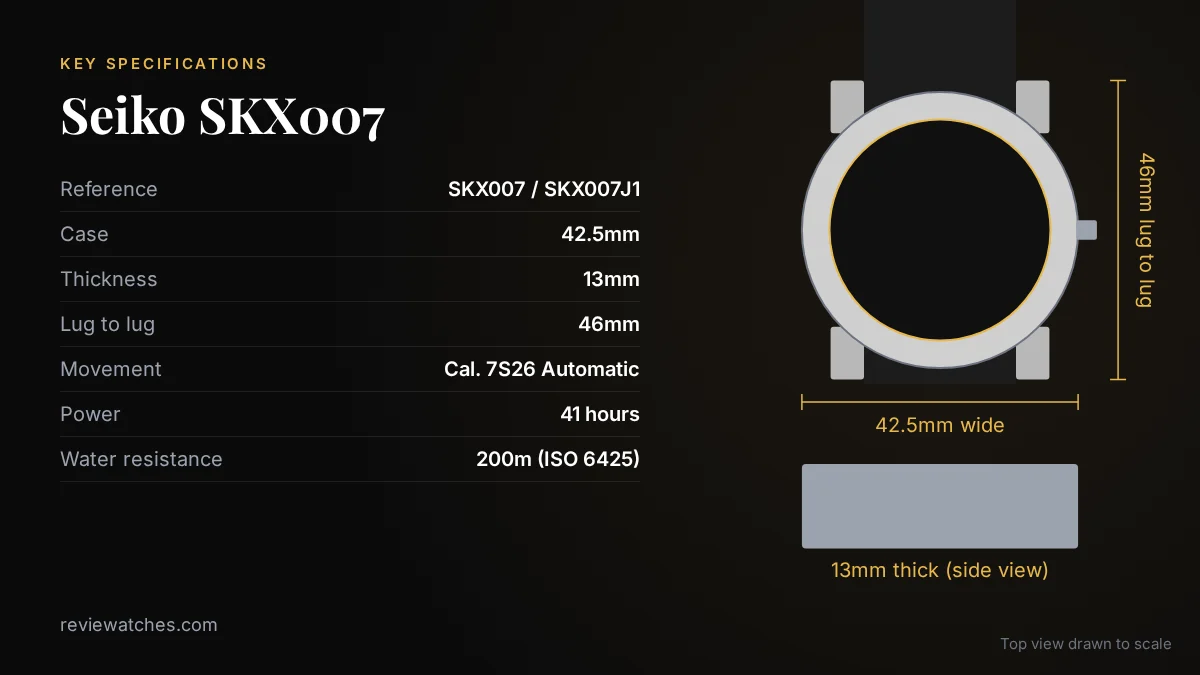
At a glance
- Case
- 42.5mm
- Thickness
- 13mm
- Movement
- Cal. 7S26 Automatic
- Power
- 41 hours
- Water resistance
- 200m (ISO 6425)
- Often praised
- Genuine ISO 6425 dive certification at accessible price point
- Common criticism
- 7S26 lacks hand-winding and hacking
📑 Table of Contents
The Seiko SKX007 has built a reputation over more than two decades as one of the most trusted entry points into serious watch collecting. Owners commonly report that the watch survives beach holidays, doorframe knocks, tile floors and building sites without missing a beat, and that it keeps running long after cheaper watches would have given up. Crystal chips, a slightly loose bezel and lume that fades gently with years of UV exposure are all frequently mentioned in long-term owner accounts, and none of it is generally reported to stop the watch working.
This is the watch that, for a huge number of collectors, defines what "tool watch" actually means, not in the sense of posing a Submariner next to a laptop, but in the sense of a watch built to be used without worry.
What Made It Special
The SKX007 arrived in 1996 and spent 23 years doing something no other watch could manage at its price point. It delivered genuine ISO 6425 dive certification, full 200 metres of water resistance, a proper screw-down crown, unidirectional bezel, and an automatic movement. All for about $200 new.
That combination didn't exist anywhere else. Orient made decent divers too, and models like the Mako reached 200m, though without ISO 6425 certification. Citizen had quartz options but not mechanical at this price. Vostok made unusual Russian pieces that either won people over or didn't. The SKX sat alone in its category, which is why it became the default recommendation on every watch forum for two decades straight. "Just get an SKX007" became something of a mantra in enthusiast circles, repeated so often it is now part of the watch's folklore.
The 7S26 Movement
Here's where honesty matters. The Seiko Calibre 7S26 is not a great movement by traditional standards. It's a 21-jewel workhorse with no hand-winding, no hacking, and accuracy that Seiko rates at -35 to +45 seconds per day. Real-world owner reports tend to cluster around the +20 to +25 seconds per day mark, which in practice means resetting the time roughly once a week.
But it's also widely regarded as close to bulletproof. Stories of SKX007s surviving years of commercial fishing work, salt water, constant impacts and temperature swings without servicing are common in owner communities, and they've done a lot to cement the watch's reputation. It won't win any chronometry competitions, but it also has a strong track record of not quitting.
The lack of hand-winding is a minor inconvenience rather than a real problem in practice, since an automatic winds itself with normal wear or a light shake. The absence of hacking (the seconds hand doesn't stop when the crown is pulled) matters more to owners who care about setting time to the second, and less to anyone treating this as a dive watch rather than a chronometer.
Power reserve is rated at 41 hours, so a watch set down on a Friday evening may still be running on Sunday morning, but will stop soon after if left unworn. For anyone who rotates watches regularly, this means a quick shake to get it running again each time it's picked up.
Design and Wearability
The SKX007 is 42.5mm across, about 13mm thick, with a 46mm lug-to-lug. On paper that sounds chunky. According to the case geometry, it wears smaller than the numbers suggest, largely because the case curves down and the relatively short lug-to-lug keeps it from overhanging even on modest wrist sizes.
It's a design that reviewers and owners repeatedly describe as unusually versatile: plain enough to sit under a shirt cuff or dress down with jeans, distinctive enough to be recognised at a glance. That balance between formal and casual wear, and reports of use everywhere from smart occasions to beach holidays to diving trips, is one of the most consistently repeated points about the watch.
The bezel action is generally described as smooth and reasonably quiet, with 120 clicks. Owners frequently report that the bezel develops some play over time compared with a tighter action out of the box, though this looseness is also noted to make the bezel easier to grip and turn while wearing gloves.
The Hardlex crystal is Seiko's proprietary mineral glass rather than sapphire, and it is well known to scratch and occasionally chip with hard use, something long-term owners frequently mention. For normal daily wear it holds up well, and its lower cost compared with sapphire is generally seen as part of what keeps this a watch that doesn't need to be treated delicately.
The Lume
Seiko's LumiBrite is widely regarded as genuinely excellent. According to owner and reviewer accounts, a short charge under a lamp produces a bright glow for the first hour that fades to a still-visible glow lasting much of the night, making it practical for checking the time in the dark without other light sources.
Both the hands and indices are lumed, along with the pip at 12 on the bezel. This is consistently cited as proper tool-watch execution. Owners note that lume brightness fades somewhat after years of UV exposure, though it continues to function well beyond that point.
The Bracelet Situation
The stock jubilee bracelet is one of the most consistently criticised parts of the package. Stamped endlinks, hollow links and a clasp that feels flimsy are common complaints, along with reports of the bracelet pulling arm hair, a well-documented enough issue that many owners switch to a NATO or other strap fairly early on.
Not everyone dislikes it, and the jubilee does have a certain vintage charm that some owners specifically seek out. But the strap-swapping habit associated with this watch is well documented for a reason: 22mm lug width, undrilled lugs (so a spring bar tool is needed for changes), and a design that suits almost anything from NATO straps and perlon to leather and rubber dive straps. This adaptability is one of the most frequently cited reasons the SKX007 became known as a "strap monster."
Dive Specifications and Reported Performance
The specifications back up genuine diving use. The 200m water resistance, ISO 6425 certification, easily gripped bezel and legible lume are all features that owners and reviewers commonly point to when describing the watch's suitability for recreational diving, including use with gloves.
The screw-down crown, a feature Seiko removed from the replacement models, is frequently cited as giving owners confidence that the watch is properly sealed. The crown itself is unsigned, a detail some owners note but few seem to consider a real drawback given how the watch performs otherwise.
Care after diving is reported to be straightforward: a rinse under fresh water and a dry-off is generally all that's needed, in keeping with the watch's reputation as something built to be used rather than babied.
The Modding Scene
Plenty of owners keep their SKX007 stock, and there's a reasonable case for doing so. That said, the appeal of modding this particular watch is easy to understand. The aftermarket is enormous. Sapphire crystal replacements run around £30, ceramic bezel inserts in various colours run £20 to £50, and hands, dials, chapter rings and even movements can all be swapped by anyone reasonably comfortable working on a watch.
Some of the results are genuinely striking. Owners often cite modified examples, such as one finished with a blue ceramic bezel insert, sapphire crystal and Mercedes hands, coming in at around £400 all-in for something that looks many times its cost. The fact that this level of modification is accessible, with parts widely available and the watch easy to work on, is a large part of why it built such a dedicated following.
The Discontinuation
Seiko discontinued the SKX line in 2019 and replaced it with the Seiko 5 Sports range (SRPE and SRPD models). Those watches are cheaper, have nicer bracelets, include hacking and hand-winding, and come in more colours. They're also rated to 100m instead of 200m, have push-pull crowns instead of screw-down, and lost the ISO 6425 certification.
The reaction from the enthusiast community was strong and widely discussed across forums and social media. The sense among many collectors was that Seiko had taken the one thing that made the SKX special, proper dive-watch specification at a budget price, and diluted it to cut costs.
In fairness to Seiko, most SKX buyers likely never took the watch below 10 metres, so the ISO certification and 200m rating were arguably more psychological reassurance than practical necessity for most owners. But that reassurance mattered to how the watch felt to wear. The SKX read as a serious tool. The Seiko 5 Sports models read as watches inspired by one. There's a meaningful difference in perception even if the practical gap is smaller.
Used SKX007 prices climbed quickly after discontinuation. Watches that sold for around £250 used in 2018 now regularly go for £400 to £500, with well-preserved or lightly worn examples commanding a premium at the upper end of that range.
Should You Buy One Today?
If you can find one for under £450 in good condition, yes. Absolutely. Check that the bezel action feels acceptable, confirm the lume still works, verify the movement is running (a shake should get the rotor spinning audibly), and ideally buy from someone who has the original box and papers. There are plenty of "frankenwatches" in circulation now, mixing genuine and aftermarket parts. That isn't necessarily a problem, but it's worth knowing exactly what you're buying.
Above £500, it gets harder to justify. At that price you're competing with the excellent Islander watches, several capable micro-brands, and, with some patience, a used Seiko Turtle or Samurai for similar money. Those alternatives use the 4R36 movement with hacking and hand-winding, offer comparable build quality, and don't carry the same discontinued-model premium.
Even so, there's something specific about the SKX007. It has a long history and an unusually large, active community behind it. Wearing one connects an owner to a genuine lineage in affordable mechanical watches, and it remains one of the most commonly cited "gateway" watches into the hobby.
Long-Term Ownership: What Owners Report
Long-term owners frequently describe reaching for the SKX007 even after acquiring far more expensive watches. Its comfort, low-stakes durability and understated design are commonly cited reasons it stays in regular rotation rather than being retired to a drawer.
The accuracy is the aspect most commonly mentioned as a drawback in long-term reports, particularly by owners who also wear more modern or higher-accuracy watches, where the contrast in timekeeping becomes noticeable. Against that, the watch's low original cost relative to the abuse it's reported to withstand is usually cited as the trade-off that makes the accuracy easy to live with.
Servicing is one of the more commonly raised concerns among long-term owners. Seiko's official service centres are often reported to charge in the region of £200 to £300, a cost that can feel disproportionate against the watch's original price. Many owners instead look for independent watchmakers who specialise in Seiko movements, where servicing is commonly reported to cost somewhat less.
The Bottom Line
The Seiko SKX007 is one of the most important watches of the modern era. Not because it's the best dive watch ever made (it isn't), not because it's the most accurate or the most beautiful or the most prestigious. It matters because it proved that serious mechanical dive watches don't need to cost thousands of pounds.
It taught a generation of collectors what to value in a watch. Durability over delicacy. Function over flash. Real-world usability over spec-sheet bragging rights. Those lessons shaped the entire affordable watch market. Every micro-brand dive watch under £500 exists, in some sense, because the SKX proved the market was there.
Years after discontinuation, used prices have climbed to the point where the value proposition isn't quite what it once was. But it remains a genuinely impressive watch on its own terms: tough, capable, and good-looking in an understated way.
For anyone who has never owned an SKX007, I think it's worth seeking one out, not because it's perfect, but because of what it represents and what it's likely to teach an owner about what actually matters in a watch. It's a design that has earned its reputation through decades of reported use, rather than marketing, and that's rare enough to matter.
⚙️ Specifications
✅ Pros
- +Genuine ISO 6425 dive certification at accessible price point
- +Bulletproof 7S26 movement that takes serious abuse
- +Excellent LumiBrite that owners report works well underwater
- +Wears smaller than 42.5mm suggests, comfortable all day
- +Massive aftermarket support for modding and parts
- +Strap monster that looks good on everything
- +Historical significance and strong community
❌ Cons
- −7S26 lacks hand-winding and hacking
- −Accuracy of -20/+40 sec/day is mediocre by modern standards
- −Stock jubilee bracelet is hollow, rattly, pulls arm hair
- −Hardlex crystal will scratch and chip with hard use
- −Discontinued status means paying premium on used market
- −Bezel develops play over time
- −Finding affordable servicing can be challenging
Written by
RevieWatches Editorial Team
RevieWatches is an independent, informational watch site. We research specifications, track pricing across retail and grey markets, and summarise what published...
More in Dive Watches
Tudor Black Bay 54 vs 58 vs 41: Which Size Is Right?
Tudor now makes its Black Bay diver in four sizes, and recent updates have changed the movements too. Here is how the 54, 58 and 41 really differ, and where the new 68 fits.
Rolex Submariner vs Omega Seamaster Diver 300M
Two of the most famous dive watches ever made, both rated to 300 metres, both with ceramic bezels. On paper they are closer than their reputations suggest. Here is where they really differ.

Zelos Watches: Singapore Microbrand With Unusual Materials
Zelos is a Singapore microbrand famous for exotic dials and case materials at accessible prices. We went through its catalogue, movements, sizes and policies.