Citizen Promaster Diver BN0150: The Dive Watch Nobody Talks About
While everyone debates Seiko's SKX successors, Citizen's Promaster BN0150 quietly delivers ISO-certified dive capability and solar power for under $300. Here's why it deserves more attention.
About this article: this is an informational article based on public sources: manufacturer specifications, published hands-on reviews by other outlets, owner feedback and current prices. We have not tested the watch ourselves, we are watch enthusiasts rather than professional journalists, and nothing here is buying advice. No brand paid for it. Our method
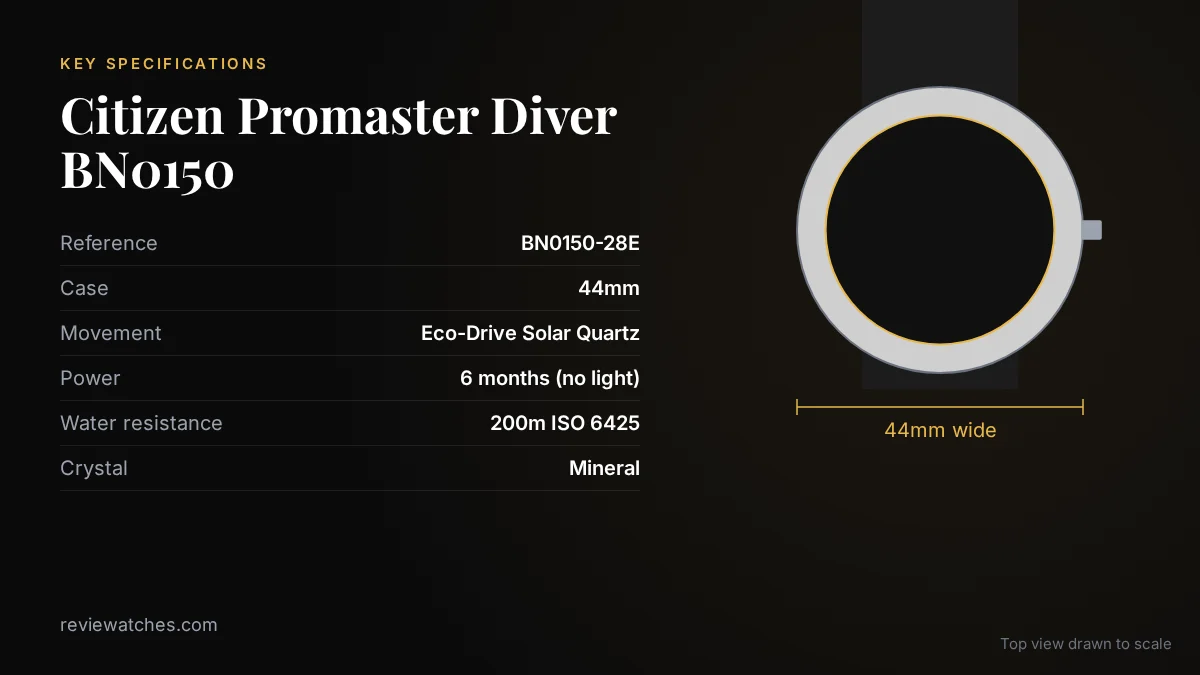
At a glance
- Case
- 44mm
- Movement
- Eco-Drive Solar Quartz
- Power
- 6 months (no light)
- Water resistance
- 200m ISO 6425
- Often praised
- Eco-Drive solar power means no battery changes, ever
- Common criticism
- Mineral crystal scratches easier than sapphire
📑 Table of Contents
- Why This Watch Exists (And Why You Should Care)
- Size and Wearability
- Eco-Drive Solar: The Feature Nobody Appreciates Until They Do
- ISO 6425 Certification: What It Actually Means
- The Strap: Shockingly Good
- Lume: Properly Bright, Properly Long-Lasting
- Practical Use: What Owners Report
- The Movement: Quartz Without Apology
- What's Missing (And What Isn't)
- Versus the Competition: Let's Be Specific
- Who This Watch Is For
- Final Thoughts: The Best Watch Nobody Buys
This article on the Citizen Promaster Diver BN0150 looks at one of the more overlooked dive watches on the market. It quietly ticks nearly every box that matters, ISO-certified dive capability, solar power, genuine build for the price, yet whenever it comes up in discussion, the response is usually silence, or someone assuming you meant to say Seiko.
This is, by most reasonable measures, one of the most underrated dive watches you can buy right now. Not just in its price bracket. Full stop.
Why This Watch Exists (And Why You Should Care)
The affordable dive watch market can feel like a running argument between Seiko loyalists and everyone else. The SKX007 was discontinued. The Turtle is chunky. The newer SRPE and SRPD models lost ISO certification in order to hit a lower price point. Meanwhile, Citizen has just kept making this watch, year after year, with very little fanfare.
The BN0150 looks like what happens when a company designs a tool watch for people who actually use tools. No heritage marketing. No limited editions. No waiting lists. Just a 44mm ISO 6425-certified dive watch with solar power that costs less than a decent pair of boots.
For buyers tired of servicing automatics or chasing a 40-hour power reserve every weekend, a solar-powered alternative that can be left in a drawer for a month and still work when picked up again is an appealing proposition, and it's one Citizen has quietly offered for years.
Size and Wearability
On paper, 44mm sounds like it could wear like a dinner plate on anyone without a larger wrist. That's a reasonable assumption to make before looking closer at the case dimensions.
In practice, the reported short lug-to-lug measurement (around 48mm, though Citizen doesn't publish this figure officially) and the way the polyurethane strap tapers appear to help it sit flatter and more centred than the diameter alone would suggest. This is a common pattern with dive watches: a 42mm watch with long, straight lugs, such as Seiko's Alpinist, can end up wearing larger on the wrist than a 44mm case with a shorter lug-to-lug span. Case diameter alone is a poor predictor of how a watch actually sits.
The case finishing is where the price point shows. Brushed surfaces throughout, no polished chamfers, nothing mirror-finished. It reads as tool-watch finishing, functional rather than refined, the kind of watch that arguably looks better with a few marks than pristine. Owners commonly report that the finish develops character with wear, picking up small dings and scuffs on the clasp and bezel edge that suit the aesthetic rather than detract from it.
Eco-Drive Solar: The Feature Nobody Appreciates Until They Do
Solar power can sound gimmicky, like something from a catalogue watch. It's an easy feature to dismiss on paper.
Owner reports tell a different story. A common theme is a watch worn for a stretch, put away for weeks at a time, and found still running and keeping accurate time when picked back up. No winding. No resetting. Just there, ready.
Citizen states a power reserve of around six months in total darkness after a full charge. That figure comes from the manufacturer rather than independent testing, but it's consistent with widely reported owner experience of the watch surviving extended periods unworn without stopping. A brief spell near a window or under indoor lighting is generally enough to top the charge back up. The solar cell sits under the dial, invisible from the outside, with nothing to suggest this isn't a standard quartz movement.
For a watch that might not be worn every single day, this is a genuinely useful advantage over an automatic, which typically needs winding or regular wear to stay accurate and running. According to owner accounts, even brief sun exposure, leaving the watch on a windowsill for an afternoon, is enough to keep it charged indefinitely, a convenience that's easy to underrate until you compare it with the upkeep an automatic demands.
ISO 6425 Certification: What It Actually Means
This detail matters more than it might first appear. ISO 6425 is the international standard for dive watches. It isn't a marketing term, it's a checklist of requirements: 200m minimum water resistance, a unidirectional bezel, legibility in darkness, shock resistance, magnetic resistance, and testing of every requirement on each production run.
The Seiko SKX007 held this certification. The current Seiko 5 Sports divers (SRPD, SRPE) do not. They're rated for diving by Seiko's own internal standards, but they aren't independently ISO certified. The Promaster is.
Whether that matters to a buyer who'll never go deeper than a swimming pool is debatable, but it speaks to build intent. This is a watch designed to meet a formal standard rather than simply hit a price point. That intent shows up in details like the 120-click bezel with a positive, audible action, a screw-down crown that's easy to grip even wet, and a case back laser-etched with the certification information.
Owners report using the watch for swimming and snorkelling without issue. Common feedback includes the lume staying legible underwater without needing to surface to check the time, the bezel holding its position reliably, and the strap remaining secure throughout.
The Strap: Shockingly Good
Polyurethane straps often get a bad reputation, while rubber gets called "premium" on pricier watches. The BN0150 comes on a black polyurethane strap with a folding clasp, and it's widely reported as one of the watch's stronger points, with many owners seeing no need to replace it.
It reportedly feels soft from the outset, with no noticeable break-in period or chemical smell. It tapers from 22mm at the lugs to a narrower width at the clasp (exact figure unpublished). The clasp uses a single push-button release with a fold-over safety, described as secure without being fiddly. Owners report wearing it comfortably in hot climates without it turning sticky or uncomfortable, and it reportedly dries quickly after exposure to water.
The one recurring complaint is that it attracts dust. Anyone working in a dusty environment or doing manual work should expect it to look grey-ish after a week or so of that kind of use. A wipe with a damp cloth reportedly sorts it out. A minor tradeoff.
Lume: Properly Bright, Properly Long-Lasting
Lume performance varies a lot by material and application. Some watches using C3 SuperLuminova are known to fade within a couple of hours, while others using BGW9 glow for much longer but take longer to charge initially. The Promaster's lume is widely reported to sit somewhere in the middle and do it well.
The hands, hour indices and bezel pip are all lumed. After a day of typical indoor ambient light, owners describe a bright glow for the first hour in darkness that settles into a dimmer but still readable glow through the night. Multiple owner accounts describe checking the time in darkness hours later and still finding it legible.
It isn't at the level of the SKX007, which had a reputation as something of a lume monster. But by most accounts it outperforms most watches at this price and does so consistently.
Practical Use: What Owners Report
This is commonly described as the sort of watch reached for when a wearer doesn't want to think too hard about what's on their wrist. Beach days, the gym, travel, situations where something more valuable might be a liability, this is the kind of role owners consistently say it fills well.
The 44mm case means it isn't going to slide easily under a shirt cuff, but as a dedicated dive watch that's arguably beside the point. Under a jumper or jacket, it's reportedly unobtrusive, and worn with a t-shirt it reads as purposeful rather than showy. Several accounts describe it working fine in casual professional settings, coming across as practical rather than an attempt to impress.
The mineral crystal is more prone to scratching than sapphire would be, and this is a commonly reported downside after extended wear. At this price point, that's arguably a reasonable tradeoff: replacing a scratched mineral crystal, or even the whole watch, costs a fraction of servicing or replacing a sapphire crystal.
The Movement: Quartz Without Apology
Quartz doesn't appeal to everyone. There's no sweeping seconds hand, no mechanical romance, just a steady tick.
What it does offer is accuracy. Citizen's Eco-Drive calibres are generally regarded as highly accurate quartz movements, typically keeping time within a few seconds a month according to widely cited specifications, a notable contrast to the several seconds a day of drift considered normal, and often tolerated, in mechanical watches.
The seconds hand is reported to hit each marker precisely, without the misalignment or juddering that can show up on lower-quality quartz movements. It ticks once per second with a faint sound, audible if held close in a quiet room but otherwise silent.
Citizen's Eco-Drive movements are a proven technology rather than something experimental, the company has been making solar quartz watches since the 1970s. The secondary cell, not a conventional battery, is generally expected to last 20 or more years. When it eventually needs replacing, the process is inexpensive, typically in the region of £50 to £60 for a new cell and service.
What's Missing (And What Isn't)
It's worth being honest about the compromises.
There's no date window. Whether that matters comes down to personal preference: some buyers value the practicality of a date, others prefer the cleaner dial without one.
There's no screw-down case back, instead a press-fit back with an O-ring. For a 200m water resistance rating this is a perfectly normal approach, and it reflects a design choice rather than a shortfall in quality.
A bracelet option doesn't exist from the factory. A 22mm aftermarket bracelet can be fitted, but Citizen only sells this model on the polyurethane strap, so anyone who prefers metal will need to budget extra for a separate bracelet.
The bezel action, while functional, has more resistance than a typical Seiko bezel. Some will prefer this, since it reduces the chance of accidental rotation, while others may find it stiffer than they'd like. It's arguably a sensible choice for a dive watch, even if it feels less fluid than the competition.
Versus the Competition: Let's Be Specific
Against the Seiko SRPD (the current "baby Turtle"), the Promaster wins on practicality. The SRPD is an attractive watch with a proper automatic movement, but it's 42.5mm, wears thicker, has only a 40-hour power reserve, and sits at a similar price. Buyers wanting the appeal of an automatic movement should look at the Seiko. Buyers wanting a watch that simply works should look at the Citizen.
Against the Orient Kamasu, the comparison is closer. The Kamasu has a sapphire crystal, an in-house automatic movement, and generally better finishing for a similar price. But it isn't ISO certified, its lume is reportedly weaker, and it requires the same winding and setting routine as any automatic.
Against the Casio Duro (the MDV106), the Promaster costs roughly twice as much but arguably represents far more watch. The Duro has a cult following at its price, but it's 44mm of largely plastic construction. The Promaster offers proper metal construction and solar power at a still-affordable price.
There doesn't appear to be another ISO 6425-certified solar dive watch under £500. On that specific combination, this appears to be the only option.
Who This Watch Is For
This suits anyone wanting a dive watch capable of actual water use, whether that's swimming, snorkelling, or just daily knocks, without wanting to think about winding or battery changes. It suits buyers looking for something under £300 that doesn't feel like a compromise, who are comfortable with quartz, and who value function over heritage.
It's not a watch aimed at collectors chasing limited editions, nor at those who need Swiss-made cachet. It's a watch built for people who wear watches rather than curate them.
Final Thoughts: The Best Watch Nobody Buys
The case for the Promaster as underrated only gets stronger the closer you look at it.
Citizen doesn't have Seiko's cult following or the YouTube hype machine behind it. The BN0150 rarely appears in "top 10 affordable dive watches" lists, likely because it isn't flashy, isn't automatic, and isn't styled as a vintage homage.
By most practical measures, though, it looks like the better watch for most people: more accurate, more convenient, just as capable, and priced the same or lower than its rivals. What it lacks is the emotional pull of a mechanical movement, an appeal that tends to fade the first time a wound watch is forgotten and runs down before a meeting.
For a first dive watch, this is a strong option. As a beater to sit alongside nicer automatics, it makes just as much sense. For anyone who simply wants a watch that works without fuss, it's difficult to argue against.
It isn't perfect. The finishing could be finer, the bezel smoother, the crystal sapphire rather than mineral. But at somewhere around £250 to £300, it comes about as close to sensible as affordable dive watches get.
⚙️ Specifications
✅ Pros
- +Eco-Drive solar power means no battery changes, ever
- +Genuine ISO 6425 dive certification at this price point
- +Six-month power reserve in total darkness
- +Comfortable polyurethane strap from day one
- +Wears smaller than 44mm specs suggest
- +Excellent, long-lasting lume
- +Quartz accuracy without the hassle
❌ Cons
- −Mineral crystal scratches easier than sapphire
- −No bracelet option from factory
- −Bezel action stiffer than Seiko competitors
- −Polyurethane strap attracts dust
- −No date complication (may matter to some)
- −Case finishing is purely functional, not refined
Written by
RevieWatches Editorial Team
RevieWatches is an independent, informational watch site. We research specifications, track pricing across retail and grey markets, and summarise what published...
More in Dive Watches
Tudor Black Bay 54 vs 58 vs 41: Which Size Is Right?
Tudor now makes its Black Bay diver in four sizes, and recent updates have changed the movements too. Here is how the 54, 58 and 41 really differ, and where the new 68 fits.
Rolex Submariner vs Omega Seamaster Diver 300M
Two of the most famous dive watches ever made, both rated to 300 metres, both with ceramic bezels. On paper they are closer than their reputations suggest. Here is where they really differ.

Zelos Watches: Singapore Microbrand With Unusual Materials
Zelos is a Singapore microbrand famous for exotic dials and case materials at accessible prices. We went through its catalogue, movements, sizes and policies.