Hamilton Khaki Field Mechanical: The £500 Watch That Keeps Its Appeal
A look at why the hand-wound £500 Hamilton Khaki Field Mechanical has a reputation for outlasting watches five times its price, and where it genuinely falls short.
About this article: this is an informational article based on public sources: manufacturer specifications, published hands-on reviews by other outlets, owner feedback and current prices. We have not tested the watch ourselves, we are watch enthusiasts rather than professional journalists, and nothing here is buying advice. No brand paid for it. Our method
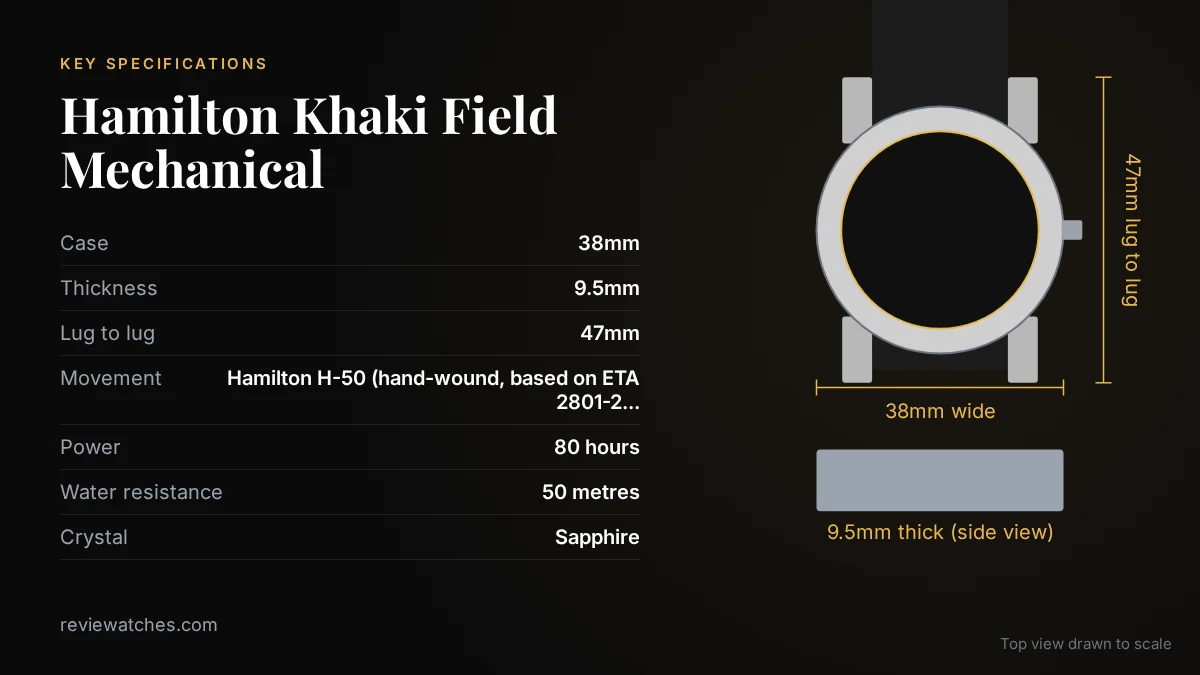
At a glance
- Case
- 38mm
- Thickness
- 9.5mm
- Movement
- Hamilton H-50 (hand-wound, based on ETA 2801-2)
- Power
- 80 hours
- Water resistance
- 50 metres
- Often praised
- Perfect 38mm size for smaller wrists, wears beautifully
- Common criticism
- Lume is genuinely poor, fades within 30 minutes
📑 Table of Contents
This article on the Hamilton Khaki Field Mechanical looks at a watch that has built something of a reputation as the £500 piece that people don't get rid of. It turns up again and again in owner discussions and long-term reviews as the piece that survives collection culls even after far pricier watches have been sold on.
The Khaki Field Mechanical isn't trying to be anything clever. It's a 38mm hand-wound field watch with a canvas strap, a basic ETA movement, and no pretension. It costs around £500, depending on where you buy it. According to widespread owner accounts, it tends to get worn more heavily than its price would suggest, precisely because there's so little about it to worry about damaging.
This isn't a straightforward love letter. There are real frustrations with this watch. But it's worth setting out why it works, why it doesn't, and whether a hand-wound military watch still makes sense in 2025.
What You're Actually Getting
The case is 38mm across and about 9.5mm thick. That's small by modern standards, but according to its dimensions it should suit smaller-to-average wrists particularly well, sitting close to the wrist rather than overhanging. The lugs are short and curved, which by design should let it hug the wrist rather than jut out the way a larger 42mm diver can, a case shape that often looks striking in photos but oversized in person.
The dial is black with beige lume plots and stick hands. There's a running seconds subdial at six o'clock, a consequence of the hand-wound movement, more on that shortly. The markers are simple Arabic numerals at 12, 3, 6 and 9, with smaller indices elsewhere. It's legible in daylight and passable at night, but the lume itself is widely reported to be genuinely weak. Owners commonly note that it charges quickly under a strong light and fades fairly quickly, leaving little useful glow in real darkness.
The case is stainless steel with a matte bead-blasted finish, which is well suited to disguising scratches. Matte finishes don't catch and reflect light the way polished surfaces do, so minor marks are far less noticeable than they would be on a polished case, where every small scratch tends to stand out.
The crown sits at three o'clock, unguarded, and unsigned, just knurled steel. It looks robust enough for daily winding, which is necessary given there's no automatic rotor here. The caseback is solid steel with military-style engravings, the Hamilton logo, the model name and some spec details. There's no exhibition window, though there's little on the movement side that would justify one.
The Movement: Calibre H-50 and the Case for Hand-Winding
Inside is Hamilton's calibre H-50, a hand-wound movement developed from the long-running ETA 2801-2. It runs at 21,600 vph, has 17 jewels and a Nivachron balance spring, and offers an 80-hour power reserve. That's modest, meaning regular wearers will need to wind it daily, but it's a well-understood and predictable calibre.
Hand-winding is often described by owners as more than a chore. It becomes a small daily ritual, and there's a reasonable case that winding a watch each morning creates a more active relationship with it than simply picking one up that's already running unattended. It's a different kind of engagement to an automatic movement, one built on maintenance rather than convenience.
Accuracy, however, is only middling. It is not a certified chronometer, and owners report accuracy that varies from watch to watch. Regulation by a watchmaker can often improve it, though results aren't guaranteed. This is a workhorse calibre that keeps decent time without costing a fortune to service, not a chronometer-grade movement.
The running seconds subdial sits at six o'clock, unusual for a field watch, where nine o'clock is more typical. This placement arguably suits the dial better, giving it more symmetry and making it easier to read at a glance, though the subdial is small enough that it could prove fiddly for anyone with less sharp eyesight.
Comfort and Everyday Wearability
This is where the Hamilton earns its reputation. Owners frequently describe it as comfortable in ways that only become apparent over extended wear. The 38mm case is slim enough to slip under a shirt cuff without catching, and the light overall weight, roughly 60 grams including the strap based on its stated dimensions, makes it easy to forget it's there.
The canvas strap is breathable, and owner feedback widely suggests it copes well with sweat without developing the odours that some leather straps can pick up over time. With only 50 metres of water resistance, submersion swimming isn't advisable, but the watch is generally considered fine for rain and handwashing.
Where it seems to fall down is in formal settings. This is a canvas-strap military watch through and through, and pairing it with a tuxedo or a sharp suit would be an odd choice. It's built for daily, casual wear rather than black tie, and trying to push it into that role tends not to land well.
The Strap Situation
The stock canvas strap draws consistent praise from owners. It's khaki green in keeping with the military styling, soft without feeling flimsy, and fitted with solid hardware. Long-term owner reports suggest it holds up well, generally only showing light fraying at the edges after extended use.
The 20mm lug width opens up plenty of alternatives. Many owners swap in NATO straps or leather options depending on preference, with a plain NATO often noted as lighter and quicker-drying than the stock canvas while keeping a broadly similar look. A leather strap is also a common swap, though it tends to push the watch towards a more formal register that some feel suits it less well.
Where It Falls Short
It's worth being clear-eyed here. This watch has flaws that are hard to overlook.
First, the lume is weak. As already noted, it charges quickly under strong light and fades within roughly half an hour, leaving little useful glow in genuine darkness. Cheaper watches, including budget Seikos, are frequently reported to perform noticeably better in this respect. Hamilton could have addressed this with more modern Super-LumiNova, but chose not to on this model. For a design rooted in field-watch practicality, that's a real shortfall.
Second, even with an 80-hour power reserve it needs winding. Leave it off for a long weekend and it will run through, but not much longer than that. A watch winder would keep it running, but that rather undermines the point of owning a simple hand-wound watch. For anyone rotating between several watches, this means regularly winding it back up from a dead stop, which typically takes around thirty turns of the crown.
Third, there's no quickset date, because there's no date function at all. This arguably works in the watch's favour, date windows can disrupt dial symmetry, but anyone relying on their watch for the date will need to check a phone instead. Not a dealbreaker, but worth flagging.
Finally, the water resistance leaves something to be desired. Fifty metres should cover daily life, but it leaves little margin, and it isn't rated for swimming or diving. For a watch styled around military toughness, that reads as a compromise. A 100 metre rating would have suited the design better.
Value Proposition: Is It Worth £500?
This is where things get interesting. At £500, the Khaki Field Mechanical is competing in a crowded field, Seiko's SPB line, some Tissots, budget Oris models on sale, micro-brands with in-house movements. So why choose this one?
Because it's honest. It doesn't pretend to be vintage. It doesn't ape a Rolex Explorer or a Blancpain Fifty Fathoms. It's a modern interpretation of a 1940s military field watch, and it owns that identity completely. The design is clean, the proportions well judged, and the build quality appears better than the price suggests, based on its finishing details. The case finishing is tidy, the dial printing crisp, the hands properly bevelled. These are the kind of details that stand out on a watch worn every day.
It also uses a Swiss movement from ETA rather than an unnamed factory calibre. Service costs are generally reported as reasonable for an ETA-based movement, and any competent watchmaker familiar with ETA calibres should be able to work on it. That matters if the plan is to keep the watch long-term.
That said, it's not exactly a bargain. Buyers are paying partly for the Hamilton name, which carries weight but also markup. A micro-brand might offer better specifications for the money, stronger lume, better water resistance, perhaps a more interesting movement. But that would come without the heritage, the brand recognition, or the same confidence that servicing will remain straightforward for decades to come.
Who Should Buy This Watch?
Anyone after a simple, wearable, unpretentious watch that doesn't demand attention should find plenty to like here. Anyone tired of 42mm dive watches that wear like dinner plates should too. It's a watch built to be worn daily without much worry about scratches or dings.
But anyone who needs a watch that actually glows in the dark, or who won't hand-wind, or who wants serious water resistance, should look elsewhere. This isn't trying to be a one-watch collection. It's trying to be a genuinely good everyday watch that happens to cost less than a decent laptop.
It's easy to spend far more on a watch and come away less satisfied by the experience of wearing it. Watches with in-house movements, exhibition casebacks and every horological flourish going don't automatically earn more day-to-day wear than something that simply gets the fundamentals right. That's the impression the Khaki Field Mechanical leaves, not a perfect watch, but a genuinely well-judged one. Right size, right style, right price, right amount of fuss, which is to say, none.
For a watch at this price point, that's about as strong a recommendation as any.
⚙️ Specifications
✅ Pros
- +Perfect 38mm size for smaller wrists, wears beautifully
- +Bead-blasted case hides scratches and looks better with age
- +Hand-winding adds daily ritual and connection to the watch
- +Excellent stock canvas strap that's comfortable and durable
- +Honest military aesthetic with no pretension
- +Solid build quality well above the price point
❌ Cons
- −Lume is genuinely poor, fades within 30 minutes
- −Only 50m water resistance feels inadequate for a field watch
- −Still needs winding every few days if kept in a rotation
- −Accuracy is not chronometer grade and varies between examples
- −No date complication (though some will prefer this)
Written by
RevieWatches Editorial Team
RevieWatches is an independent, informational watch site. We research specifications, track pricing across retail and grey markets, and summarise what published...
More in Military & Tactical
What Is a Field Watch? A Buyer's Guide
Field watches trace their roots to military trenches, not boardrooms. Here's what defines them, why they still matter, and how to pick one that'll actually survive your life.
Best Military Watches 2026: Actually Issued to Armed Forces
Forget marketing nonsense. These are the watches actually worn by soldiers, with MIL-PRF certs and deployment history to prove it.
Marathon GSAR: The Only Real Military Watch You Can Buy
This isn't a military-inspired watch. It's the actual issue watch worn by pararescue jumpers, and the specifications make that hard to argue with.