Suunto Core All Black: The Tactical ABC Watch That Refuses to Die
The Suunto Core All Black is not the smartest watch on the market, but its reputation among hikers and outdoor users suggests it's one of the most trusted for actual use in the field.
About this article: this is an informational article based on public sources: manufacturer specifications, published hands-on reviews by other outlets, owner feedback and current prices. We have not tested the watch ourselves, we are watch enthusiasts rather than professional journalists, and nothing here is buying advice. No brand paid for it. Our method

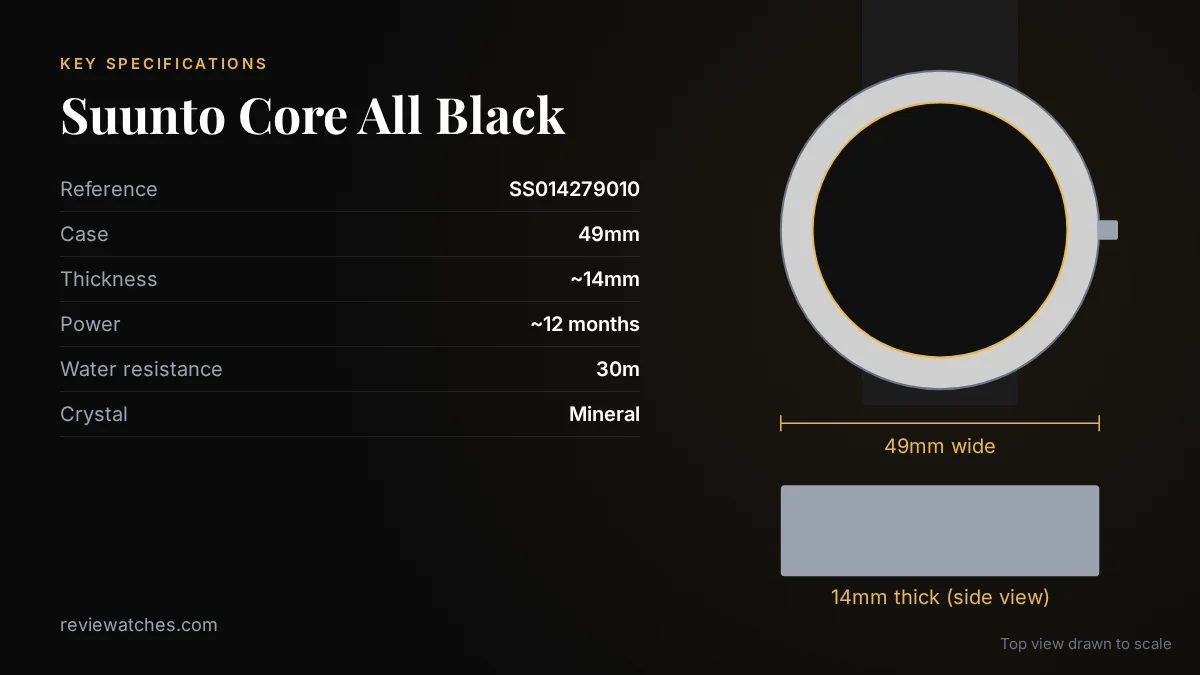
At a glance
- Case
- 49mm
- Thickness
- ~14mm
- Power
- ~12 months
- Water resistance
- 30m
- Often praised
- User-replaceable battery lasts a full year
- Common criticism
- Only 30m water resistance limits swimming/water sports use
📑 Table of Contents
This article on the Suunto Core All Black starts with the obvious question: the watch has been on the market since the mid 2000s, so why does it still sell today? Against Garmin's Fenix range, which requires charging every week, the Core offers a year of runtime on a single user-replaceable battery. That single fact explains much of its enduring appeal among hikers and outdoor users who don't want another device to plug in.
Nearly two decades on, it remains in production largely unchanged. That longevity says something about what this watch is actually for, and where it falls short becomes clear once you look closely at what the specifications and owner reports reveal.
What You're Actually Getting
The Suunto Core isn't trying to be a fitness coach or a notification centre. It's an ABC watch: Altimeter, Barometer, Compass. That's the entire point. It tells you how high you are, what the air pressure is doing, and which way is north. For hikers, climbers, and anyone who spends real time outdoors, these three things matter more than step counts.
The All Black variant is the tactical version, with a matte black composite case, black mineral crystal, and black detailing throughout. It measures 49mm across, though much of that is bezel rather than case, and sits at roughly 14mm thick according to Suunto's published dimensions. At 64 grams, it's considerably lighter than most steel dive watches.
The non-reflective finish is designed for low-profile use in tactical contexts, though for most buyers it will simply read as a rugged, purposeful aesthetic.
The ABC Suite: Does It Actually Work?
Altimeter
The altimeter is pressure-based, meaning it measures barometric changes and converts them into an elevation reading. Suunto claims 1-metre precision, which reviewers generally consider accurate provided the watch is calibrated at a known elevation, using GPS or a map reference at the trailhead.
The catch is that atmospheric pressure changes with weather, not just altitude. If conditions shift while you're climbing, the altimeter will drift. The Core attempts to auto-correct when it detects the watch is stationary, but this isn't foolproof, and owners commonly report readings drifting by tens of metres over the course of a day when weather turns.
The total ascent and descent tracking is well regarded, and is generally reported as accurate against known routes and elevation gains, making it useful for planning future trips or reviewing a day's effort.
Barometer
The barometer is arguably the watch's strongest feature. It runs continuously in the background, logging atmospheric pressure hourly, and displays a four-day trend graph that is genuinely useful for spotting incoming weather changes.
The storm alarm is widely cited by owners as one of the Core's most valuable features, with sharp overnight pressure drops reportedly giving early warning of approaching bad weather. This kind of feature matters most for people spending extended periods outdoors, where knowing when conditions are about to turn can be more than just a convenience.
Compass
The digital compass uses a 3-axis magnetometer with declination correction, letting the user account for the difference between magnetic north and true north. That matters for anyone navigating seriously.
In practice, most reviewers agree it shouldn't be relied on alone in the backcountry. It's fine for quick bearing checks or general orientation, but comparisons with dedicated baseplate compasses typically show a deviation of several degrees depending on conditions. It also requires fairly frequent calibration, particularly after exposure to magnetic interference from cars, electronics, or metal structures. The process itself is simple, rotating the watch in a figure-eight pattern, but it is something owners report having to repeat mid-hike.
For casual orientation it's perfectly adequate. As a sole means of navigation, most experienced users pack a proper compass as backup.
Size and Wearability
The Core is not a dress watch. At 49mm, it's considerably chunkier than anything designed to sit under a shirt cuff. For casual and outdoor wear, however, the composite case keeps the weight down, and the strap (commonly swapped for an aftermarket NATO once the original wears through, according to owner discussions) makes it suited to extended wear.
The negative display mode, which inverts the LCD to show light text on a dark background, is a useful touch, easier to read in bright sunlight and less visible at night. Whether to leave it permanently in negative mode or switch back to the standard display is largely down to preference.
Battery life matches Suunto's stated figures. Regular use of the ABC functions appears to draw down a CR2032 in around 12 months, and the ability to replace it yourself with a small screwdriver, rather than sending the watch away for service, is one of the more practical selling points of the design.
Where It Falls Short
Water resistance is rated at only 30 metres, sufficient for splashing and rain but not for swimming, according to Suunto's specifications. For a watch marketed heavily to outdoor users, this is a notable limitation, particularly compared with dive watches rated to 200 metres or more. The Core simply isn't built for water sports.
The mineral crystal is also widely reported to scratch easily over time. It's not prone to cracking or chipping, but visible hairline scratches after a few years of use appear to be the norm rather than the exception. Sapphire crystal would have addressed this, though it would likely have pushed the price higher.
The interface takes some getting used to. Five buttons control everything, and some functions require holding or double-pressing, which is not particularly intuitive compared with a touchscreen. The trade-off is that it can be operated with gloves on, which matters more in the field than it does at a desk.
How It Compares
The obvious competitor is Garmin's Fenix series, which by most accounts offers more accurate GPS and sensors across the board. It's also considerably more expensive, needs charging weekly, and weighs more. The Fenix is essentially a computer on the wrist. The Core is a simpler tool.
Casio's ProTrek line is another solid alternative for ABC accuracy and is often cheaper, though it lacks the same tactical aesthetic or the track record the Core has built up. The Core has reportedly been in service with military and search and rescue teams since 2007, and that kind of sustained field use counts for something.
Who This Is For
Anyone wanting notifications, fitness tracking, or a colour screen should look elsewhere. This isn't that kind of watch.
The Core is aimed at people who actually use altitude, barometric pressure, and compass bearings: hikers, climbers, mountaineers, backcountry skiers, and others who need environmental data more than smartphone integration. It also has a strong reputation among military and law enforcement users, based on how widely it's been adopted in those fields.
At $349, it isn't cheap, but it's reasonable for what it offers: nearly two decades of refinement, proven reliability, and a watch that won't leave you stranded because you forgot to charge it.
Long-Term Reliability
The Core has been in production, largely unchanged, since the mid 2000s, and its continued presence in outdoor and tactical circles suggests it does one thing well rather than many things adequately. It isn't the most advanced ABC watch available today. Garmin has overtaken it on raw specifications. But the Core's reputation rests on consistency: no updates required, no charging cable, few reported failures.
It has become something of a benchmark for the "boring but dependable" category of tool watch, the wrist equivalent of a good knife or a reliable torch. For anyone weighing up whether that kind of reliability is worth more than a longer feature list, the Core's staying power over nearly two decades is itself a fairly persuasive argument.
⚙️ Specifications
✅ Pros
- +User-replaceable battery lasts a full year
- +Genuinely useful ABC sensors for outdoor activities
- +Light weight (64g) and comfortable for extended wear
- +Storm alarm has proven reliable for weather warnings
- +Non-reflective matte finish for tactical use
- +Proven reliability over 15+ years in the field
❌ Cons
- −Only 30m water resistance limits swimming/water sports use
- −Mineral crystal scratches easily with regular use
- −Compass accuracy can drift, requires frequent calibration
- −Interface is not intuitive, requires learning curve
- −Altimeter drifts with changing weather conditions
- −Large 49mm case too bulky for dress or formal wear
Written by
RevieWatches Editorial Team
RevieWatches is an independent, informational watch site. We research specifications, track pricing across retail and grey markets, and summarise what published...
More in Military & Tactical
What Is a Field Watch? A Buyer's Guide
Field watches trace their roots to military trenches, not boardrooms. Here's what defines them, why they still matter, and how to pick one that'll actually survive your life.
Hamilton Khaki Field Mechanical: The £500 Watch That Keeps Its Appeal
A look at why the hand-wound £500 Hamilton Khaki Field Mechanical has a reputation for outlasting watches five times its price, and where it genuinely falls short.
Best Military Watches 2026: Actually Issued to Armed Forces
Forget marketing nonsense. These are the watches actually worn by soldiers, with MIL-PRF certs and deployment history to prove it.