Marathon GSAR: The Only Real Military Watch You Can Buy
This isn't a military-inspired watch. It's the actual issue watch worn by pararescue jumpers, and the specifications make that hard to argue with.
About this article: this is an informational article based on public sources: manufacturer specifications, published hands-on reviews by other outlets, owner feedback and current prices. We have not tested the watch ourselves, we are watch enthusiasts rather than professional journalists, and nothing here is buying advice. No brand paid for it. Our method
At a glance
- Case
- 41mm
- Thickness
- 14mm
- Movement
- ETA 2824-2 Automatic
- Power
- ~38 hours
- Water resistance
- 300m
- Often praised
- Genuine military-issue specification (MIL-PRF-46374G)
- Common criticism
- Factory rubber strap is functional but reportedly uncomfortable for long wear
📑 Table of Contents
There's a point at which most tactical watches reveal themselves as costume. A G-Shock starts to look toyish next to it. A Bremont starts to look like theatre. The GSAR doesn't look military. It is military, and this article on the Marathon GSAR starts from that fact. Marathon has been supplying watches to military forces, including those of the US and Canada, since 1939, and the GSAR available to civilians is, according to Marathon, identical to the version issued to active-duty personnel.
This article is built from Marathon's published specifications and from what owners and reviewers consistently report about living with the watch, rather than from a hands-on test.
Built to Government Specification (Actually)
The case is built to MIL-PRF-46374G, the official US military watch specification. Not inspired by it, not "in the spirit of" it. Built to pass the actual standard. That means 316L stainless steel, a 41mm diameter that reads as compact next to most modern dive watches, and a sterile dial on early-issue versions with no logo on the face. The case back carries NSN-style government markings that resemble serial numbers from a quartermaster's inventory sheet.
On paper the finishing sounds plain, and by most accounts it is: no bevels, no polishing, no attempt at luxury, just bead-blasted steel with a flat, purposeful lack of shine. That reads as a deliberate choice rather than a shortcoming. This isn't a watch designed to impress at a desk. It's designed not to reflect moonlight during a night insertion.
The 300m water resistance comes from a screw-down crown described as easy to grip even with wet fingers. The bezel is unidirectional, 120-click, and reportedly firmer than most dive watch bezels, which suits a tool meant to resist accidental movement when timing something that matters.
Tritium Tubes Change Everything
Here's where the GSAR stops being just another tool watch. Instead of Super-LumiNova, Marathon uses tritium gas tubes for illumination. Tritium glows continuously for around 25 years without needing to be charged by light, which means the watch reads the same in the dark whether it was last worn yesterday or six months ago.
This is a genuinely useful distinction from lume-based watches, and it's the feature owners most often single out. In a situation with no other light source, constant low-level tritium glow beats a bright charge that fades within an hour, because there's nothing to fumble for and nothing to remember to charge under a lamp first.
The tubes are green, arranged in twelve small capsules around the hour markers, with matching tubes on the hands. By most descriptions the glow is dim compared with freshly charged lume, but constant, which owners tend to value more than peak brightness once the novelty wears off. In daylight, the white-on-black dial offers strong contrast, and the simple painted handset (no sword hands or arrow tips) reads at a glance.
The ETA 2824-2: Boring is the Point
Inside is an ETA 2824-2 automatic movement. Anyone who has spent time around watches will have heard the complaints: it's basic, it's everywhere, it's what brands use when they can't afford anything more interesting. All broadly true. Also beside the point here.
The ETA 2824-2 is one of the most serviceable movements in existence. It can be repaired almost anywhere there is a technician with a parts kit and a loupe, and Marathon's government contracts require parts availability for decades. This is a watch built to be maintained indefinitely, not replaced when a component fails.
Accuracy figures reported by owners tend to sit within a few seconds a day, which is unremarkable next to COSC-certified movements but entirely adequate for a tool watch. The stated power reserve is around 38 hours, so a watch taken off on a Friday evening will likely need winding by Sunday.
Size and Wearability
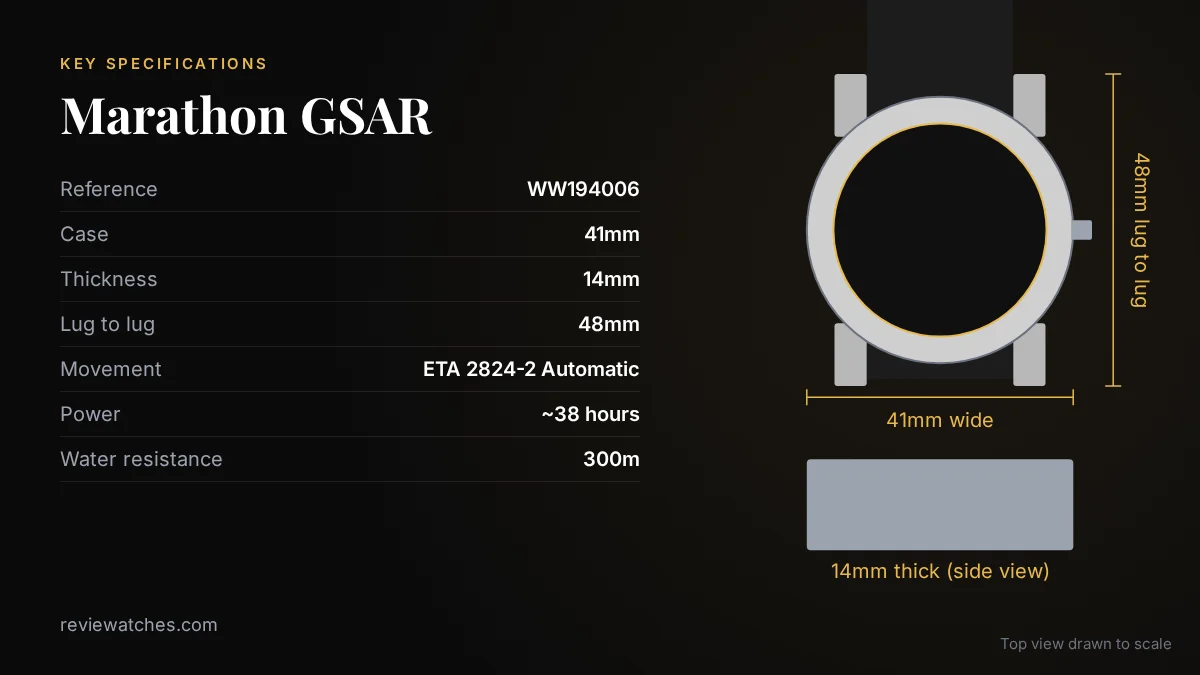
The GSAR measures 41mm across, 48mm lug-to-lug, and about 14mm thick. Those dimensions, combined with the short lugs and compact case shape widely reported by owners, suggest it wears smaller than the numbers imply, closer to a 39mm watch on the wrist. This also makes it a plausible fit for smaller wrists, not just larger ones.
The weight is described as noticeable but not oppressive, a proper steel watch with enough heft to feel serious without becoming a burden during activity. The case shape is reported to sit close to the wrist without digging into the wrist bone the way some dive watches can.
The factory rubber strap is functional rather than pleasant. It's the kind of strap that keeps the watch attached and holds up to salt water, but it's often described as stiff and prone to trapping sweat, with a stiff, utilitarian look to match. Many owners swap it early for a NATO or Zulu strap, which by most accounts transforms the watch's character considerably. The fixed spring bars make strap changes slightly fiddly, but the case is reportedly happy on rubber, nylon, or leather alike.
Frustrations (Because Nothing's Perfect)
The GSAR has no date window, which suits anyone who prefers a clean dial and one less thing to set or break. Anyone who checks the date on their watch regularly will likely find this frustrating. A dated version, the MSAR, exists, though the dial balance of the GSAR arguably benefits from the omission.
The bezel action is firm, which helps prevent accidental movement, but it lacks the smoothness reported on watches like the Seiko Prospex or the tactile polish of a Rolex. It reads as industrial, which is consistent with the watch's purpose, but anyone coming from a more refined bezel action should expect a step down in feel.
The tritium tubes, while functionally excellent, mean the dial can't simply be swapped for a different look. They're sealed units with a half-life, dimming gradually over roughly 12 years and reaching a point around 25 years where Marathon recommends replacement. That's a long service life, but not indefinite, unlike a lume-based dial that can be relumed at will.
There's also the branding question. Early military-issue GSARs reportedly carried no logo on the dial at all, just "Marathon" on the case back. The civilian version carries a small "Marathon" at 12 o'clock and "GSAR" at 6, more understated than most watches but less sterile than the true military-issue dials, which are harder to find and tend to command a premium on the secondhand market.
What Owners Report
Accounts from owners who have taken the GSAR into demanding conditions, cold-weather hiking, water crossings, extended camping, describe a watch that holds up without complaint: no condensation, no meaningful time loss, no bezel slip, and a tritium glow that remains visible and useful after extended periods without any need to recharge it. The factory rubber strap is the most commonly cited weak point, with reports of chafing over multi-day wear prompting a switch to NATO straps.
Beyond outdoor use, the GSAR is also described as comfortable in everyday settings: worn to the office (looking slightly out of place with a suit, by most accounts), at the gym, and on daily walks, with no reports of the watch failing to perform.
Who This Watch Is For
Anyone wanting to feel like an operator without needing the certification could reasonably choose a Bremont or a Bell & Ross, both well-made watches designed to evoke military heritage at a matching price. Anyone wanting the watch actually used by operators should look at the Marathon GSAR. It isn't designed to win awards. It's designed to tell the time reliably in conditions where that reliability might genuinely matter.
This is a watch suited to people who value function over finish and authenticity over aesthetics: hikers, sailors, night-shift workers, anyone who wants a tool that performs without being babied.
It's not suited to a collector chasing rarity or prestige. The GSAR carries no heritage mystique, no limited editions, no celebrity endorsements. It's a very good watch that does exactly what its specification promises, right down to the NSN number stamped on the case back, the kind of detail that underlines what this watch actually is.
The Bottom Line
Watches costing ten times as much, with in-house movements, complications, and presentation boxes, rarely offer the same quiet confidence that the GSAR's specification sheet suggests. It isn't designed to be exciting. It isn't designed to start conversations or appreciate in value. It's designed to be the watch reached for when the only requirement is knowing the time and getting on with the day.
At its price point, the GSAR offers what looks like the most authentic military watch available to civilians. The tritium tubes alone go a long way to justifying the cost. The MIL-PRF-46374G certification is the proof that this isn't marketing language. The ETA 2824-2 is the assurance of a watch that can still be running and serviceable decades from now.
If that combination appeals, it's hard to find a strong reason not to buy one. Anyone after something prettier or more prestigious should look elsewhere. The GSAR isn't trying to compete on those terms.
⚙️ Specifications
✅ Pros
- +Genuine military-issue specification (MIL-PRF-46374G)
- +Tritium tubes glow constantly for 25+ years without charging
- +ETA 2824-2 movement is serviceable anywhere in the world
- +Compact 41mm case wears smaller than specs suggest
- +300m water resistance with proper screw-down crown
- +Understated, tool-watch aesthetic that works on any strap
❌ Cons
- −Factory rubber strap is functional but reportedly uncomfortable for long wear
- −Bezel action is firm but not as refined as premium dive watches
- −No date window (pro for some, con for others)
- −Tritium tubes have finite lifespan (25+ years, but not infinite)
- −Sterile military-issue dials are hard to find on civilian market
- −Plain bead-blasted finish lacks any decorative flourishes
Written by
RevieWatches Editorial Team
RevieWatches is an independent, informational watch site. We research specifications, track pricing across retail and grey markets, and summarise what published...
More in Military & Tactical
What Is a Field Watch? A Buyer's Guide
Field watches trace their roots to military trenches, not boardrooms. Here's what defines them, why they still matter, and how to pick one that'll actually survive your life.
Hamilton Khaki Field Mechanical: The £500 Watch That Keeps Its Appeal
A look at why the hand-wound £500 Hamilton Khaki Field Mechanical has a reputation for outlasting watches five times its price, and where it genuinely falls short.
Best Military Watches 2026: Actually Issued to Armed Forces
Forget marketing nonsense. These are the watches actually worn by soldiers, with MIL-PRF certs and deployment history to prove it.