Vintage Omega Speedmaster: The Moon Watch You Can Actually Afford
NASA-qualified for spaceflight and worn on every lunar landing, vintage Speedmasters remain shockingly accessible. Here's what you need to know before buying one.
About this article: this is an informational article based on public sources: manufacturer specifications, published hands-on reviews by other outlets, owner feedback and current prices. We have not tested the watch ourselves, we are watch enthusiasts rather than professional journalists, and nothing here is buying advice. No brand paid for it. Our method
At a glance
- Case
- 42mm
- Thickness
- 13mm
- Movement
- Calibre 861 Manual Chronograph
- Power
- 48 hours
- Water resistance
- 50m (vintage, not recommended for water exposure)
- Often praised
- Genuine Apollo-era space heritage at accessible pricing
- Common criticism
- Hesalite crystal scratches easily (though easily polished)
📑 Table of Contents
Buyers who dive into vintage Omega Speedmaster ownership without doing their homework tend to find out the hard way how specific you need to be, because not all Speedmasters are created equal, and the market is full of frankenwatches that will cost you money the moment you try to sell them on.
The Speedmaster Professional is the only watch qualified by NASA for spaceflight and worn during every Moon landing. You already know this. What you might not know is that you can own an Apollo-era example for less than a modern Submariner. The 145.022, produced from 1968 to 1988, regularly sells for $4,000 to $7,000. That's a watch with genuine spaceflight heritage, not a reissue, not a tribute, the actual thing.
Why the Vintage Speedmaster Still Makes Sense
Unlike vintage Rolex, where a 1960s Submariner looks nothing like what you'd buy today, the Speedmaster has barely changed. Put a 1969 Speedy next to a 2024 Hesalite Professional and you need to squint to spot the differences. Crown guards are slightly different, dial printing varies, but the silhouette is identical. This visual continuity matters because it gives you the vintage collecting experience without the "what is that?" questions from people who don't know watches.
It's a point owners frequently make: because the design has changed so little, a decades-old Speedmaster is easily mistaken for a current-production piece by anyone who isn't already a watch person. Telling the story afterwards, that the reference on your wrist is older than most of the room and shares its lineage with the watches worn on the Moon, tends to land rather well.
The modern Speedmaster Professional costs around $6,800 new. For $5,500, you can have a 40-year-old example that's functionally identical and historically significant. The maths just works.
The References That Matter
The Speedmaster timeline is complex, but you only need to know a few key references if you're buying your first vintage example.
105.012 (1963-1969) was the first reference officially designated "Professional". These are Apollo-era watches, the earliest with straight lugs that transitioned to the twisted lyre lugs we know today. You're looking at $8,000 to $15,000 for a decent example, and condition matters enormously at this price point.
145.012 (1967-1970) was the final reference fitted with the Calibre 321 column-wheel chronograph movement. This is the most collectible vintage Speedmaster for serious enthusiasts. Prices start around $10,000 and climb quickly if the dial is original and the case hasn't been butchered by polishing.
145.022 (1968-1988) is where the value proposition gets interesting. This was the first reference fitted with the Calibre 861, a cam-actuated chronograph movement that's easier to service and more robust than the 321. Production ran for 20 years, so there are plenty of examples out there. Prices sit between $4,000 and $7,000 depending on condition, dial originality, and service history.
The 145.022 is the vintage Speedmaster most worth recommending to first-time buyers. It shares the same case, same dial layout, and same 42mm size as the Apollo watches, but at a price that won't keep you awake at night worrying about depreciation.
3590.50 (1988-1997) is the transitional reference with a sapphire caseback. These are almost modern watches, wear like modern watches, and can be had for $3,500 to $5,500. If you want vintage aesthetics but modern serviceability, this is your entry point. But personally, I think if you're going vintage, commit to the Hesalite crystal and solid caseback. The sapphire versions feel like a compromise.
What to Actually Check Before Buying
Drawing on what collectors and dealers commonly flag about this reference, here's what separates a good buy from a money pit.
Movement Verification
The Calibre 321 (1957-1968) is a column-wheel chronograph, beautifully finished, expensive to service. The Calibre 861 (1968 onwards, later updated to 1861) is a cam-actuated workhorse that any competent watchmaker can service for $400 to $600. Both are excellent movements. The 321 is more collectible and commands a premium, but the 861 is the more practical choice for a watch you'll actually wear.
Match the movement to the case reference using the serial number tables on Speedmaster101.com. This is non-negotiable. It's not uncommon to find 145.022 cases fitted with replacement 1861 movements, which is fine if you're buying a wearer and the price reflects it, but not fine if you're paying collector money.
Dial Originality
Original tritium dials age consistently. The lume plots turn cream, then khaki, sometimes orange. The dial surface develops a subtle texture. Tropical dials, where UV exposure has turned the black dial chocolate brown, are stunning and command two to three times the price of a standard black dial. Tropical examples of the 145.012 have reportedly sold for as much as $28,000, which gives some sense of how strong that market has become.
Service replacement dials are marked "T Swiss Made T" at the bottom and are correct period parts, but they reduce value compared to an original dial. That's fine if you're wearing the watch, less fine if you're collecting it. The real problem is refinished dials with bright white reprinted markers. They look wrong in person, feel wrong, and kill resale value.
A 145.022 fitted with a 1980s service dial rather than an original one might reasonably trade for around $4,800 with an otherwise strong case, a fair discount against the extra $1,500 or so an original dial in similar condition could command. That gap is worth weighing before you decide how fussy to be.
Pushers, Crown, and Chronograph Function
Original pushers are "small" pushers, service replacement pushers from the 1980s onwards are "large" pushers. This affects value, but honestly, unless you're chasing museum-grade originality, it's not a dealbreaker. Check that the chronograph starts, stops, and resets with clean, snappy action. The pushers should have firm resistance, not a mushy, spongy feel.
The crown should screw down smoothly. If it's cross-threaded or feels crunchy, walk away. Water resistance on vintage Speedmasters is essentially theoretical anyway (rated 50m, though I wouldn't trust it past hand-washing), so you're not buying this to swim with, but a damaged crown means moisture ingress and potential movement corrosion.
Common Buying Mistakes
Bracelets are a minefield. Most vintage Speedmasters were sold on leather straps. If a dealer shows you a vintage Speedy on a period-correct bracelet, that bracelet alone is worth $800 to $1,500. Replica bracelets are everywhere and some are very convincing. Original reference 1039 or 1171 bracelets have specific end-link fits and clasp codes. Do your homework or just buy the watch on a strap and source a modern bracelet later.
Polished cases are heartbreaking. The lyre lugs on a Speedmaster have sharp bevels and distinct edges. Over-polishing rounds them off, removes metal, and kills the architectural quality of the case. A lightly worn, unpolished case with scratches is worth more than a heavily polished case that looks "new". Buyers who end up with a polished example often regret it once they understand what's been lost, and polished cases commonly resell at a noticeable discount compared with unpolished ones.
Service history matters less than you think. Yes, it's nice to have papers showing the watch was serviced every five years by an Omega boutique. But most vintage watches don't come with full service records, and frankly, a watchmaker can tell you more in five minutes with a loupe than a stack of service papers can. Get the watch checked by someone who knows Speedmasters before you buy. It'll cost you £50 and could save you thousands.
Size and Wearability
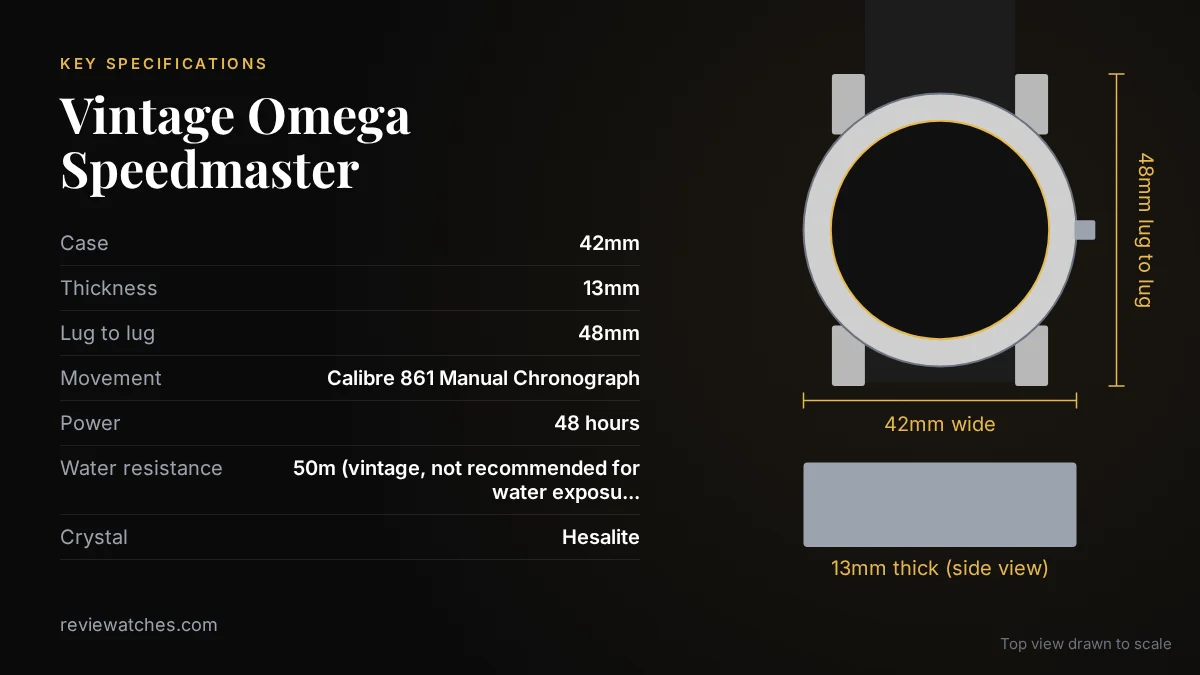
The 145.022 is 42mm across, 13mm thick, with a 48mm lug-to-lug. By modern standards, that's mid-sized. Owners commonly note that the twisted lugs curve down and hug the wrist more effectively than you'd expect from a watch this old, which helps the case wear smaller than the numbers suggest. The Hesalite crystal domes up slightly, catches light well, and scratches if you look at it wrong.
Owners widely report that the Hesalite crystal picks up scratches over time, but these polish out with Polywatch paste in well under a minute. This is often cited as part of the watch's charm. Modern sapphire is scratch-resistant but also, by comparison, a little soulless. Hesalite has warmth, develops character, and can be refreshed whenever you like.
The manual-wind Calibre 861 needs winding roughly daily, about 20 turns of the crown, and this daily ritual is frequently mentioned by owners as part of the appeal rather than a chore. The chronograph hand sweeps, not ticks, which is mesmerising in a way no modern quartz chronograph replicates. Using the chronograph feels mechanical and tangible, a quality reviewers consistently point to, even though most owners rarely need to time anything with it.
Reviewers generally agree the weight sits well, neither too heavy nor too light, and that the case sits flat on the wrist without tipping. Leather straps are usually considered the most fitting choice for a vintage piece, NATO straps can read as too casual, and a modern Omega bracelet, while comfortable, tends to make the watch look more contemporary than its vintage character suggests.
What Ownership Involves
Servicing a vintage Speedmaster costs $400 to $600 every five to seven years. That's not nothing, but it's also not Rolex money. Any competent watchmaker who's seen a few Omegas can handle a Calibre 861. Parts are available, service manuals are available, and the community is helpful.
The movement was never COSC certified, but a well-serviced example keeps respectable time for a manual-wind chronograph of its age, and most owners find little reason to have theirs regulated further.
Water resistance is best treated as nominal only. It's generally recommended to keep vintage examples away from rain, washing up, and showering, given the age of the gaskets and crown threads. The risk of moisture ingress simply isn't worth it.
Should You Actually Buy One?
If you want a vintage watch with genuine historical significance, wearable size, accessible pricing, and strong community support, the vintage Speedmaster is hard to beat. For $5,500, you're not buying a speculative investment, you're buying a piece of space history that happens to tell time.
Compared with vintage chronographs generally, and with most modern watches, the vintage Speedmaster stands out because it doesn't try to be anything other than what it is. It's not a status symbol, it's not a flex, it's just a very good chronograph with an extraordinary story.
Would I recommend it to someone buying their first serious watch? Probably not. Start with something modern and robust, learn what you like, then come back to vintage when you know what you're looking for. But for buyers who already have a few watches under their belt and want something with real depth, the 145.022 is arguably the best $5,000 you'll spend in this hobby.
Just check the dial, verify the movement, don't buy a polished case, and for the love of God, get it inspected before you hand over the money.
⚙️ Specifications
✅ Pros
- +Genuine Apollo-era space heritage at accessible pricing
- +Wearable 42mm size with excellent wrist presence
- +Calibre 861 movement is robust and affordable to service
- +Visual continuity with modern Speedmasters makes it timeless
- +Strong collector community and parts availability
❌ Cons
- −Hesalite crystal scratches easily (though easily polished)
- −Limited practical water resistance on vintage examples
- −Requires careful verification of dial and movement originality
- −Manual wind only, needs daily winding
- −Market has many polished cases and service-dial examples
Written by
RevieWatches Editorial Team
RevieWatches is an independent, informational watch site. We research specifications, track pricing across retail and grey markets, and summarise what published...
More in Vintage

Lorier Watches: New York Microbrand, Mid-Century Style
Lorier is a husband-and-wife microbrand from New York making compact, mid-century inspired watches. We looked at the current range, movements, prices and policies.
Buying Vintage Seiko: What to Check Before You Pay
Vintage Seiko watches offer brilliant value, but the market's full of traps. Here's how to spot redials, franken builds, and dodgy mods before you hand over cash.
Best Vintage Watches to Invest In (2026)
Which vintage watches offer the best appreciation potential in 2026? Our guide to investment-grade Rolex, Omega, and Patek references with proven track records.