Buying a Vintage Rolex GMT-Master 1675: What Buyers Need to Know
The 1675 is one of the most heavily faked and refinished vintage Rolex references on the market. Here's how to avoid the common mistakes and find a proper one.
About this article: this is an informational article based on public sources: manufacturer specifications, published hands-on reviews by other outlets, owner feedback and current prices. We have not tested the watch ourselves, we are watch enthusiasts rather than professional journalists, and nothing here is buying advice. No brand paid for it. Our method
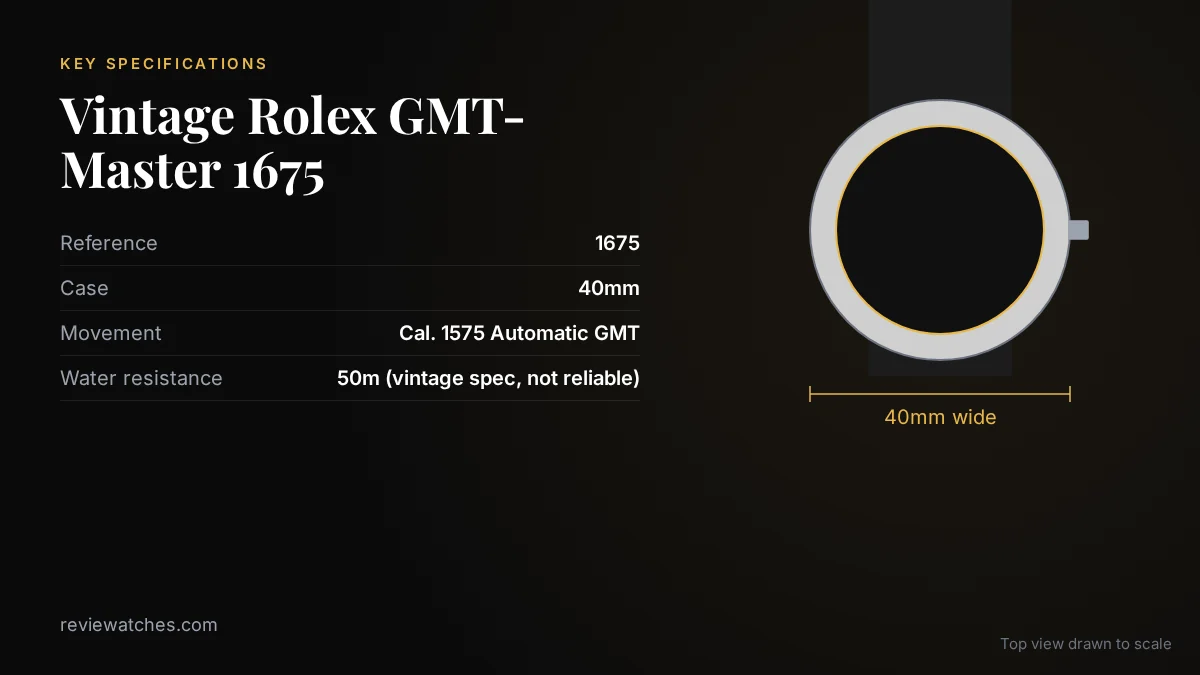
At a glance
- Case
- 40mm
- Movement
- Cal. 1575 Automatic GMT
- Water resistance
- 50m (vintage spec, not reliable)
- Often praised
- Wearable 40mm size, thinner than modern GMT-Master II
- Common criticism
- Market flooded with refinished dials and Franken-watches
📑 Table of Contents
The vintage Rolex GMT-Master 1675 has a reputation problem that has nothing to do with the watch itself and everything to do with the market around it. Refinished dials get passed off as original. Replacement hands get paired with aged dials and sold as untouched. Bezels, crowns and even case parts get mixed and matched into "Franken-watches" that look right at a glance and fall apart under a loupe. Buyers who don't know what to look for regularly overpay for compromised watches, sometimes badly. This Rolex GMT-Master 1675 buying guide covers what actually matters when assessing one.
Why the 1675 Matters
Produced from 1959 to 1980, the GMT-Master reference 1675 is the longest-running and most varied GMT in Rolex history. Twenty-one years of continuous production. Worn by Pan Am pilots back when Pan Am still existed. Steve McQueen had one. So did a lot of people who weren't famous, which is the point. This wasn't a limited edition made to flip. It was a tool watch that people actually used to track two time zones, and it remains one of the more wearable vintage Rolexes today.
At 40mm, it wears smaller than modern sports Rolexes. The case sits flatter. The bracelet, when original, has a vintage flex that modern Oyster bracelets lost somewhere around 2000. It's a watch that doesn't announce itself. Reviewers and collectors consistently describe it as understated in a way that reads as taste rather than expense.
But here's the thing about vintage Rolexes in general and the 1675 specifically: the market is full of traps. Refinished dials. Replaced hands. Service bezels. Franken-watches assembled from bits of three different references. Unless you know what to look for, it's easy to get burned.
Dial Condition: The Heart of Value
Tritium lume is everything. The hands and dial markers on a 1675 were filled with radioactive tritium that decays over time, turning from white to cream to brown to sometimes almost chocolate. This aging, when even and attractive, is called "tropical" patina, and collectors pay strong premiums for it.
What you want: matching patina across the dial and hands. If the dial has turned a warm caramel colour, the hands should have too, to roughly the same degree. They aged together. That's honest.
What kills value: mismatched lume. A cream dial with bright white hands means someone replaced the hands. Or worse, someone replaced the dial. A re-lumed dial, where the tritium was scraped out and replaced with modern lume, tends to look "too good" under close inspection. The lume plots are too white, too even, too perfect. Original tritium has texture, slight irregularities, a kind of organic quality. It looks old, because it is old.
Dealers sometimes describe mismatched lume as "charming" or "honest service history." It's neither. It's widely reported to tank value by 30 to 50 percent, and rightly so. Vintage money should buy a vintage watch, not a vintage case with replacement parts.
There are two main dial types: gilt (gold printing, produced 1959 to roughly 1967) and matte (white printing, 1967 to 1980). Gilt dials are rarer, more beautiful, and vastly more expensive, with good examples now running £30,000 to £50,000. Matte dials are more accessible, typically £15,000 to £25,000, and generally more practical to wear day to day rather than keep in a safe.
Case Condition: Polishing Is the Enemy
Rolex cases are soft. Rolex steel polishes beautifully, which is great for a new watch and disastrous for a vintage one. Every time a 1675 gets polished, whether by an owner, a high-street jeweller, or Rolex during a service, metal is removed. The sharp lines between the case flanks soften. The lugs get thinner. The chamfers disappear.
Original, unpolished 1675 cases have crisp, geometric lugs with visible "shoulders" where the lug meets the case body. The case flanks are flat and defined. There's a specific line between the brushed top surface and the polished side. On a heavily polished case, all of that goes soft. The lugs look rounded, and the case takes on an almost melted appearance.
A lightly polished case with retained definition is generally considered acceptable. Heavily polished cases, where the lugs have lost their shape entirely, are widely reported to command significantly less money, often around 40 percent less than sharp examples, and for good reason.
When inspecting a case, look at it from the side and tilt it under light. You should see sharp transitions, not gradual curves. If everything looks smooth and rounded, it's worth walking away, since better examples are out there.
Bezel: The Expensive Bit
Original aluminium bezel inserts are worth thousands on their own. A proper vintage Pepsi insert (red and blue, with even UV-faded colour) can sell for £3,000 to £5,000 separately. A Coke insert (black and red, rarer) even more. Modern replacement inserts cost a couple of hundred pounds and can halve the value of the watch.
Colour is the main tell. Original inserts fade in specific ways. The red goes pinkish. The blue goes greyish or purplish. The black goes charcoal. Modern repro inserts are too saturated, too "correct." They look new because they are new. It's also worth checking the pearl at 12 o'clock. Original pearls are slightly domed and slightly yellowed, while repro pearls tend to be bright white and flat.
There's also a small detail worth knowing: early 1675 bezels (up to about 1963) have a tiny round dot above the triangle at 12 o'clock. Later bezels don't. It's a minor point, but it helps date the watch and adds a bit of premium for early examples.
Long E and Other Dial Variants
Rolex made dozens of small variations over 21 years. "Long E" dials (where the middle arm of the E in "Rolex" is slightly longer) are a specific variant that collectors pay premiums for. There are "small GMT hand" dials, "underline" dials, and "exclamation point" dials among others. For most buyers looking to wear and enjoy the watch, these distinctions matter less than honest condition and matching patina. For value, though, they matter a great deal.
If you're buying a 1675 to wear, condition and character should come first. If you're buying primarily as an investment, it's worth involving an expert, since the difference between a standard matte dial and a rare variant can run into the tens of thousands, and it's not a gap most buyers will spot unaided.
Service History: A Blessing and a Curse
An "all original" 1675 with its original crystal, crown, hands, and dial is incredibly rare. Most have been serviced. Rolex service centres, even in the 1980s and 1990s, routinely replaced dials, hands, and crystals as a matter of policy, without asking, and the original parts were typically discarded.
A truly all-original 1675 commands a significant premium, but it's also something of a gamble. A watch that hasn't been serviced in decades likely has a tired movement and gaskets that are long gone. A proper vintage-friendly service from an independent specialist, rather than Rolex itself, which tends to replace parts wholesale, typically runs £1,500 to £2,000.
Many collectors would rather have a 1675 with one sympathetic service in its history, focused on mechanical care with cosmetic originality left untouched, than an all-original example that has never been opened up. That combination, mechanical care paired with cosmetic preservation, is generally seen as the ideal outcome.
Always ask for paperwork: service receipts, before and after photos, watchmaker's notes. If a seller can't provide any service history, it's sensible to assume the worst. And if a watch is claimed to be "never serviced" yet runs perfectly, treat that claim with real scepticism.
Where to Buy One
Auction houses like Phillips, Christie's, and Sotheby's regularly offer strong 1675s. Expect a premium in the form of a buyer's fee, typically 15 to 25 percent on top of the hammer price, but in return you get research, condition reports, and a guarantee of authenticity.
Established vintage dealers (Hodinkee Shop, Analog/Shift, A Collected Man, Wind Vintage) are generally the safer route for buyers without deep expertise. Pricing sits closer to retail than auction, but a warranty, a return policy, and a point of contact if something goes wrong are worth paying for.
Chrono24 and eBay are more mixed. Both platforms have honest sellers, and both have listings for compromised watches at strong money. Unless a seller has an established reputation, a long history, and a clear return policy, these platforms carry real risk for anyone without the expertise to authenticate a watch unaided.
Grey market dealers at watch fairs are another mixed bag. Deals can be found, but undisclosed issues and no recourse are common complaints. A seller with a folding table and no fixed address is unlikely to honour a return three months later if a dial turns out to have been repainted. Buying from sellers with reputations and fixed addresses is the safer path.
Size and Wearability
At 40mm, the 1675 fits under a shirt cuff more easily than the modern GMT-Master II, which shares the 40mm case diameter but runs noticeably thicker. The vintage case profile is thin enough that it doesn't tend to catch on cuffs or sleeves. The original bracelet, a Rolex 7206 folded-link design, has a distinctive vintage flex and jangle that owners tend to either love or dislike, in contrast to the more rigid feel of a modern Oyster clasp.
The GMT function is widely regarded as one of the more intuitive dual-time systems around, with home time shown on the red hand while local time sits on the regular hands. The bezel can also be used to track a third time zone.
Accuracy on a well-maintained example is often reported in the region of a few seconds a day, which for a decades-old automatic movement without recent regulation is a reasonable result, even if it falls short of chronometer-spec performance. The appeal of the 1675 lies in character rather than precision.
Water resistance, rated at 50 metres when new, should be treated as unreliable on a watch of this age. Vintage seals degrade over time regardless of the original rating, and owners are generally advised against swimming, showering, or otherwise exposing these watches to water. A 1675 can be pressure-tested and resealed to restore genuine water resistance, though some collectors consider that a step too far from originality. Keeping it dry is the simpler and more widely recommended approach.
The Bottom Line
A good 1675 is one of the best vintage watches available. It's historically important, genuinely useful, good looking, and, compared to Daytonas or Submariners, relatively affordable. But buying one requires knowledge, patience, and a willingness to walk away from bad deals.
Anyone serious about buying a 1675 should budget at least £15,000 for an honest example. Between £20,000 and £25,000 tends to buy something genuinely strong, with good patina, an original bezel, and solid case condition. £30,000 and up moves into investment-grade gilt dials and rare variants. It's worth not stretching to the very top of a budget on a first vintage Rolex purchase, leaving room instead for service costs and the inevitable learning curve.
And a 1675, once properly authenticated, is a watch that rewards being worn. Steve McQueen didn't baby his.
⚙️ Specifications
✅ Pros
- +Wearable 40mm size, thinner than modern GMT-Master II
- +Genuine tool watch history with real-world provenance
- +Tritium patina adds character and collector value
- +GMT function is intuitive and actually useful for travel
- +Strong investment potential with proper authentication
❌ Cons
- −Market flooded with refinished dials and Franken-watches
- −Requires expert knowledge to authenticate properly
- −Vintage water resistance is unreliable, avoid moisture
- −High barrier to entry, minimum £15,000 for honest examples
- −Service costs are significant with vintage specialists
Written by
RevieWatches Editorial Team
RevieWatches is an independent, informational watch site. We research specifications, track pricing across retail and grey markets, and summarise what published...
More in Vintage

Lorier Watches: New York Microbrand, Mid-Century Style
Lorier is a husband-and-wife microbrand from New York making compact, mid-century inspired watches. We looked at the current range, movements, prices and policies.
Buying Vintage Seiko: What to Check Before You Pay
Vintage Seiko watches offer brilliant value, but the market's full of traps. Here's how to spot redials, franken builds, and dodgy mods before you hand over cash.
Best Vintage Watches to Invest In (2026)
Which vintage watches offer the best appreciation potential in 2026? Our guide to investment-grade Rolex, Omega, and Patek references with proven track records.