Patek Philippe Nautilus 5711: The Watch I'll Never Own (And Why I'm Okay With That)
The discontinued 5711/1A is the most hyped steel sports watch ever made. Here's what the specs, the history and widespread owner reports reveal about desire, value, and why Patek pulled the plug.
About this article: this is an informational article based on public sources: manufacturer specifications, published hands-on reviews by other outlets, owner feedback and current prices. We have not tested the watch ourselves, we are watch enthusiasts rather than professional journalists, and nothing here is buying advice. No brand paid for it. Our method
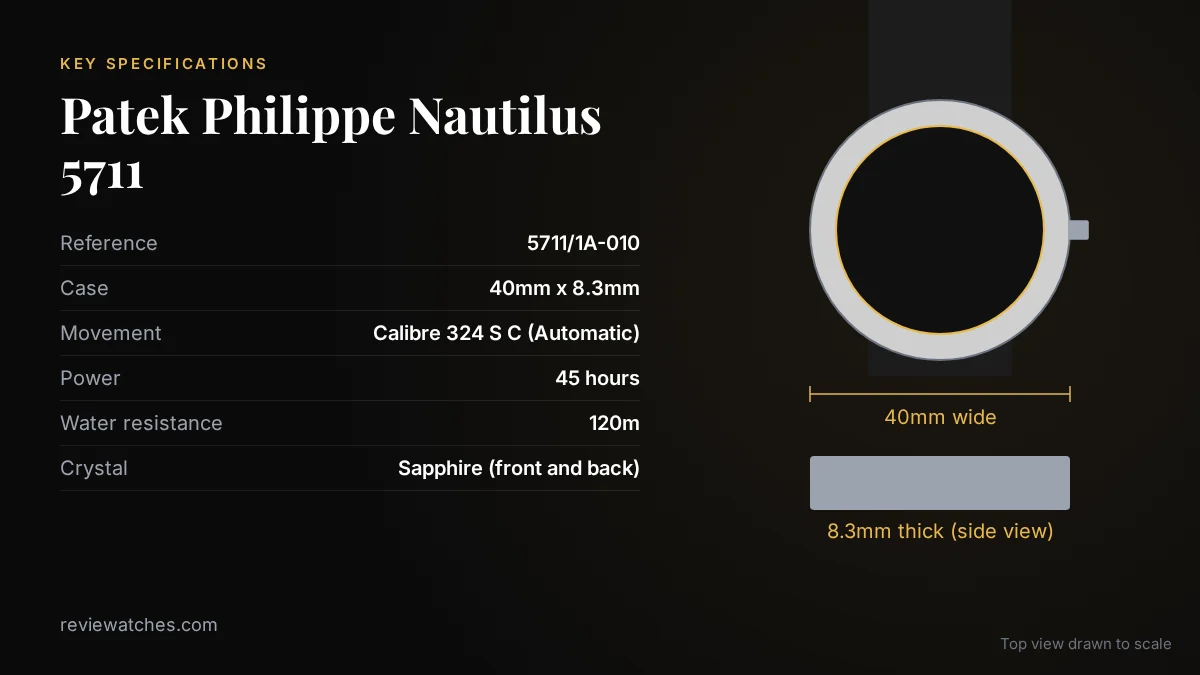
At a glance
- Case
- 40mm x 8.3mm
- Movement
- Calibre 324 S C (Automatic)
- Power
- 45 hours
- Water resistance
- 120m
- Often praised
- Arguably the most comfortable bracelet design in watchmaking
- Common criticism
- Secondary market prices ($150k+) are utterly absurd for what you get functionally
📑 Table of Contents
Let's get this out of the way: I don't own a Patek Philippe Nautilus 5711. I never will, at least not at current secondary market prices (well into six figures for a steel sports watch, let me repeat that: steel). Getting hands-on time with one isn't realistic either, which is exactly why this article is built the way it is: from the published specifications, Patek's own material, and the mountain of owner and reviewer commentary that surrounds this watch.
That distance is worth admitting upfront, because the 5711 is one of those watches that generates more myth than information. So here it is, an honest attempt to look past the hype using what's actually documented about the watch, from someone with nothing to sell you.
What Makes the 5711 Special (On Paper)
Gerald Genta designed the original Nautilus in 1976, four years after the Royal Oak. Both were radical: luxury steel sports watches when the industry was obsessed with gold and dress pieces. The porthole case design, the integrated bracelet, the whole "elegant sports watch" category that every brand now copies.
The 5711/1A specifically is the 40mm steel version with the blue dial. It's been in production (with tweaks) since 2006. In 2021, Patek announced they were discontinuing it. Cue the frenzy. Prices doubled overnight, then tripled, and now sit at stratospheric levels that make little rational sense.
The movement is the calibre 324 S C, Patek's workhorse automatic. It's thin (3.3mm), reliable, and by all accounts beautifully finished. Power reserve is 45 hours, which is fine but not spectacular by modern standards. The case is 40mm x 8.3mm. Water resistance is 120m, laughable for a sports watch but perfectly adequate for what this actually is: a fancy dress watch pretending to be sporty.
Size and Wearability
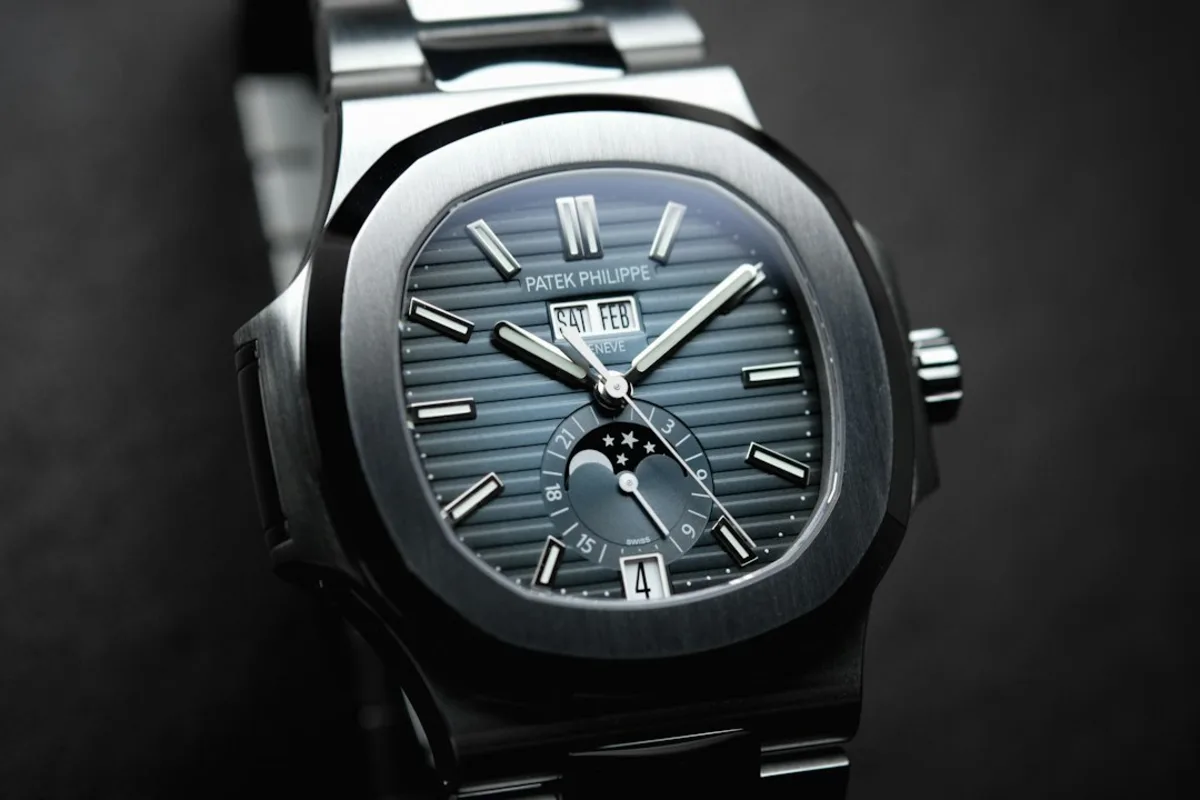
Photos of the 5711 tend to make it look imposing, chunky, statement-making. On paper, though, it's compact. At 40mm, it's smaller than most modern sports watches, and the thinness (8.3mm) means the case profile should sit easily under a cuff. The integrated bracelet is widely described as hugging the wrist in a way that makes the watch feel smaller still.
Owners consistently report that despite its reputation as a watch that screams wealth, in person it reads as understated. That gap between reputation and reality seems to be a big part of its appeal.
The blue dial is one of the most talked about elements of the design. That horizontal embossed pattern (Patek calls it a groove) creates a subtle shimmer that shifts with the light, appearing almost black in dim conditions and a vibrant navy in sunlight. It's a detail that reviewers return to again and again, and even sceptics of blue dial hype tend to concede this one earns it.
What Owners Report
A recurring theme in owner accounts is that the 5711 works well dressed up, sliding cleanly under a shirt cuff and looking at home with a suit thanks to its thinness. It's also widely reported to draw attention from people who recognise it, in a way few other watches do.
Equally common is the observation that the 5711 doesn't feel like a genuine tool watch despite the "sports" branding. Owners frequently mention a reluctance to wear it for anything physical, given the modest 120m water resistance and the general preciousness that comes with a watch worth this much. The result, according to many accounts, is a watch that looks like a tool while living a fairly pampered life.
In casual settings, the consensus seems to be that the 5711 is extremely versatile but not especially exciting on its own terms, more the watch equivalent of a perfectly tailored navy blazer than a conversation piece, unless the person you're talking to knows what it costs. Watches with more unusual designs, even inexpensive ones, are often reported to generate more genuine interest day to day.
The bracelet, though, is where the praise is close to universal. Independently articulating links, no pinching, no awkward gaps, a drape that's frequently compared to fine jewellery rather than a typical metal bracelet. It's consistently rated as one of the best in the industry, Rolex and Grand Seiko included.
The Movement: Impressive But Not Groundbreaking
Through the sapphire caseback, the calibre 324 S C is by all accounts stunning: Geneva stripes, bevelled edges, a gold rotor with the Patek seal. It's traditional haute horlogerie done right, and reviewers who've examined it closely report excellent timekeeping and smooth winding.
But it's worth being clear-eyed about what it isn't. There's no chronograph, no GMT, no annual calendar. It's time and date, full stop. At $150,000 on the secondary market, buyers aren't paying for technical innovation, they're paying for finishing, heritage and scarcity.
Compare it to something like the Rolex 3235, found in a Submariner costing roughly $10,000 new. The Rolex specification sheet shows a better power reserve (70 hours) and generally more robust shock and water resistance. The Patek is prettier, much prettier, but functionally it isn't doing anything a far cheaper watch can't do.
None of that is a knock on the watch. Haute horlogerie has never been about specs, it's about craft, artistry and tradition. But it's worth resisting the temptation to frame this as a technical marvel. It's a beautifully executed simple watch.
The Discontinuation: Genius or Cynicism?
Patek discontinued the 5711 in 2021. The official line was that the model had run its course and the brand wanted to move on. The more cynical reading is that Patek saw secondary market prices skyrocketing and killed the model while demand was at its peak, cementing its legend status forever.
Either way, it worked. The 5711 is now effectively untouchable. You can't walk into an authorised dealer and buy one, and you can't get on a waiting list. The only route is the secondary market, where prices run several times the original retail figure of around $30,000.
Is it worth it? Financially, probably. These watches are likely to hold value, maybe even appreciate further. As an object to actually enjoy day to day, I'm far less convinced. At $150,000, I'd rather have a Lange 1, a vintage Daytona, and a holiday. Or a house deposit. Or almost anything else.
Who Should Buy a 5711 (If You Can Find One)?
If you have the money and want the ultimate insider's sports watch, the case is understandable. The 5711 is the watch other collectors tend to respect, subtle enough to go unnoticed by non-enthusiasts but instantly recognisable to anyone who knows.
If you're buying it purely as an investment, the track record suggests you're probably fine. But you'd be buying art rather than a watch to use, and by most owner accounts that means limited wear, careful handling and constant worry about scratches. That's not a relationship with a watch I find appealing.
If you're a normal person with a healthy relationship to money, there are dozens of watches offering a large share of the experience for a fraction of the price. The Grand Seiko SLGA009 is reported to have finishing that rivals some Pateks. The Cartier Santos offers similar elegance on the wrist. Even the Tissot PRX delivers an integrated bracelet sports watch feel for under $500.
What Stands Out
The bracelet is by every account genuinely world class. The blue dial is a standout design detail. The thinness makes it, on paper, an extremely wearable watch. The finishing is consistently described as flawless. The history and design pedigree are real, this isn't hype built purely on marketing, it's a legitimately significant design.
Where It Falls Short
The date window is widely reported as too small and hard to read. The clasp, while beautifully made, is frequently described as fiddly to operate. Water resistance is inadequate for anything beyond light splashing, and lume performance is a common complaint. And then there's the price. A watch that retailed around $30,000 now trades for roughly five times that, purely because Patek turned off the tap. That's not value, that's artificial scarcity dressed up as desirability.
The Bottom Line
Looking closely at the 5711, on paper and through the weight of owner and reviewer consensus, it's clearly a beautiful, brilliantly engineered watch with genuine design pedigree. The craftsmanship is not in question.
What is in question is whether owning one, at current prices, would actually be enjoyable. The accounts suggest a watch that makes people cautious, precious and anxious, worn less and stressed over more, which is the opposite of what most people want from a watch.
The discontinued 5711 looks like a victim of its own success. Too expensive to enjoy freely, too hyped to be judged purely on its merits, too scarce to obtain through normal channels. It has become a symbol rather than simply a watch. And symbols tend to be less interesting than the objects they replace.
If I had $150,000 to put into watches, I'd rather spread it across a Lange Saxonia, a Rolex Daytona, a Speedmaster, a Grand Seiko and a Cartier Tank, building a collection that covers every occasion and mood, with money left over for straps and servicing.
The 5711 might be the best watch I'll never own. And I'm completely fine with that.
⚙️ Specifications
✅ Pros
- +Arguably the most comfortable bracelet design in watchmaking
- +Stunning blue dial with incredible depth and shimmer
- +Beautifully thin case (8.3mm) that should slide under any cuff
- +Impeccable finishing throughout, movement and case
- +Iconic Gerald Genta design that still looks modern
- +Will absolutely hold value as an investment piece
❌ Cons
- −Secondary market prices ($150k+) are utterly absurd for what you get functionally
- −Date window is tiny and reportedly hard to read at a glance
- −Lume performance is widely criticised as weak
- −120m water resistance is laughable for a 'sports' watch
- −Too precious for most owners to actually use as intended, often becomes a safe queen
- −Clasp is reportedly fiddly and doesn't match the bracelet's elegance
Written by
RevieWatches Editorial Team
RevieWatches is an independent, informational watch site. We research specifications, track pricing across retail and grey markets, and summarise what published...
More in Luxury
How to Buy a Rolex at Retail: Waiting Lists Explained
Buying a Rolex at list price isn't impossible, it's just slow, political, and nothing like buying any other watch. Here's how the waiting list game actually works.
Farer Watches: British Design, Swiss Movements, Bold Colour
Farer is an independent British brand making colourful, Swiss-made watches sold direct. We looked at its movements, sizes, prices, guarantee and returns.
AIS Watches: Is This Pre-Owned Luxury Dealer Legit?
AIS Watches is an Atlanta dealer in pre-owned and new luxury watches with a strong review record. Its payment and return terms put more risk on the buyer than big platforms, so here is how to buy safely.