Timex Weekender: The £35 Watch That Embarrasses £3,500 Ones
The Weekender is consistently the most recommended sub-£50 watch on every forum and in every Reddit thread going. A close look at its specifications and the widely reported owner experience explains exactly why.
About this article: this is an informational article based on public sources: manufacturer specifications, published hands-on reviews by other outlets, owner feedback and current prices. We have not tested the watch ourselves, we are watch enthusiasts rather than professional journalists, and nothing here is buying advice. No brand paid for it. Our method
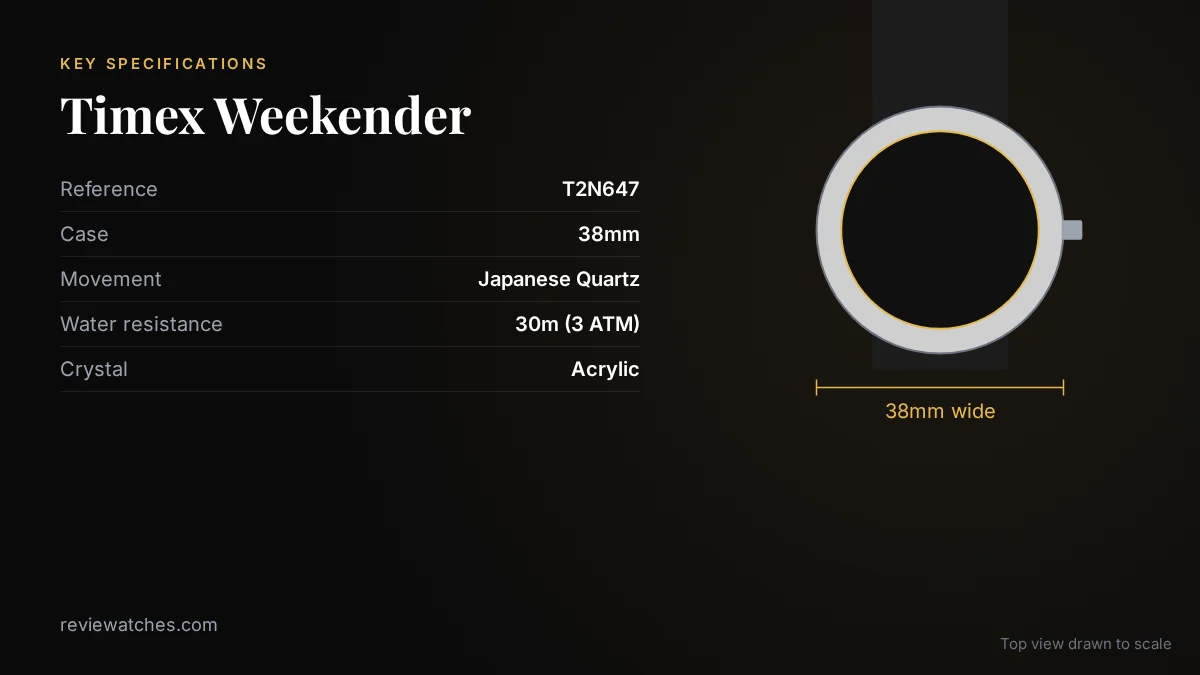
At a glance
- Case
- 38mm
- Movement
- Japanese Quartz
- Water resistance
- 30m (3 ATM)
- Often praised
- Indiglo backlight widely reported as more effective than luxury watch lume in full darkness
- Common criticism
- Small crown is fiddly to grip, particularly with cold fingers or short nails
📑 Table of Contents
This article on the Timex Weekender starts with a simple observation: the watch keeps turning up as the default answer whenever someone asks what to buy under £50, on enthusiast forums, in Reddit threads, everywhere people discuss affordable watches. That reputation is worth examining properly, because on paper this is a £35 watch made largely of brass and nylon, and yet it's regularly held up against watches costing many multiples of its price, from Rolex Submariners to Omega Speedmasters.
This article looks at what the Weekender actually offers, based on its published specifications and the experience widely reported by owners, to work out why it keeps earning that recommendation and whether it deserves it.
What You Actually Get
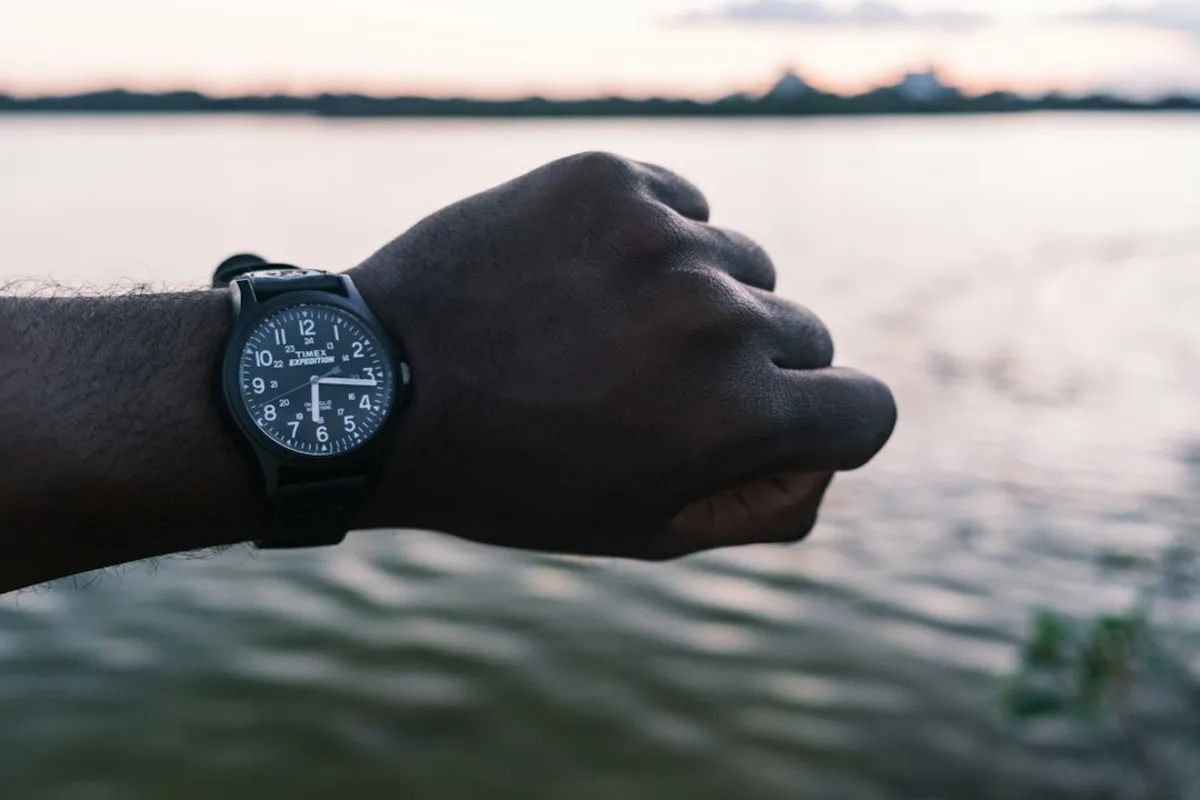
The Weekender ships in a cardboard box that feels appropriately humble for the price. Inside: a 38mm brushed brass case with a white dial, bold black Arabic numerals, and a NATO strap. One version, reference T2N647, comes with a navy-and-white striped strap, though the 20mm NATO lug fitting means swapping it for a solid colour takes moments.
Brass, not steel, is the key material choice, and it matters. Brass ages and develops patina with wear. Owners commonly report their Weekender picking up a bronze tone around the lugs and crown after months of regular use. Reactions to this vary, some think it looks like a watch that's been somewhere and done something, others find it looks simply worn. Either way, brass doesn't pretend to be a precious metal. It just becomes more textured with time.
The dial is refreshingly honest. White background, black numbers, simple stick hands with a red second hand for a small pop of colour. No date window, no subdials, no chronograph text that doesn't function. The typeface sits somewhere between military field watch and mid-century kitchen clock, and the simplicity is exactly why it's frequently cited as highly legible in a range of lighting, from bright sun to dim rooms. Lume on the hands themselves is minimal, which is where Indiglo comes in.
Indiglo: The Feature Luxury Watches Wish They Had
Press the crown and the entire dial glows blue-green, not just the hands or a few painted dots but the whole face, in the manner of a 1990s calculator watch. Owner accounts consistently describe it as more useful in full darkness than the Super-LumiNova found on far pricier watches, since it lights the whole dial rather than relying on stored charge in small lume plots.
Indiglo was patented by Timex in the 1990s and remains an underrated feature at this price point. It runs on a small electroluminescent panel, draws very little power, and by most accounts works reliably every time. If a luxury brand offered something functionally similar, it would likely be marketed as a premium feature and priced accordingly.
A quirk worth noting: pressing the crown to activate Indiglo can also nudge the time forward by a second or two if pressed too firmly, a fiddle owners often mention. A gentler press avoids it.
The Movement Situation
It's a straightforward Japanese quartz module. No handwinding, no sweeping seconds hand, no connection to mechanical horology's traditions. It ticks once per second with the characteristic quartz tick, audible enough in a quiet room that some owners find it comforting and others find it irritating.
Published accuracy for this type of movement is within a few seconds per month, consistent with what owners generally report, with no notable drift over time. Battery life is around two years with regular Indiglo use, longer with lighter use. Replacement is inexpensive, a few pounds at Timex or a local jeweller. No servicing, no regulation required. For a watch that might end up worn while doing DIY or lent to a teenager, this simplicity is exactly the point.
There's a strand of opinion that dismisses any watch without a mechanical movement as somehow "not real." That view doesn't hold up well against a watch that does its one job, telling the time reliably, for less than the price of a decent meal.
Size and Wearability
At 38mm, the case sits comfortably within the size range that suits the vast majority of wrist sizes, roughly 5.75 to 7 inches by common sizing guidance, without looking oversized or undersized at either end. The current trend toward 42mm-plus dive watches has somewhat obscured the fact that 38mm was the standard men's watch size for most of the 20th century. On paper, this proportion reads as balanced rather than showy.
The lugs are short and slightly curved, a detail that should help the case sit close to the wrist rather than protrude, and reportedly makes it wearable equally under a dress shirt cuff or with a t-shirt. The brushed brass finish catches light without drawing much attention, reading as "watch" rather than "statement piece."
Weight is minimal, with the whole watch on a NATO strap coming in at roughly 35 grams, dramatically lighter than most steel sports watches, which commonly weigh well over 100 grams. This lightness is one of the qualities most frequently praised in owner feedback, especially by anyone used to heavier steel watches.
Water resistance is rated at 30 metres, which in practical terms means splash resistance rather than swim-readiness. Owners commonly note it handles rain, hand-washing and the odd shower without trouble, but deliberate submersion such as swimming isn't recommended given the acrylic crystal and pressed-in caseback, neither of which is built for sustained pressure.
The NATO Strap Ecosystem
This is where the Weekender becomes genuinely clever as a product. The 20mm lugs accept any standard NATO strap, and Timex sells a range of colours cheaply. It's common for owners to build a small rotation, olive green for casual wear, navy blue for something slightly smarter, even a leather strap on the same spring bars for more formal occasions.
Swapping takes seconds: pull the spring bar, slide the new strap through, done. NATO straps have a practical advantage too, since the strap sits between the case and the wrist, so if a spring bar fails, the watch doesn't hit the ground, it just hangs from the remaining bar. Spring bar failure is reported as rare on this model, but the design offers a sensible safety margin regardless.
The stock strap is perfectly serviceable nylon. The real appeal, though, is treating straps like fast fashion done properly. A strap typically costs a fraction of the watch's price, which makes building a small collection an easy way to vary the look without buying multiple watches.
Where It Falls Short
The crown is small and can be fiddly, and setting the time is reported to require a bit of patience or decent fingernails, a complaint that comes up often, particularly in cold weather when fingers are less dextrous.
The acrylic crystal scratches easily with normal wear, a trait consistently mentioned by owners after a few months of use. It can be polished out with a product like Polywatch, a cheap tube that restores clarity, but that's maintenance most buyers wouldn't expect at this price. Sapphire crystal would push the cost up significantly, so the trade-off makes sense, even if it's a fair criticism.
The caseback is pressed in rather than screwed down, which is fine for the 30m water resistance rating but reads as slightly less finished when the watch is turned over. There's no exhibition window, unsurprising for a quartz movement, just plain stamped brass. It doesn't affect function but the back looks less considered than the front.
The audible quartz tick is loud enough in quiet settings, cinemas being a commonly cited example, that it's bothered some wearers enough to remove the watch temporarily. Others find it barely noticeable or even reassuring. Worth knowing either way.
Who This Watch Is Actually For
Students, first-time watch buyers, anyone wanting a reliable backup, and travellers who don't want to risk a more expensive watch abroad are the most obvious audience. It's also a sensible option for parents buying a first watch for a teenager, given the low cost of loss or damage.
It also appeals to collectors with much larger holdings who want something they can wear without worrying about it, and by most accounts it's often the watch that wins over people who insist they don't care about watches at all. Its simplicity does most of the persuading.
Value Proposition (Because That's Why You're Here)
At £35 to £45 depending on strap choice, the Weekender costs less than a tank of petrol, less than a decent pair of jeans, less than a couple of cinema trips in a major city. For that outlay, it delivers accurate timekeeping, a genuinely useful backlight, and a design that should hold up for years with nothing beyond an occasional battery change.
Set against other watches at this price point, many of which are either purely digital or fashion pieces with poorly finished cases and flimsy straps, the Weekender stands out as a product refined over several iterations since its 2010 launch, with the kind of small fixes that suggest genuine attention rather than a single cheap run.
Set against far pricier watches that often end up worn only occasionally, the Weekender's everyday usefulness is arguably where its real value lies. A watch worn often at £35 delivers more per wear than one worn rarely at ten times the price.
Final Thoughts (But Not "In Conclusion")
What comes through most clearly from researching the Weekender is its flexibility. It doesn't demand attention, doesn't require strap coordination in advance, and suits almost any context, gym, casual meet-up, desk work, without asking the wearer to think twice about it.
If the question is whether the Weekender is worth buying, the answer is yes. If the question is whether it's worth buying even when you already own something far more expensive, the answer is also yes. Buy a couple of straps to go with it, rotate them, and treat it as a low-stakes way to enjoy a watch rather than protect one.
Its reputation as the watch most often recommended in this exact price bracket is well earned. For roughly £35, it's hard to find a more sensible first, second, or backup watch on the market.
⚙️ Specifications
✅ Pros
- +Indiglo backlight widely reported as more effective than luxury watch lume in full darkness
- +38mm case size suits a broad range of wrist sizes based on typical proportions
- +Instant NATO strap swaps let you change the entire look in seconds
- +Brass case is reported to develop a character patina over time
- +Quartz accuracy and roughly two-year battery life with essentially no maintenance
- +Absurdly good value at £35-45, less than the cost of a meal out
❌ Cons
- −Small crown is fiddly to grip, particularly with cold fingers or short nails
- −Acrylic crystal scratches easily (though it can be polished with Polywatch)
- −Audible quartz tick in quiet rooms may bother some wearers
- −30m water resistance means splash-proof only, not suitable for swimming
- −Pressed caseback feels less finished than the front of the watch
Written by
RevieWatches Editorial Team
RevieWatches is an independent, informational watch site. We research specifications, track pricing across retail and grey markets, and summarise what published...
More in Budget Picks
Seiko 5 Sports vs Orient Kamasu: Best Automatic Under $500?
Two of the best-value automatics you can buy sit within a hundred quid of each other. Here's how the Seiko 5 Sports and Orient Kamasu actually differ once you look past the spec sheet.
Reverie Watches: The Singapore Microbrand, Not the Replica Site
Two very different businesses use the Reverie name: a Singapore microbrand known for guilloché dials, and a replica site selling copies of Rolex and Patek. Here is how to tell them apart, and what the real watches offer.
Are Armitron Watches Good? An Honest Look at the Brand in 2026
Armitron sells hundreds of inexpensive quartz and digital watches. We looked at the catalogue, the warranty terms and the 2026 change of ownership to see what you really get.