Seiko 5 Sports vs Orient Kamasu: Best Automatic Under $500?
Two of the best-value automatics you can buy sit within a hundred quid of each other. Here's how the Seiko 5 Sports and Orient Kamasu actually differ once you look past the spec sheet.
About this article: this is an informational article based on public sources: manufacturer specifications, published hands-on reviews by other outlets, owner feedback and current prices. We have not tested the watch ourselves, we are watch enthusiasts rather than professional journalists, and nothing here is buying advice. No brand paid for it. Our method
📑 Table of Contents
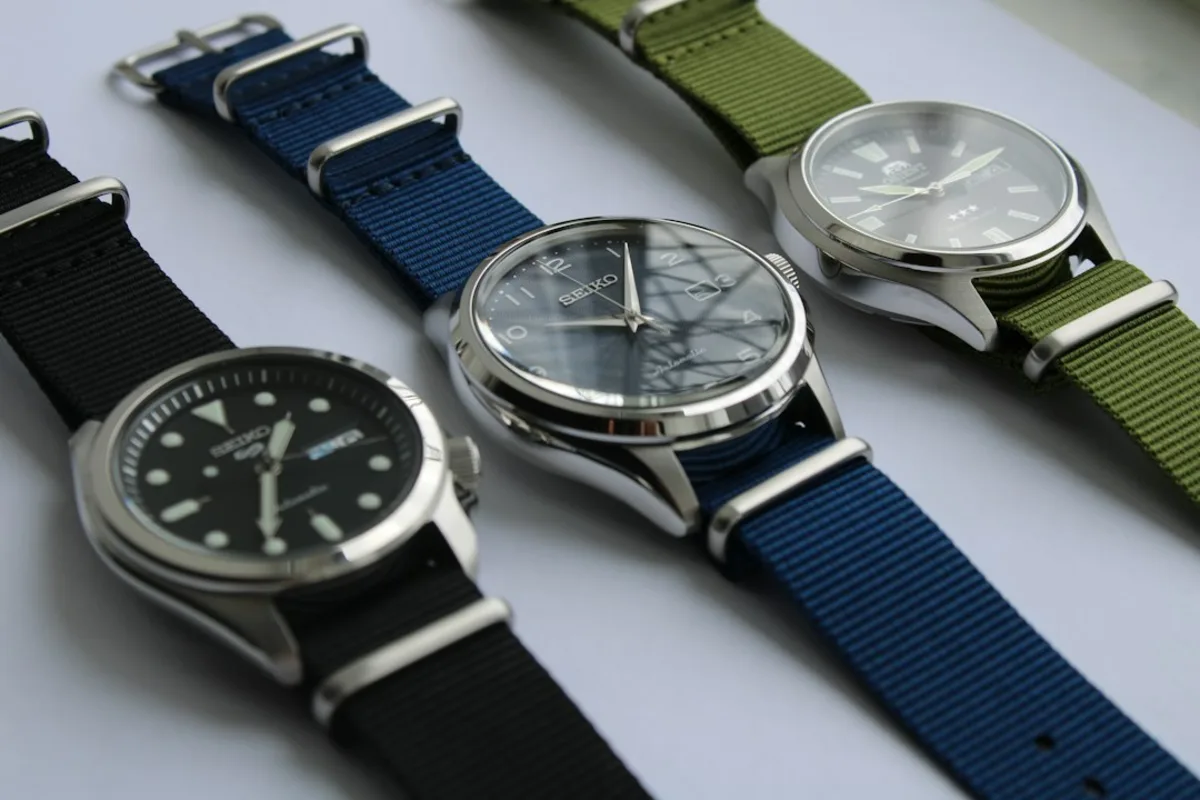
If you've spent any time on r/watches or WatchUSeek asking what automatic to buy first, these two names come up in almost every thread. The Seiko 5 Sports and the Orient Kamasu have become the default answer to 'what's a proper mechanical watch that won't wreck my bank account', and for good reason. Both are made by companies that have been building movements since before most of us were born, both undercut the Swiss competition by a country mile, and both punch well above what their price tags suggest they should.
But they're not the same watch wearing different clothes. Once you actually compare them feature by feature, some real differences emerge, and which one is 'better' depends entirely on what you want from a daily automatic.
Design
The Seiko 5 Sports range is enormous, which is both its biggest strength and its biggest source of confusion. There are field watch variants, GMT-styled pieces, dressier options, and full-on sports models with rotating bezels and chunky lugs. Seiko leans into variety here, releasing new colourways and dial textures constantly, which means there's almost certainly a 5 Sports that matches your taste, whatever that taste happens to be. The trade-off is consistency. Build quality and finishing can vary noticeably between models depending on case shape and bracelet type, even within the same range.
The Orient Kamasu takes the opposite approach. It's a single, tightly focused design: a dive-style watch with a coin-edge unidirectional bezel, applied indices, and a case shape that's been compared (fairly or not) to the Seiko SKX and even, at a real stretch, to a Rolex Submariner silhouette. Orient doesn't chase trends with the Kamasu the way Seiko does across the 5 Sports line. It just refines the same idea. That focus shows in the finishing, which reviewers generally describe as tidy and well controlled for the price, with a polished bezel insert and a case that photographs better than you'd expect from something in this bracket.
If you like the idea of collecting a few different 5 Sports models for different moods, Seiko gives you that flexibility. If you want one watch that looks the part on a wetsuit or a shirt cuff without fuss, the Kamasu's singular design does that job cleanly.
Movement
This is where the philosophical split really shows. Seiko's 5 Sports models are built around the 4R36, a workhorse automatic movement with hacking seconds and hand-winding, and a power reserve of roughly 41 hours. It's not a glamorous calibre. It's not chronometer-rated, it's not decorated, and Seiko doesn't pretend otherwise. What it is, is proven. The 4R-series has been running in Seiko's affordable range for years and has a reputation among owners for being dependable and easy to service, even if accuracy out of the box can vary a few more seconds a day than you'd like.
Orient's in-house automatic movement inside the Kamasu offers the same core functionality (hacking, hand-winding) and a broadly comparable power reserve, but Orient has generally positioned its movements as slightly more accurate out of the factory, at least according to owner reports and forum consensus rather than any official chronometer certification. Neither watch is going to compete with a COSC-rated Tudor Black Bay or an Omega Speedmaster on timekeeping precision. That's not the point of either. But if raw accuracy out of the box matters to you more than brand recognition, the Kamasu tends to edge it in casual comparisons.
Daily Wearability
Both watches sit in that same low-to-mid 40s millimetre range that suits most wrists, and both wear reasonably true to size thanks to sensible lug-to-lug proportions. Where they diverge is in the details that matter once you're actually living with a watch day to day.
The Kamasu uses a sapphire crystal as standard, which means it resists scratches from keys, desk edges and watch boxes far better than the Hardlex crystal fitted to most Seiko 5 Sports models. Hardlex is tough (it won't shatter easily) but it does pick up fine scratches over time in a way sapphire simply doesn't. The Kamasu also typically comes with a screw-down crown, adding a bit more confidence around water and dust ingress, and generally carries a dive-rated water resistance that makes it a genuinely usable pool or beach watch, not just a watch that looks like one.
The 5 Sports counters with sheer breadth of options. Bracelet, NATO, rubber, even mesh depending on the model, and a day-date complication on plenty of variants that some people find genuinely useful and others find cluttered. Lume performance is generally strong on both watches, though dive-focused Seiko 5 Sports models and the Kamasu both tend to outperform the dressier 5 Sports variants after dark.
Quick Spec Comparison
| Seiko 5 Sports | Orient Kamasu | |
|---|---|---|
| Movement | Seiko 4R36 automatic, hacking and hand-winding | Orient in-house automatic, hacking and hand-winding |
| Crystal | Hardlex (most models) | Sapphire |
| Crown | Standard push/pull (varies by model) | Screw-down |
| Design range | Very wide, multiple sub-lines | Single dive-style design |
| Water resistance | Typically around 100m on sports models | Dive-rated, generally higher than the 5 Sports |
Value
Both watches sit comfortably under the $500 mark, and both are usually available closer to the lower half of that range depending on the specific model and where you buy. Neither is going to hold its value the way a Rolex Submariner or a Tudor Black Bay might on the secondhand market. These are tools, not investments, and anyone buying one expecting it to appreciate is looking in the wrong category entirely.
Where value really gets interesting is in what each brand chooses to spend its budget on. Seiko spreads its money across variety and dial design, giving you more choice for roughly similar money. Orient concentrates its budget into build quality on a narrower range, which is why the Kamasu often feels like it's punching a notch above its actual price when you look closely at the case finishing and crystal. If you're comparing pound for pound, dollar for dollar, the Kamasu arguably gives you more watch for the same outlay. But 'more watch' isn't always the same as 'more watch you'll want to wear'.
Who Each Is For
The Seiko 5 Sports makes sense if you want a first automatic that can double as several watches in spirit. Someone who wants a GMT-style piece for a work trip, a field watch for weekends, and a slightly dressier option for a wedding, all under the same trusted movement and price bracket, will find exactly that inside the 5 Sports catalogue. It's also the better pick if brand recognition matters to you. Seiko is simply a bigger, more widely known name, and the 5 Sports badge carries weight with people who've never opened a watch forum in their life.
The Orient Kamasu suits someone who's already decided they want a dive-style watch and doesn't need seventeen other options to choose between. If sapphire crystal, a screw-down crown and tighter, more focused finishing matter more to you than variety, this is the better buy. It also makes sense as a step up from something like an Orient Mako II, for anyone who liked that formula but wanted a slightly more refined execution of it.
The Bottom Line
Neither watch is the objectively 'better' one. That's the honest answer, even if it's not a satisfying one. The Seiko 5 Sports wins on choice, brand weight and sheer flexibility across styles. The Orient Kamasu wins on build focus, crystal quality and that dive-watch usability that comes from a screw-down crown and proper water resistance rating.
If I had to put money down for a single all-rounder that I'd want to actually wear most days, I'd lean toward the Kamasu. The sapphire crystal alone solves one of the most common long-term complaints people have about budget automatics, and the design has aged well without needing constant reinvention. But I wouldn't argue hard against anyone picking a 5 Sports instead, especially if they want a specific dial or complication that Orient simply doesn't offer. At this price point, you're not really choosing between a good watch and a bad one. You're choosing between two genuinely good watches with different priorities, and that's a rare and good problem to have under $500.
⚙️ Specifications
✅ Pros
- +Seiko 5 Sports: huge range of dials, cases and complications to choose from
- +Seiko 5 Sports: strong brand recognition and easy servicing thanks to widespread 4R36 use
- +Orient Kamasu: sapphire crystal resists scratches far better than Hardlex
- +Orient Kamasu: screw-down crown and dive-rated water resistance suit real water use
- +Both: genuinely capable automatics well under four figures
❌ Cons
- −Seiko 5 Sports: build and finishing quality varies noticeably between models
- −Seiko 5 Sports: Hardlex crystal picks up fine scratches over time
- −Orient Kamasu: far less design variety than the 5 Sports range
- −Both: neither will hold resale value like a Tudor Black Bay or Omega Speedmaster
Written by
RevieWatches Editorial Team
RevieWatches is an independent, informational watch site. We research specifications, track pricing across retail and grey markets, and summarise what published...
More in Budget Picks
Reverie Watches: The Singapore Microbrand, Not the Replica Site
Two very different businesses use the Reverie name: a Singapore microbrand known for guilloché dials, and a replica site selling copies of Rolex and Patek. Here is how to tell them apart, and what the real watches offer.
Are Armitron Watches Good? An Honest Look at the Brand in 2026
Armitron sells hundreds of inexpensive quartz and digital watches. We looked at the catalogue, the warranty terms and the 2026 change of ownership to see what you really get.
The Best Watches Under $500 in 2026: What I'd Actually Buy
Seven genuinely brilliant watches that prove you don't need thousands to get something worth wearing.