Tudor Black Bay 58 vs Rolex Submariner: Which Should You Buy?
Same family tree, very different money. Here's an honest, research-based look at how the Black Bay 58 stacks up against the watch it was always going to be compared to.
About this article: this is an informational article based on public sources: manufacturer specifications, published hands-on reviews by other outlets, owner feedback and current prices. We have not tested the watch ourselves, we are watch enthusiasts rather than professional journalists, and nothing here is buying advice. No brand paid for it. Our method
📑 Table of Contents
In the Tudor Black Bay 58 vs Rolex Submariner debate, there's no getting around it: every review of the Tudor Black Bay 58 eventually mentions the Rolex Submariner, and every review of the Submariner eventually gets a comment from someone saying "but have you considered the Tudor?" The two brands share a parent company, a factory history, and a design language that goes back to the 1950s when Tudor was essentially Rolex's slightly more affordable sibling wearing the same case with a different badge. That relationship hasn't disappeared. It's just got more interesting.
So let's actually compare them properly, not as a proxy war between fanboys, but as two dive watches that do genuinely different jobs for genuinely different budgets.
Design
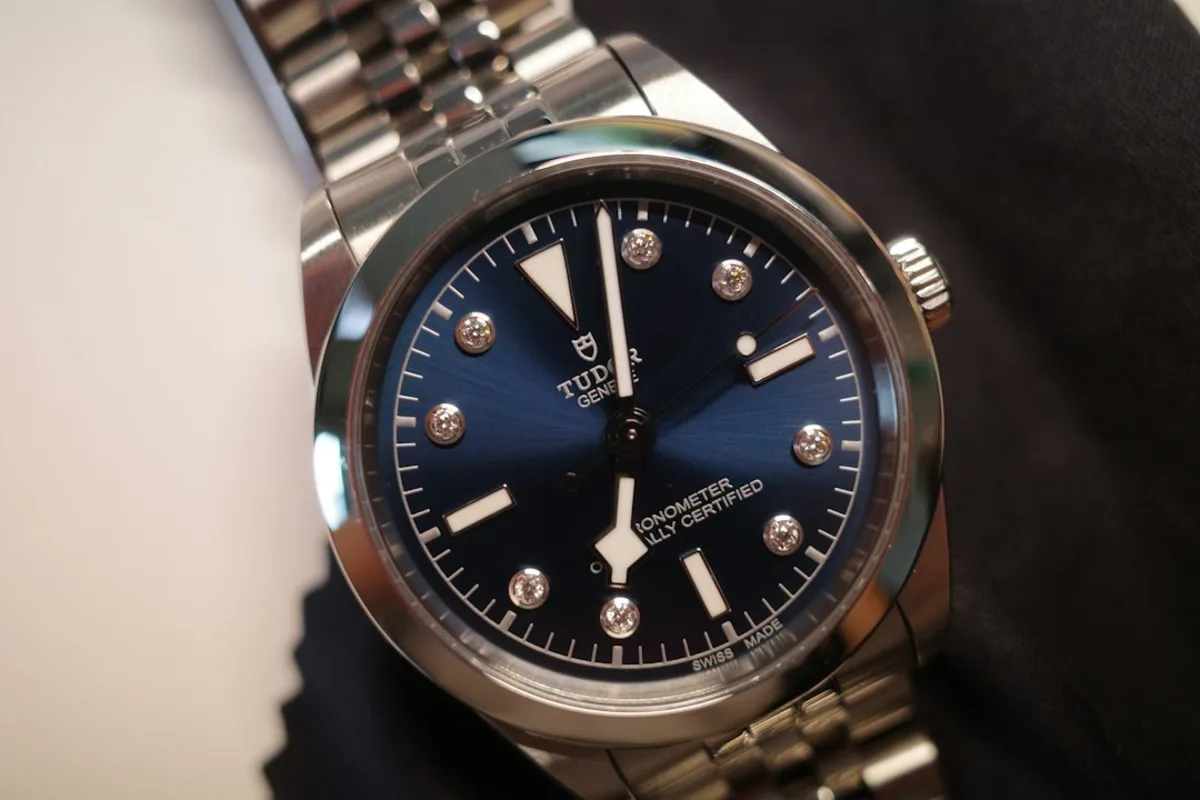
The Black Bay 58 exists because Tudor listened to what people were actually saying about the wider Black Bay range: too big, too much domed crystal, too much bezel. The 58 (named for 1958, the year of the original Tudor Submariner reference it nods to) is built around a case that measures 39mm, which by 2020s dive watch standards is refreshingly restrained. It's got a snowflake-adjacent hour hand, a matte or gilt dial depending on the version, and a bezel insert that reads as properly vintage without tipping into pastiche. It looks like a watch designed by people who actually wear watches, rather than a watch designed to fill a display case.
The current Submariner, by contrast, sits at 41mm and carries all the visual weight you'd expect from Rolex's flagship sports model: thicker lugs, a wider bezel, the Cerachrom ceramic insert that Rolex has been refining since the mid-2000s, and that unmistakable Mercedes hand set. It's a bigger, more assertive watch on the wrist, and it reads as more expensive because, well, it is. The Submariner has also had a slightly awkward relationship with case size over the decades, creeping up from the 40mm era to today's 41mm, and some long-time fans still prefer the older proportions. The Black Bay 58 was Tudor's answer to exactly that nostalgia, and it landed well.
Neither watch is trying to reinvent the dive watch. Both are working from the same 70-year-old blueprint: rotating bezel, luminous markers, screw-down crown, robust case. The difference is entirely in scale and finishing, and honestly, that's most of what separates them.
Movement
This is where the gap narrows considerably, and it's the reason the Black Bay 58 gets recommended so often as "the sensible choice." Tudor's in-house MT5402 movement, used in the 58, is COSC-certified, runs on a free-sprung balance with a silicon hairspring, and offers around 70 hours of power reserve, meaning it'll comfortably survive a weekend off the wrist without needing resetting. That's proper modern watchmaking, not a rebadged generic movement, and it's a big part of why Tudor's reputation has shifted so much over the last decade.
The Submariner runs Rolex's calibre 3235, also with roughly 70 hours of power reserve, also chronometer-certified (to Rolex's own tighter Superlative Chronometer standard, which allows for a tighter daily rate tolerance than standard COSC). Rolex's movement has the Chronergy escalpe, err, escapement, and benefits from decades of Rolex's own metallurgy and manufacturing scale. On paper the two movements are closer than the price gap would suggest. In practice, both will run accurately, both will likely outlast their owners with proper servicing, and the difference comes down to brand engineering pedigree and the intangible sense that you're wearing something Rolex made entirely under its own roof, right down to the alloys.
Daily Wearability
This is the part I think gets underweighted in a lot of comparisons. A 39mm case with modest lug-to-lug dimensions and Tudor's fabric or riveted steel bracelet options means the Black Bay 58 disappears under a shirt cuff in a way the 41mm Submariner simply doesn't. If you've got a smaller wrist, or you just don't want a watch announcing itself before you've said hello, the 58 is the easier daily companion. It's also lighter, which matters more than people admit after eight hours at a desk.
The Submariner wears its size with confidence and, for a lot of people, that's exactly the point. It sits well on medium-to-large wrists, the Oysterlock clasp with its diver's extension is genuinely clever for adjusting over a wetsuit or just a warm day when your wrist swells slightly, and the bracelet integration is about as good as it gets in this price bracket. Neither watch is going to let you down on water resistance for anything you're realistically doing, whether that's the pool, a beach holiday, or actual diving, though the Submariner's rating is generally quoted higher than the Black Bay 58's, in keeping with its position as the more overtly tool-oriented watch of the two.
Value
Here's the uncomfortable truth for Rolex fans: the Submariner costs roughly double what the Black Bay 58 does, sometimes more once you factor in the market premiums that Rolex steel sports watches still command over their official list prices in a lot of regions. That premium isn't really about the movement, or even the finishing, which is excellent on both watches. It's about the badge, the waiting lists, the resale confidence, and seven decades of the Submariner being the reference point every other dive watch gets measured against, including the one it inspired at Tudor.
If you're buying purely on spec-for-spec value, the Black Bay 58 wins comfortably. You're getting an in-house COSC movement, excellent build quality, and a design pedigree that traces back to the same well as the Rolex, for roughly half the outlay. If you're buying on long-term resale strength and the simple fact that a steel Submariner has never really gone out of demand, Rolex's case is just as strong, even if it costs more to make.
Quick Comparison
- Case size: Black Bay 58, 39mm. Submariner, 41mm.
- Movement: Tudor MT5402 (in-house, COSC, ~70hr reserve) vs Rolex calibre 3235 (in-house, Superlative Chronometer, ~70hr reserve).
- Bracelet: Tudor offers steel, fabric, and leather options. Rolex Submariner comes on the Oyster bracelet with Glidelock/diver's extension.
- Price tier: Black Bay 58 sits in the low four-figure range. Submariner runs to roughly double, sometimes considerably more depending on market conditions.
- Water resistance: Submariner is rated higher, in keeping with its more overtly professional-tool positioning.
Who Each Is For
The Black Bay 58 makes sense if you want a genuinely excellent, historically grounded dive watch that wears small and comfortable, and you'd rather put the money you save toward a second watch, a decent holiday, or simply not spending it. It's also the better pick if you're not fussed about the badge on the dial and more interested in what's inside the case. It sits nicely alongside other watches worth knowing in this space, the wider Tudor Black Bay range being the obvious sibling, but also things like the Omega Speedmaster for anyone building a small, meaningful collection rather than chasing hype.
The Submariner makes sense if the badge genuinely matters to you (and there's no shame in that, brand equity is a real thing you're paying for), if you want the watch that virtually everyone, watch person or not, will recognise instantly, and if resale value and long-term demand are part of your calculation. It's also simply the bigger, more commanding watch on the wrist, which some people actively want.
If you're earlier in your watch journey and neither of these fits the budget yet, it's worth knowing the same DNA, oversized crown guards, bold lume, rotating bezels, trickles all the way down to watches like the Seiko 5 Sports or the Orient Mako II, which borrow heavily from this exact design lineage at a fraction of the cost.
The Bottom Line
I don't think this is really a fair fight, and I don't think it's meant to be. The Black Bay 58 was built to be the accessible, wearable, brilliantly engineered alternative to a watch most people will never own, and it succeeds completely at that job. The Submariner was never trying to be good value. It's trying to be the definitive dive watch, the one every other brand still gets compared to, seventy-odd years after it first strapped a rotating bezel to a case and changed what a sports watch could be.
If I were spending my own money and wanted the better all-round object for daily wear, I'd take the Black Bay 58 without much hesitation. If I wanted the watch that needs no explanation to anyone, anywhere, and I had the budget to not think twice about it, I'd understand exactly why someone chooses the Submariner instead. Neither answer is wrong. That's rare in this hobby.
⚙️ Specifications
✅ Pros
- +Black Bay 58 offers in-house COSC movement and vintage-correct proportions for roughly half the outlay
- +Submariner carries unmatched brand recognition and long-term resale strength
- +Both share a genuine design lineage rather than one simply copying the other
❌ Cons
- −Submariner's premium is largely about badge and demand rather than a proportionally better watch
- −Black Bay 58's smaller case and lower water resistance rating won't suit everyone chasing a 'tool watch' feel
- −Both require patience or market awareness to buy at sensible prices given current demand
Written by
RevieWatches Editorial Team
RevieWatches is an independent, informational watch site. We research specifications, track pricing across retail and grey markets, and summarise what published...
More in Dive Watches
Tudor Black Bay 54 vs 58 vs 41: Which Size Is Right?
Tudor now makes its Black Bay diver in four sizes, and recent updates have changed the movements too. Here is how the 54, 58 and 41 really differ, and where the new 68 fits.
Rolex Submariner vs Omega Seamaster Diver 300M
Two of the most famous dive watches ever made, both rated to 300 metres, both with ceramic bezels. On paper they are closer than their reputations suggest. Here is where they really differ.

Zelos Watches: Singapore Microbrand With Unusual Materials
Zelos is a Singapore microbrand famous for exotic dials and case materials at accessible prices. We went through its catalogue, movements, sizes and policies.