Garmin Fenix 5: The Multisport Watch That Changed Everything
The Fenix 5 remains one of the most capable multisport GPS watches on the used market. Here's why it still holds up, even with newer models available.
About this article: this is an informational article based on public sources: manufacturer specifications, published hands-on reviews by other outlets, owner feedback and current prices. We have not tested the watch ourselves, we are watch enthusiasts rather than professional journalists, and nothing here is buying advice. No brand paid for it. Our method
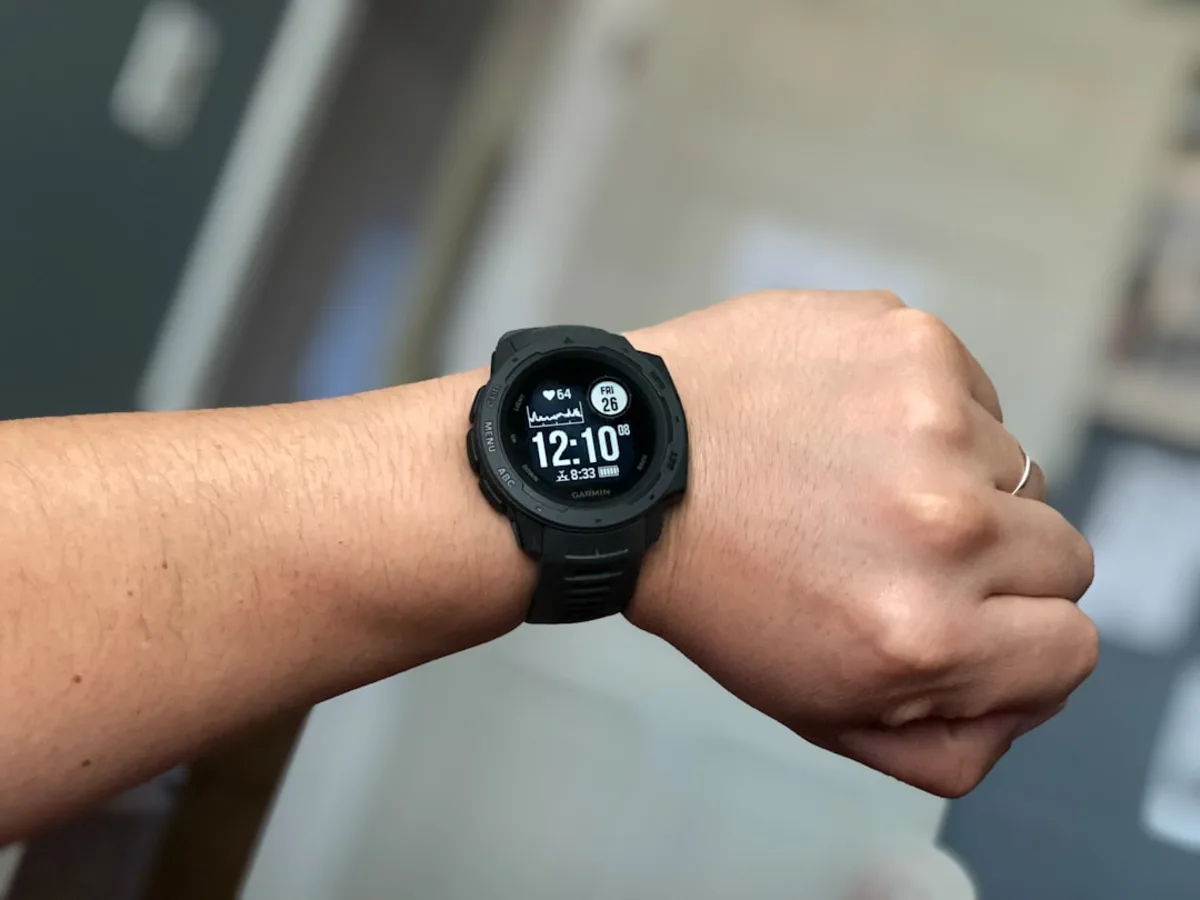
At a glance
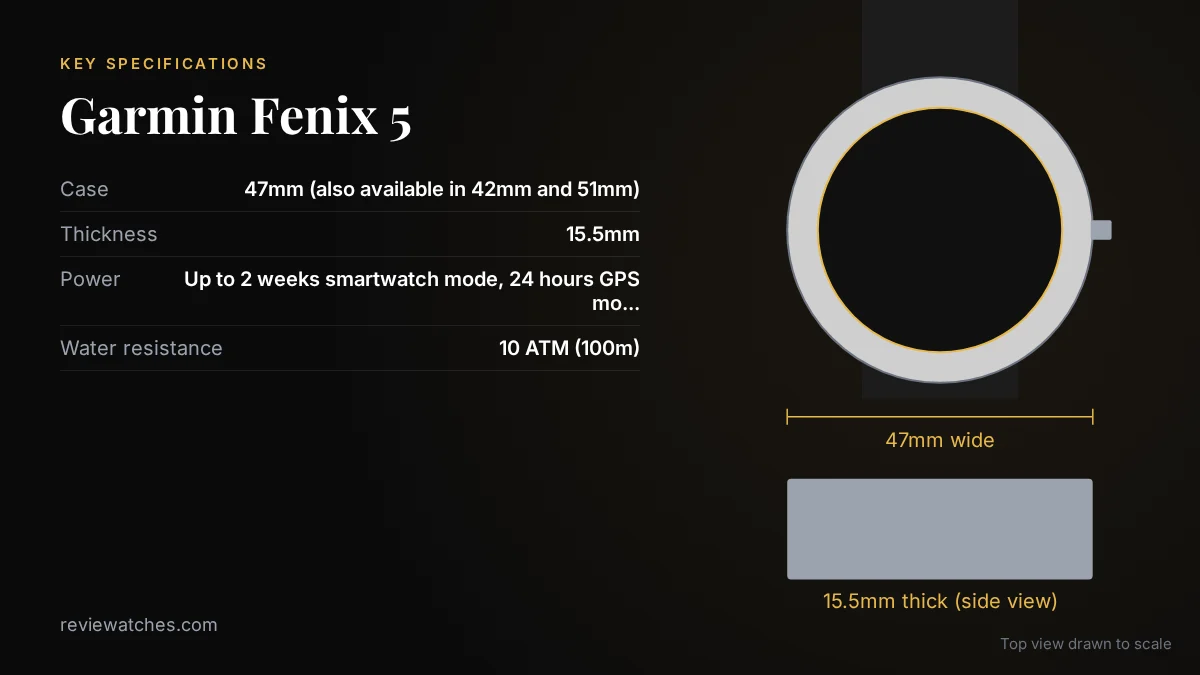
- Case
- 47mm (also available in 42mm and 51mm)
- Thickness
- 15.5mm
- Power
- Up to 2 weeks smartwatch mode, 24 hours GPS mode, 60 hours UltraTrac mode
- Water resistance
- 10 ATM (100m)
- Often praised
- Excellent GPS accuracy with GLONASS support
- Common criticism
- Optical HR sensor lags during high-intensity intervals
📑 Table of Contents
In this article on the Garmin Fenix 5, we look at why the watch has been out of production for years, yet it keeps turning up in recommendations for anyone shopping for a multisport GPS watch on a budget. Given how much newer hardware Garmin has released since, that says something about how well this watch was designed in the first place.
The Fenix 5 was Garmin's first proper attempt at making a multisport GPS watch you could wear to dinner without looking like you'd forgotten to take off your training gear. By most accounts, they got it right. This is the watch that convinced a lot of serious athletes they didn't need a separate dress watch anymore.
What Makes the Fenix 5 Different
Before the Fenix 5, multisport watches were chunky beasts. The Fenix 3 was 51mm and thick as a brick, brilliant for mountain running, awkward for everything else. Garmin's redesign for the 5 clearly took that feedback on board.
The result is a watch that reads as genuinely balanced on paper and in owner reports. The stainless steel bezel gives it presence without shouting about what it's built for. The fiber-reinforced polymer case keeps weight down. The standard version comes in at 47mm, and according to owners who've compared it directly to the Fenix 3, it wears smaller than the number suggests.
At 15.5mm thick, the case is slim enough by sports watch standards that owners commonly report wearing it under a shirt cuff without it catching on jacket sleeves or looking out of place at smarter occasions. That's a meaningful shift from the 5X and earlier Fenix models, where the size made that kind of everyday flexibility much harder.
GPS Performance
GPS is where the Fenix 5 earns its keep, whether the activity is trail running, open-water swimming or road cycling.
According to Garmin's specifications and widely reported real-world use, GPS lock is fast, typically 10 to 15 seconds in open areas and closer to 30 seconds in dense urban surroundings. The addition of GLONASS support is commonly cited as making a real difference in valleys and urban canyons, areas where GPS-only devices are more prone to losing signal.
Battery life in GPS mode is rated at around 24 hours of continuous tracking, which covers most training days. The more interesting feature is UltraTrac mode, which drops the GPS sampling rate in exchange for up to 60 hours of tracking, aimed squarely at ultra-distance and multi-day events. The trade-off, as reviewers note, is a slightly jagged-looking track on the map afterwards, though the navigation and basic stats remain usable.
Accuracy is generally rated as excellent by reviewers, with GPS-derived pace and distance figures matching closely against other GPS-based devices over long routes. For running, this consistency between reported pace and perceived effort is often cited as the real test of whether a watch's GPS is trustworthy.
The Sports Profiles: Deep but Not Overwhelming
This watch comes preloaded with over 20 sports profiles, covering running, cycling, swimming (pool and open water), rowing, skiing, golf, SUP and more. Each profile has its own metrics and data screens.
Running profiles include pace, cadence, vertical oscillation and ground contact time. Cycling profiles support power data if a meter is paired, or fall back to speed and elevation. Swimming profiles track stroke count, SWOLF and distance per stroke. Overall, it's comprehensive without feeling cluttered.
Every data screen can be customised, with fields added, removed or rearranged to suit personal preference, something reviewers regularly point to as one of the watch's strengths for athletes who want a clean, glanceable display during hard efforts.
The Connect IQ store adds a further layer of customisation, with third-party watch faces and data fields (such as normalised power calculations for cycling) available to install. It's optional, but it extends the watch's usefulness for anyone who wants to dig into it.
Heart Rate: Good Enough, Not Perfect
The optical heart rate sensor is generally rated as decent rather than outstanding. For steady-state cardio, reviewers commonly report readings within 3 to 5 bpm of a chest strap. For intervals or anything involving rapid heart rate changes, lag is a widely reported limitation, which is fairly typical of optical sensors from this era.
The standard recommendation from reviewers is to pair the watch with a chest strap for high-intensity interval work and rely on the wrist sensor for steady efforts, where it performs reliably.
Sleep tracking is more mixed. It reliably logs sleep and wake times, but the breakdown between deep and light sleep is often described by users as inconsistent, and it's generally treated as a rough guide rather than a precise metric.
Navigation: Proper Breadcrumb Trail, Not Full Mapping
The Fenix 5 doesn't offer full colour mapping. Instead it provides a breadcrumb trail and basic turn-by-turn guidance when a route is loaded, which is enough for most users according to owner feedback.
Routes are typically loaded as GPX files via Garmin Connect and synced to the watch, after which the device displays a line to follow. The screen isn't as detailed as a phone or a dedicated GPS unit, but it's generally reported as sufficient to keep runners and cyclists on an unfamiliar route.
For road cycling, turn alerts (arrows and beeps as a junction approaches) are frequently mentioned as a useful feature, saving cyclists from having to stop and check a phone.
Anyone wanting full topographic maps on the wrist needs to look at the Fenix 5X or 5 Plus models, which are larger and more expensive. For many users, the simpler breadcrumb navigation on the standard 5 is enough.
Comfort and Everyday Use
Owners frequently report wearing the Fenix 5 continuously, including through showers, sleep and work, suggesting it's comfortable enough to largely disappear on the wrist.
The stock silicone strap is functional rather than special. It's smooth enough to avoid snagging on clothing and dries quickly after swimming. With a 22mm lug width, it's straightforward to swap in a NATO or leather strap for a smarter look.
At 85 grams, the watch is noticeable on the wrist but well within the range considered manageable for long runs or all-day wear. For comparison, the Apple Watch Ultra weighs 61.3g, though weight distribution differs enough that the two aren't directly comparable in how they feel.
The five physical buttons are consistently highlighted as one of the watch's best features. They work reliably with gloves, in the rain and underwater, and the firm, clicky action makes accidental presses unlikely even during rough activity like trail running.
The Screen: Readable, Not Stunning
The transflective LCD display is always-on and actually improves in bright sunlight, making it well suited to outdoor sports. Text remains legible in direct sun without needing the backlight.
In low light, the backlight (triggered via the top-left button) is bright enough for night use, though it doesn't match the visual quality of an OLED display. Text stays crisp, if the colours are muted.
The trade-off for this screen type is battery life. A week between charges with daily activity tracking and several GPS sessions is a commonly reported figure, compared with the daily charging typically required by OLED-based smartwatches like the Apple Watch or Galaxy Watch line.
Common Drawbacks
The Fenix 5 isn't without its frustrations, and several issues come up repeatedly in owner and reviewer feedback:
Syncing can be temperamental. Bluetooth sync occasionally fails, often requiring a restart of one or both devices, or a switch to Wi-Fi. It's an intermittent annoyance rather than a dealbreaker.
The interface feels dated. Menus are deep and not always intuitive, with settings buried in nested layers. Later Garmin watches streamline this considerably, and the Fenix 5 shows its age here.
No music storage. The standard Fenix 5 has no onboard music, a feature reserved for the 5 Plus. Anyone wanting to run without a phone for music will need to look at that model or another upgrade.
Notifications are basic. Messages and calls appear on screen, but replying is phone-only. It's useful for awareness, not for interaction.
The altimeter can drift. As a barometric altimeter, readings are affected by weather changes, and a shift in pressure overnight can throw off morning elevation figures by a noticeable margin. Manual calibration, or waiting for GPS to auto-calibrate, is the usual fix.
Value Proposition: Brilliant on the Used Market
New Fenix 5 units are hard to come by now, with Garmin having moved through the 6, 6 Pro, 7 and 8 series since. The used market, however, is well stocked with Fenix 5s from owners upgrading to newer models, and that's where the value case is strongest.
Clean used examples typically sell in the £250 to £350 range, which is remarkable value for a watch that still covers what most athletes need. Newer models bring better HR sensors, solar charging and more storage, but for accurate multisport tracking, the Fenix 5 still delivers.
Against a new Forerunner 955 at roughly £450 or a Fenix 7 at £600 plus, the Fenix 5 offers a large share of the functionality for around half the price. Unless the latest features are a genuine requirement, it's an easy watch to recommend.
For anyone buying their first multisport watch ahead of a first triathlon, a used Fenix 5 is a sensible starting point: it's a way to learn what features actually get used before deciding whether an upgrade is worth it.
Who This Watch Is For
The Fenix 5 suits anyone doing multiple sports seriously without needing the absolute latest tech. Triathletes, adventure racers, trail runners and cyclists who also swim are the obvious fits, particularly for buyers willing to shop used.
It also suits anyone who'd rather not charge a device daily. A week between charges is a genuine convenience compared with the daily routine required by most smartwatches.
Runners who stick to roads and don't need navigation or multisport features are probably better served by a Forerunner, which is lighter and cheaper. Anyone wanting smartwatch features like payments, music or apps should look at an Apple Watch or Galaxy Watch instead. The Fenix 5 is aimed squarely at athletes who prioritise tracking accuracy and battery life above everything else.
Final Thoughts
Plenty of watches have come along since, with nicer screens and more features, but the Fenix 5 continues to be recommended precisely because it still does the core job well. It has a long track record of being used across running, cycling, swimming and general daily wear, and it holds up to years of use according to owners who've stuck with the same unit long after newer models arrived.
Newer options like the Fenix 7 bring a nicer screen, an improved HR sensor and solar charging, and for some buyers those upgrades will be worth the extra outlay of £600 or more. For others, the Fenix 5 still does everything required without that additional cost.
For anyone shopping the used market for a multisport GPS watch, a clean Fenix 5 at a fair price is hard to argue against. It's the watch that changed expectations for what a sports watch could look like day-to-day, and by most accounts it's still very good at the job.
⚙️ Specifications
✅ Pros
- +Excellent GPS accuracy with GLONASS support
- +60-hour UltraTrac mode perfect for ultra-distance events
- +Genuinely wearable size compared to earlier Fenix models
- +Week-long battery life with daily use
- +Comprehensive sports profiles for virtually every activity
- +Physical buttons work in all conditions (gloves, rain, underwater)
- +Outstanding value on the used market
❌ Cons
- −Optical HR sensor lags during high-intensity intervals
- −No onboard music storage (requires 5 Plus model)
- −Menu interface feels dated and nested
- −Bluetooth syncing can be temperamental
- −No full topographic maps (breadcrumb navigation only)
- −Barometric altimeter requires occasional manual calibration
Written by
RevieWatches Editorial Team
RevieWatches is an independent, informational watch site. We research specifications, track pricing across retail and grey markets, and summarise what published...
More in Sports Watches
What Is a Tool Watch? A Clear Definition
Tool watch is one of the most used and least defined terms in watch collecting. Here is what it actually means, and the features that separate a real tool from a watch that just looks like one.
Omega Speedmaster Moonwatch Buying Guide: Hesalite or Sapphire?
The Moonwatch has barely changed in decades, but the choice between versions still matters. Here is what separates the Hesalite and Sapphire Sandwich models, and the older calibres.
Rolex Explorer vs Explorer II: Which One Is for You?
They share a name, but the Explorer and Explorer II are very different watches. One is a pared-back three-hander, the other a 42mm GMT with a fixed 24-hour bezel.