Garmin Fenix 7X Sapphire Solar: An In-Depth Look
The Garmin Fenix 7X Sapphire Solar promises exceptional battery life, detailed maps and comprehensive training data. Based on official specifications and widely reported owner experience, this article asks whether it's worth the money if you'll actually use what it offers.
About this article: this is an informational article based on public sources: manufacturer specifications, published hands-on reviews by other outlets, owner feedback and current prices. We have not tested the watch ourselves, we are watch enthusiasts rather than professional journalists, and nothing here is buying advice. No brand paid for it. Our method
At a glance
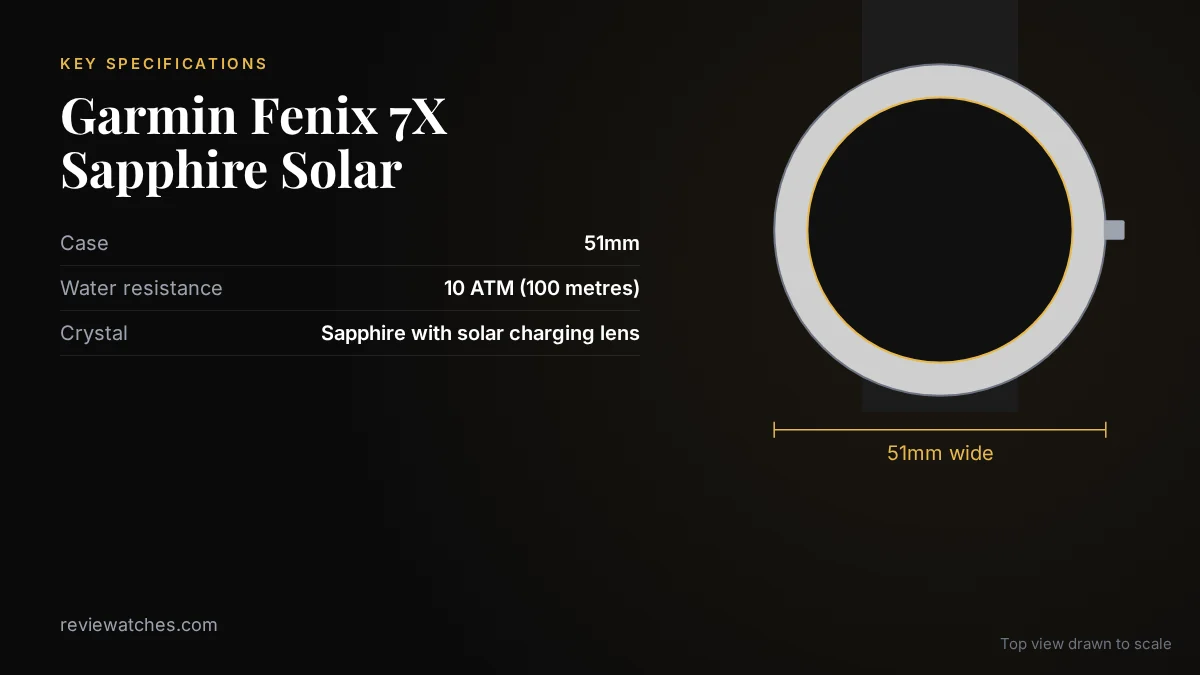
- Case
- 51mm
- Water resistance
- 10 ATM (100 metres)
- Often praised
- Exceptional battery life, especially with solar charging
- Common criticism
- Large and heavy, takes time to adjust to the size
📑 Table of Contents
The Garmin Fenix 7X Sapphire Solar is a serious piece of kit, and not an obvious purchase for someone who already owns a decent running watch and a smartphone with maps. Yet it has built a reputation as one of the best GPS sports watches on the market, and this article on the Garmin Fenix 7X Sapphire Solar looks at the specifications that go some way to explaining why.
According to Garmin's own material and the wealth of reviews and owner reports available, the Fenix 7X does enough well that it becomes hard to justify carrying separate devices for navigation, training and daily wear. This is a long article because this is a complicated watch. The short version: it looks like the best GPS sports watch currently available, but only if you'll actually use what makes it special.
Size and Build
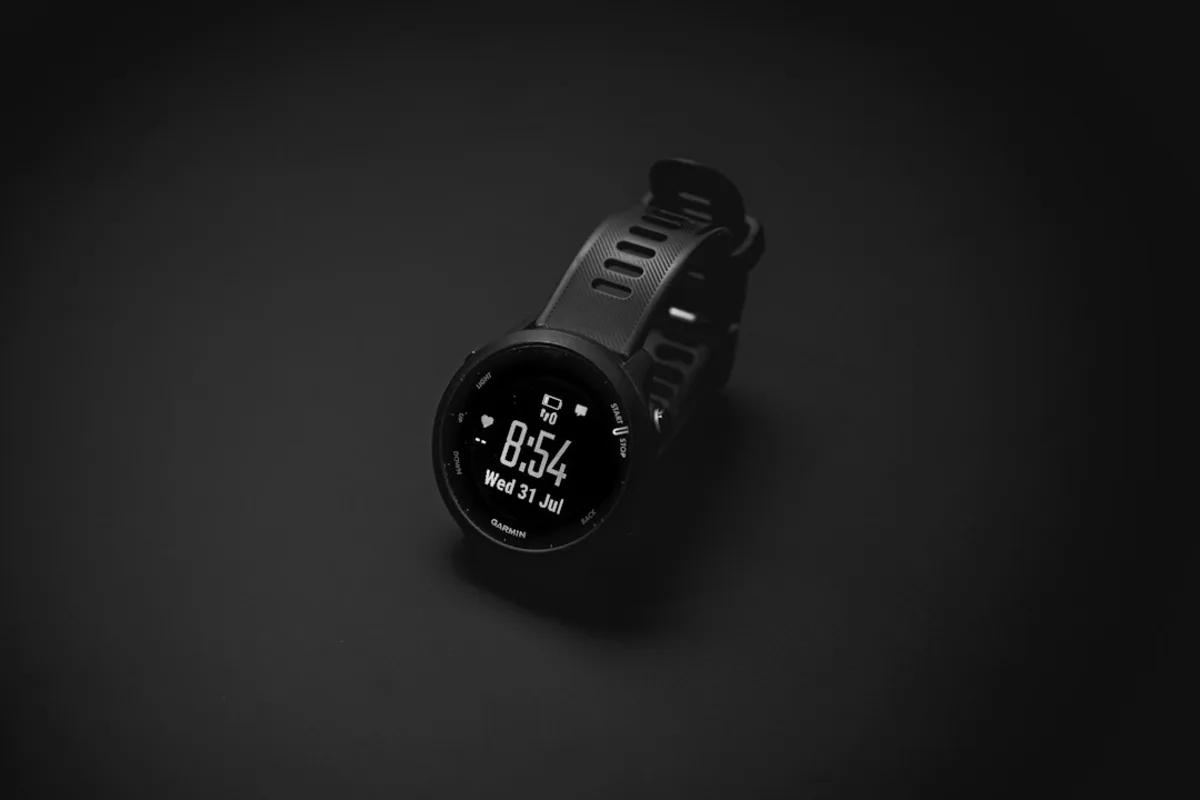
Let's not dance around it: at 51mm across, the Fenix 7X is a large watch, and it's not light either. Reviewers and owners frequently describe an adjustment period, with the size taking some getting used to, particularly for smaller wrists. It commonly takes around ten days of daily wear before the size stops feeling unusual, according to widely reported owner experience.
Garmin also sells a titanium bezel version that shaves off some weight, though the standard steel model discussed here carries a certain reassuring heft that suits its positioning as a tool watch rather than an everyday dress piece.
The sapphire crystal is widely reported to be highly scratch-resistant, a known property of sapphire compared with mineral glass, and owners commonly note that the case shows no visible marks even after knocks against door frames, rock and gym equipment during outdoor and fitness use. The solar charging lens sits beneath the sapphire and is essentially invisible unless you know to look for it, a detail that suggests Garmin has worked hard to keep the technology unobtrusive.
Solar Charging: Actually Useful, Not a Gimmick
Solar charging has a poor reputation among gadget owners, since many devices require direct equatorial sunlight to add any meaningful charge. According to Garmin's specifications, the Fenix 7X is different: it claims up to 37 days of battery life in smartwatch mode when solar charging is factored in.
The mechanism isn't designed to fully recharge the watch from solar alone. Instead, it extends what is already a strong baseline battery life. Reviewers in less sunny climates, including the UK, commonly report battery life noticeably longer than non-solar GPS watches, even if the full 37-day figure requires more consistent daylight than many users get. In GPS mode, Garmin lists up to 122 hours of battery life without solar, and considerably more with solar assistance, a figure that puts the 7X well ahead of most competitors for multi-day use without charging.
One recurring criticism in owner feedback is that the watch doesn't display a live readout of how much solar charge is actually being harvested in real time. There's a widget showing solar intensity, but it isn't especially granular, and a more detailed live reading would be a welcome addition.
Maps and Navigation: The Real Reason to Buy This
For anyone deciding between the 7X and the smaller Fenix 7 or 7S, the maps are the deciding factor. The larger screen makes topographic navigation genuinely usable, and the preloaded TopoActive maps are widely praised in reviews for hiking in unfamiliar terrain.
The touchscreen is reported to be responsive, and buttons remain available for use with gloves or in wet conditions, generally the preferred method among reviewers. Zooming and scrolling are described as smooth, closer to using a small phone screen than a typical GPS watch interface, without needing a phone signal.
Multi-band GPS (GPS + GLONASS + Galileo) is widely reported to lock on quickly, including in dense tree cover, and to hold a cleaner track than phone-based GPS in the same conditions according to various comparisons published by reviewers.
Turn-by-turn navigation works for routes pre-loaded or created on the watch, alerting the wearer at each turn. Some users note that routes based on OpenStreetMap data occasionally suggest paths that are technically rights of way but impractical on the ground, a limitation of the underlying map data rather than Garmin's software. A navigate-back-to-start feature, which retraces a breadcrumb trail, is commonly cited as a useful safety feature for anyone who loses their bearings.
Health and Training Metrics: Deep But Overwhelming
Garmin's health ecosystem is comprehensive by any measure: VO2 max estimates, training load, training status, recovery time, sleep tracking, pulse oximeter, stress tracking, body battery and menstrual cycle tracking are all included.
Serious athletes tend to rate the training load feature highly, since it tracks acute versus chronic load and flags when a user is pushing too hard or not hard enough. The recovery time advisor is generally considered accurate by reviewers, though it is also commonly reported that users override its recommended rest periods and later regret it.
VO2 max tracking is useful for spotting trends over time, though as with most wrist-based estimates, the absolute figure is considered less reliable than a lab test.
Sleep tracking is described as good, though not as detailed as a dedicated sleep tracker. It covers sleep stages and provides a sleep score, and many users report that the score correlates reasonably well with how rested they actually feel.
The sheer volume of data is also the most commonly cited drawback. New owners often report spending the first weeks exploring every widget and graph before settling into checking only a handful of key metrics, such as training load, recovery time and sleep score, and largely ignoring the rest.
Wearability and Daily Use
The Fenix 7X is designed for daily wear across gym sessions, running, hiking and swimming, rated to 10ATM water resistance. It's not a dress watch and doesn't try to be, and its size means it would sit awkwardly under a shirt cuff for formal occasions, as its published dimensions make clear.
The silicone strap that ships with the watch is generally well regarded for comfort and quick drying, though the lack of a quick-release strap system is a recurring complaint, since swapping straps requires tools rather than a simple push-button mechanism. Aftermarket nylon straps are a popular alternative for hot weather or hiking, according to owner discussions.
The watch face is highly customisable, with dozens of available data fields covering time, date, sunrise and sunset, training load, battery percentage and more, allowing each owner to configure a layout suited to their own priorities.
Notifications are widely reported to be reliable. Android users can send canned quick replies from the watch, a feature not available on iOS due to Apple's platform restrictions rather than any limitation on Garmin's part.
Where It Falls Short
No product is without flaws. The most commonly reported issues include the following.
The Garmin Connect app is cluttered. Reviewers and users frequently describe too many menus and tabs, and more scrolling than necessary to find key information. It's powerful, but often criticised as feeling like it was designed by committee, with rivals such as Strava's app seen as cleaner.
Syncing can be slow. Some users report occasional delays of up to around thirty seconds when syncing an activity to a paired phone, a minor but noticeable inconvenience.
The optical heart rate sensor is good, not great. It's considered accurate enough for most training, but a recurring criticism is that it lags during high-intensity interval work. Serious heart rate trainers are often advised to pair the watch with a chest strap, which it supports.
The price. This is an expensive watch by any standard. Garmin's RRP sits well above most competitors, and even discounted, it represents a significant outlay. Buyers who won't use the mapping and advanced training features are likely paying for capability they don't need, and the smaller, cheaper Fenix 7 or a Forerunner model may suit them better.
It's not elegant. Anyone wanting a watch that looks at home with a suit should look elsewhere. This is a tool, and it looks like one. That's fine if you accept the trade-off, frustrating if you were hoping for one watch to cover every occasion.
Who Should Buy This?
The Fenix 7X Sapphire Solar makes sense for:
- Trail runners and ultra-distance athletes who need serious battery life and GPS accuracy
- Hikers and mountaineers who want proper maps and navigation on their wrist
- Triathletes or multi-sport athletes tracking a dozen different activities
- People who do multi-day trips without easy access to charging
- Data nerds who want to track every possible health metric
It doesn't make sense for:
- Casual runners who just want basic stats and notifications (get a Forerunner 255 and save £400)
- People who don't go outside much (why pay for GPS and maps you won't use?)
- Anyone who wants a watch that looks good with formal wear
- People on a tight budget (this is not a cheap watch by any measure)
The Competition
The obvious alternatives: Apple Watch Ultra (if you're in the Apple ecosystem), Suunto 9 Peak Pro (lighter, less feature-dense), Coros Vertix 2 (better battery, fewer features), and Garmin's own Fenix 7 and 7S (smaller, cheaper, no maps).
The Apple Watch Ultra is the closest competitor for iPhone users. It has better app integration, a nicer screen, and is generally considered more attractive. But the battery life is worse even with low-power mode, the GPS accuracy is regarded as less consistent, and it doesn't have proper topographic maps. For serious outdoor athletes, the Fenix appears to win out.
Suunto and Coros make excellent watches, but Garmin's ecosystem is deeper, with more training metrics, better app integration and more third-party support. Anyone wanting simplicity might look at Suunto. Anyone wanting data should look at Garmin.
Final Thoughts
This has turned into a long piece, which says something about how much there is to cover with a sports watch like this. The Garmin Fenix 7X Sapphire Solar rewards the kind of deep dive it invites, and even after extensive research, it's clear this is a watch with more features than most owners will ever fully explore.
Is it the best GPS sports watch money can buy? Based on the specifications and the weight of reviewer and owner opinion, it looks that way for serious outdoor athletes. The battery life is unmatched by most rivals, the maps are genuinely useful according to widespread testimony, the training metrics are comprehensive, and the build quality holds up well by all accounts.
Is it worth the price? That depends entirely on whether the buyer will use what it offers. For someone running a few times a week and relying on a phone for directions, this is very likely overkill, and money is better spent on a Forerunner. But for multi-day hikes, ultra-distance events, trail running in unfamiliar terrain, or anyone wanting the best available tool for serious outdoor training, the Fenix 7X appears to justify its cost.
It's not an obvious purchase for most people. For the right user, though, it looks like one of the few watches capable of replacing several other devices at once.
⚙️ Specifications
✅ Pros
- +Exceptional battery life, especially with solar charging
- +Preloaded topographic maps with smooth touchscreen navigation
- +Multi-band GPS is fast and accurate, even in difficult terrain
- +Comprehensive training and health metrics for serious athletes
- +Genuinely scratch-resistant sapphire crystal
- +Water-resistant enough for swimming and water sports
❌ Cons
- −Large and heavy, takes time to adjust to the size
- −Garmin Connect app feels cluttered and overwhelming
- −Optical heart rate sensor can lag during high-intensity intervals
- −Expensive, especially if you won't use the maps and advanced features
- −Not suitable for formal or dress occasions
- −Strap changes require tools, no quick-release
Written by
RevieWatches Editorial Team
RevieWatches is an independent, informational watch site. We research specifications, track pricing across retail and grey markets, and summarise what published...
More in Sports Watches
What Is a Tool Watch? A Clear Definition
Tool watch is one of the most used and least defined terms in watch collecting. Here is what it actually means, and the features that separate a real tool from a watch that just looks like one.
Omega Speedmaster Moonwatch Buying Guide: Hesalite or Sapphire?
The Moonwatch has barely changed in decades, but the choice between versions still matters. Here is what separates the Hesalite and Sapphire Sandwich models, and the older calibres.
Rolex Explorer vs Explorer II: Which One Is for You?
They share a name, but the Explorer and Explorer II are very different watches. One is a pared-back three-hander, the other a 42mm GMT with a fixed 24-hour bezel.