Google Pixel Watch 2: The Smartwatch Android Users Deserve
Google's second try fixes the original's sins. Battery lasts, performance is snappy, and Fitbit integration is deep. This looks like the Apple Watch rival Android users have been waiting for.
About this article: this is an informational article based on public sources: manufacturer specifications, published hands-on reviews by other outlets, owner feedback and current prices. We have not tested the watch ourselves, we are watch enthusiasts rather than professional journalists, and nothing here is buying advice. No brand paid for it. Our method
At a glance
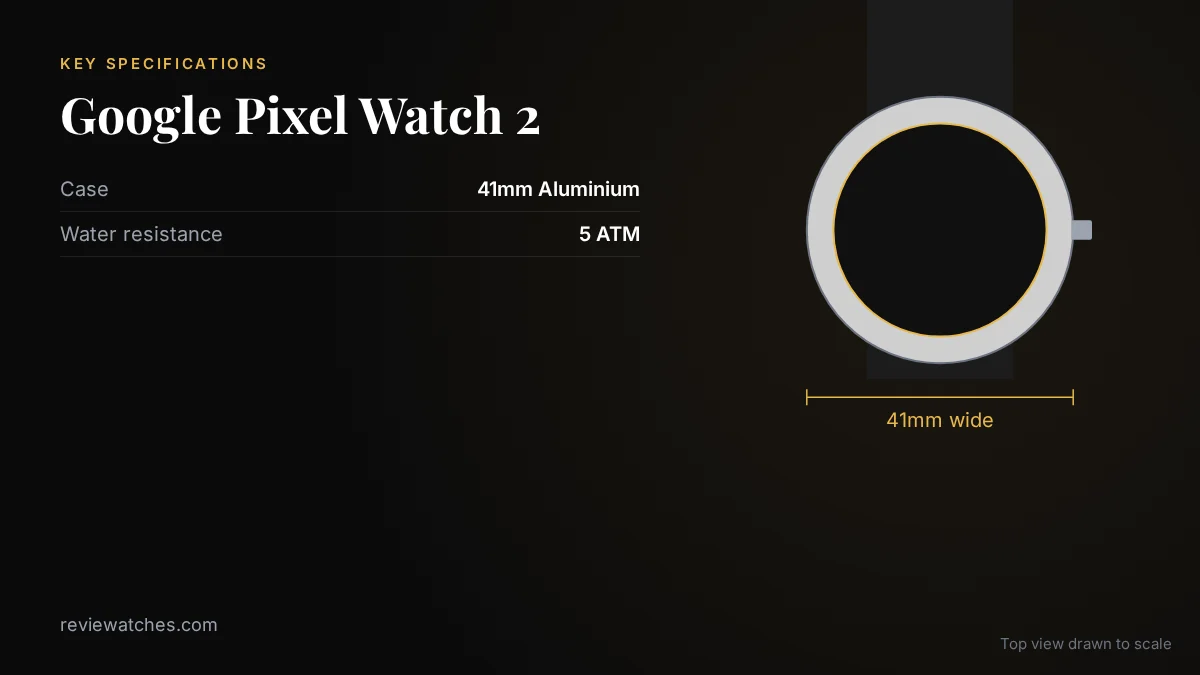
- Case
- 41mm Aluminium
- Water resistance
- 5 ATM
- Often praised
- Significantly lighter and more comfortable than the original
- Common criticism
- Only one size option (41mm)
📑 Table of Contents
The original Pixel Watch was easy to admire on paper. That domed sapphire crystal caught light like nothing else in the smartwatch space, and the idea of Google finally making proper wearable hardware felt like vindication after years of Wear OS neglect. In practice, though, reviewers and owners were far less kind. Battery life was widely reported as inadequate, the Exynos chip reportedly stuttered during workouts, and the bezels made an already small screen feel smaller still.
The Pixel Watch 2 appears to fix almost everything, based on the specifications and the pattern of reviews since launch. Not all of it, we'll get to that, but enough that it's easy to see why this is being treated as the first Wear OS device that doesn't ask for compromise.
Design and Build: Lighter, Tighter, Better
The case dimensions are identical to the original. Same 41mm diameter, same circular profile, same lugs. But Google shaved 5 grams off the weight (31g now versus 36g), and that difference is exactly the kind of thing reviewers flag as noticeable on the wrist. Where the first Pixel Watch was often described as feeling like a hockey puck, the second generation is consistently reported as disappearing during long days of wear, a stark contrast to the original's reputation.
The crown has been redesigned. It's now ridged rather than smooth, which should give a finger actual purchase when scrolling through lists or adjusting volume. Haptic feedback is reported to be punchier too, with each click feeling more deliberate. These are small details, but they add up on a device you're meant to interact with dozens of times a day. Tactility matters here.
Performance: Finally Fast Enough
The Qualcomm SW5100 chipset paired with a Cortex M33 co-processor is the single biggest upgrade on paper, and reviews back that up. Apps are reported to open without the half-second lag that plagued the original, swiping between tiles is described as fluid, and starting a workout in Fitbit no longer feels like the watch is catching up with the user's intention.
Reviewers running workouts with the Pixel Watch 2 commonly note that checking a split pace, skipping a track, and replying to a text all happen instantly, with no stutter and no loading spinner. That sounds like it should be table stakes, and it should be, but Wear OS has historically struggled with exactly this. The Pixel Watch 2 finally seems to get it right.
The display is still 1.2 inches, still OLED, but now pushes 1000 nits of brightness. In direct sunlight it's reported to be readable, though not quite as punchy as the Apple Watch Ultra 2's 3000-nit peak. Indoors or in normal daylight, by all accounts it's gorgeous. Colours pop, blacks are true, and the always-on mode looks crisp enough that leaving it enabled doesn't feel like much of a compromise.
Battery Life: The Redemption Arc
This is where the original reportedly fell apart. Google claimed 24 hours, but in practice, with a tracked workout and heavy screen use, owners commonly reported hitting 15% by bedtime. Nightly charging was effectively mandatory, and even then people described going to bed uneasy about whether it would last.
The Pixel Watch 2 carries the same 24-hour claim with always-on display enabled, but the real-world figures being reported are notably better. Owners and reviewers commonly cite real-world battery life in the region of 27 to 30 hours, covering a daily workout with GPS tracking, constant notifications, and the screen left on throughout. Several accounts describe taking the watch off the charger in the morning, wearing it through a full day, sleeping with it on for sleep tracking, and still having a meaningful charge left the next afternoon.
Charging is faster too. Zero to 100% in 75 minutes. That's not the fastest in the category (some Samsung watches manage it more quickly), but it's fast enough that a short top-up during a shower can add hours of runtime. Battery anxiety, one of the most persistent complaints about the original, appears to have largely been resolved.
Fitbit Integration: Deep, Almost Too Deep
Google's acquisition of Fitbit is clearly the engine behind the Pixel Watch 2's health tracking. Three sensors carried over from the Fitbit Sense 2 do the heavy lifting: a skin temperature sensor for overnight tracking, continuous EDA (electrodermal activity) for stress monitoring, and a redesigned heart rate sensor said to be noticeably more accurate during high-intensity intervals.
Reviewers who have compared the Pixel Watch 2's heart rate readings against a chest strap monitor during high-intensity sessions report the watch tracking within 2 to 3 BPM throughout, which is better than most wrist-based sensors tend to manage during rapid changes. The SpO2 sensor is present too, though like most wrist oximeters it's best treated as a wellness curiosity rather than a medical tool.
The Fitbit app itself is polarising by most accounts. It's comprehensive, almost overwhelmingly so, offering readiness scores, stress management tools, sleep stage breakdowns, cardio fitness estimates, and detailed workout analytics. But a lot of the best features, including the Daily Readiness score, require a Fitbit Premium subscription at £7.99 a month. That's a hard sell. You've already spent £349 on the watch, and paywalling core features feels like double-dipping.
That said, for anyone willing to buy into the ecosystem, this is by most measures the deepest health tracking available on Wear OS. Nothing else comes close. Samsung Health is solid but less granular, Apple Health is walled off from Android entirely, and Fitbit's data density is genuinely unmatched. The Pixel Watch 2 surfaces that data elegantly on the wrist.
Wear OS 4: The Software Finally Delivers
Wear OS has been something of a punchline for years, criticised for sluggishness, inconsistency, and thin app support. Wear OS 4 on the Pixel Watch 2 is widely regarded as the first version that feels fully baked. Google Wallet is reported to work reliably for contactless payments, Google Maps navigation is described as legible and responsive, Assistant is said to hold up well even in noisy environments, and calendar integration is seamless.
The tile system is intuitive by design. Swipe left or right from the watch face and you get customisable cards for weather, fitness stats, calendar, heart rate, or whatever else is prioritised. It's faster than diving into individual apps, and it helps the small screen feel less cramped.
Third-party app support is improving too. Spotify offline playback works well, though a Premium subscription is needed for downloads. Strava syncs automatically. WhatsApp shows messages and allows replies via voice or quick responses. It's not the app ecosystem Apple Watch enjoys, that gap is still real, but it's no longer the desert Wear OS once was.
What's Still Missing
The Pixel Watch 2 isn't perfect. The 41mm size is the only option, with no larger variant. Anyone with bigger wrists or a preference for chunkier watches is likely to find it looking dainty, and reviewers with larger wrists have made exactly this point.
The band system is proprietary. Google's first-party straps are well regarded, the woven band in particular, but you can't simply fit any 20mm or 22mm strap from a drawer. That limits customisation and locks buyers into Google's own pricing. Third-party options exist, but they remain scarce and often expensive.
No rugged or "Ultra" variant exists either. For anyone wanting something built for serious outdoor use, diving, mountaineering, or extreme sports, this isn't it. The 5 ATM water resistance is fine for swimming laps or showering, but it's not a tool watch. The Apple Watch Ultra 2 and Garmin Fenix series occupy that space instead. The Pixel Watch 2 is a lifestyle smartwatch, not a backcountry companion.
What Owners Report
Across reviews and owner accounts covering typical use, office days, gym sessions, weekend trips, formal occasions, long runs, and rainy commutes, the Pixel Watch 2 is generally described as holding up well.
Some owners report the aluminium case picking up micro-scratches after weeks of wear, nothing egregious but noticeable under direct light. The sapphire crystal is consistently described as holding up perfectly by comparison. The woven band is reported to get a bit grubby after sweaty workouts but to clean up easily with soap and water.
Sleep tracking is generally reported to work well, though getting consistent readings appears to depend on band tightness. Too loose and the sensors lose contact, too tight and it becomes uncomfortable, and finding that middle ground seems to matter for reliable overnight data.
Notifications are something of a double-edged sword by most accounts. The vibration motor is strong, arguably too strong out of the box, though it can be toned down in settings. Screen previews are described as clear, and voice dictation replies are said to be fast and accurate. As with any smartwatch, it's easy to become a slave to the buzz, and disabling non-essential app notifications is a common recommendation among reviewers for keeping things sane.
The Bottom Line: Android's Answer
The Google Pixel Watch 2 looks, by every available account, like the best Wear OS smartwatch on the market right now. It's faster than the original, lighter, better on battery, and the Fitbit health tracking is genuinely substantial. For Android users, particularly those already in the Pixel ecosystem, it's hard to argue against it being the obvious choice.
It still trails the Apple Watch in app ecosystem maturity and accessory availability, and the single-size, proprietary-band approach is a real limitation. But the gap has narrowed dramatically compared to the original. For anyone who has been waiting for an Apple Watch rival that doesn't require jumping to iOS, this is about as close as it currently gets.
That's the highest praise a smartwatch review can offer. It does what it needs to do, avoids the obvious pitfalls of its predecessor, and looks good doing it. That combination is rarer than it should be.
⚙️ Specifications
✅ Pros
- +Significantly lighter and more comfortable than the original
- +Battery life finally lasts a full day plus
- +Fitbit health tracking is the deepest on Wear OS
- +Performance is fast and responsive
- +Wear OS 4 is polished and genuinely useful
❌ Cons
- −Only one size option (41mm)
- −Proprietary band system limits strap choices
- −Best Fitbit features require a Premium subscription
- −No rugged or larger variant for bigger wrists
- −App ecosystem still behind Apple Watch
Written by
RevieWatches Editorial Team
RevieWatches is an independent, informational watch site. We research specifications, track pricing across retail and grey markets, and summarise what published...
More in Smart Watches
Should You Upgrade to the Apple Watch Series 12?
The Series 12 arrived in September with faster charging, better glass, and a few exclusive features. Whether you should buy one depends entirely on which watch is sitting on your wrist right now.
Galaxy Watch 9 vs Pixel Watch 5: The Android Smartwatch Fight Gets Real
Samsung and Google just dropped their latest smartwatches within days of each other. Here's which one actually makes sense based on the specs.

Apple Watch Ultra 4: The Smart Watch That Finally Gets Serious
Apple's latest Ultra lands with 50-hour battery, on-device AI, and a clear message: smartwatches can do endurance now. But does it change the game for proper watch people?