TAG Heuer Carrera: The Chronograph That Finally Gets It Right
After years of wandering, TAG Heuer's new Carrera returns to Jack Heuer's 1963 vision. Here's a close look at the 39mm Calibre TH20-00 version and what actually matters.
About this article: this is an informational article based on public sources: manufacturer specifications, published hands-on reviews by other outlets, owner feedback and current prices. We have not tested the watch ourselves, we are watch enthusiasts rather than professional journalists, and nothing here is buying advice. No brand paid for it. Our method
At a glance
- Case
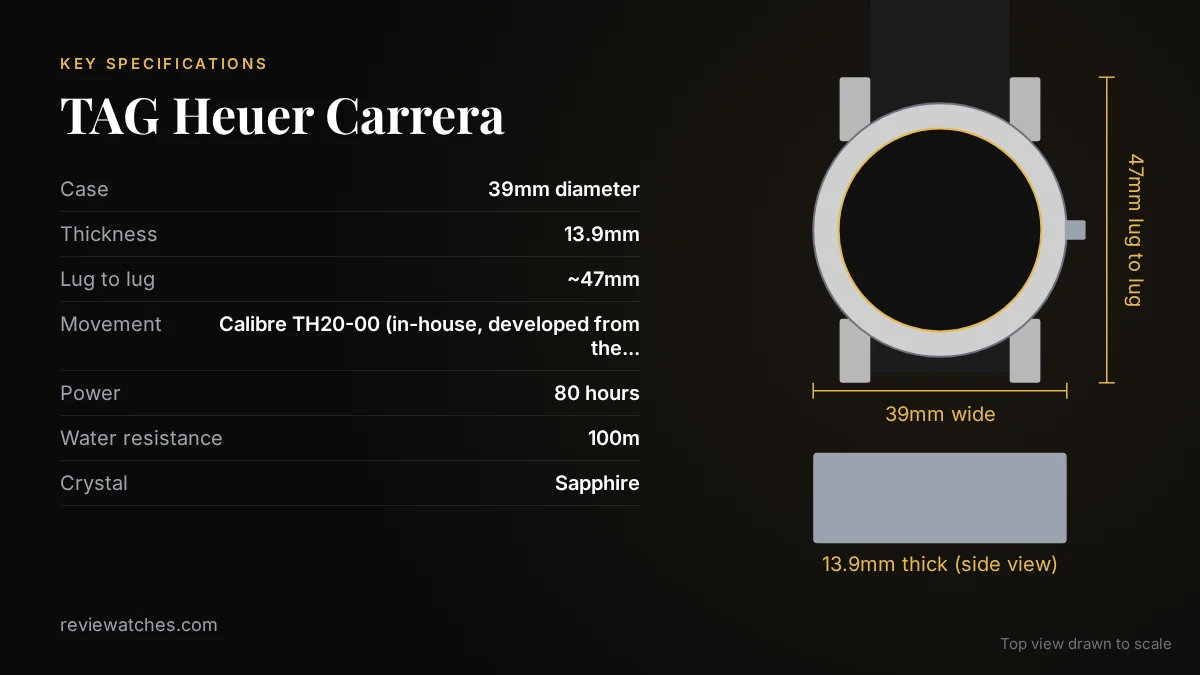
- 39mm diameter
- Thickness
- 13.9mm
- Movement
- Calibre TH20-00 (in-house, developed from the Heuer 02)
- Power
- 80 hours
- Water resistance
- 100m
- Often praised
- Perfect 39mm size wears well across wrist sizes
- Common criticism
- Non-screw-down pushers limit water resistance to 100m
📑 Table of Contents
TAG Heuer has cycled through several Carrera reinterpretations over the years, and few of them have settled the argument about what the model is supposed to be. Too big, too busy, too many design committees involved, according to plenty of long-time critics. So when TAG announced it was going back to the original 1963 Carrera blueprint, scepticism was the reasonable response for this article on the TAG Heuer Carrera. We've heard "back to basics" before.
But this one's different. Genuinely different.
The new Carrera chronograph with the in-house Calibre TH20-00 looks, on the specifications and in photographs, like the most coherent Carrera TAG has produced in years. It's 39mm across, 13.9mm thick, and the numbers suggest a watch designed by someone who understands how a chronograph actually sits on a wrist rather than one drawn purely for a press release.
What Jack Heuer Got Right in 1963
The original Carrera (reference 2447, if you're keeping score) was designed for racing drivers. Not "inspired by motorsport" in that vague marketing way. Actually designed for people timing laps while fighting a car through corners. That meant legibility first, flash second.
Jack Heuer kept it simple: two sub-dials, big numerals, high contrast. No tachymetre bezel fighting for attention. No date window interrupting the dial symmetry. Just the information you need, presented clearly enough to read at a glance.
This new version keeps that discipline. The dial is available in white or black; this article focuses on the white version. Two sub-dials at 3 and 9. Running seconds at 9, 30-minute chronograph counter at 3. Applied indices and numerals. It's clean in a way modern watches rarely manage.
The Movement: TH20-00 (AKA Sellita With Ambition)
Let's address the elephant first. The Calibre TH20-00 is TAG Heuer's in-house automatic chronograph movement, developed from the Heuer 02. TAG calls it "in-house" because it has added its own column-wheel chronograph module on top and finishes it in-house. Purists will scoff. Fine, scoff away.
Here's what matters: according to the specifications, it should work beautifully. The chronograph action is built around a column wheel, which typically gives that mechanical snick when the pushers are engaged, and the claimed 80-hour power reserve means the watch should still be running after sitting unworn over a weekend.
Plenty of watches with fully in-house movements have disappointed on feel, and plenty of Sellita- or ETA-based movements have impressed in practice. The base calibre isn't the whole story. What TAG appears to have done here is take a proven workhorse and add the elements that make a chronograph feel special. The pushers are reported to have genuine travel and feedback, without mush or crunch.
And at $6,450, this isn't Rolex Daytona money. If it carried a completely proprietary movement, the price would likely sit closer to $10k. Building on a Sellita base looks like a reasonable trade if it keeps the watch within reach.
Size and Wearability
For years, brands have released 38-40mm "vintage-sized" watches that still wear large because they're thick as bricks or fitted with oversized lugs. On paper, the Carrera avoids both traps.
At 39mm and 13.9mm thick, the case dimensions suggest it should sit neatly under a shirt cuff and work equally well dressed up or down. Lug-to-lug is about 47mm, a figure that should suit a wide range of wrist sizes without noticeable overhang. Good proportions at this size tend to scale well across different wrists rather than looking tiny or cartoonish, and the reported dimensions here point in that direction.
The height is especially notable for a chronograph. The Omega Speedmaster Professional, for comparison, is 13.2mm, and that's a hand-wound movement with no date. Fitting an automatic column-wheel chronograph with an 80-hour power reserve into 13.9mm is a genuine engineering achievement.
The Dial: Where TAG Remembered They Can Design
This is the most restrained TAG Heuer dial in years. No busy sub-registers, no overlapping text, no random pops of colour that don't mean anything. Just white lacquer, black printing, polished applied indices.
The sub-dials are finished with a sunray pattern that should catch light differently to the main dial, adding some depth. The chronograph hand is black with a red tip (this is still TAG Heuer, after all, there has to be one bit of red), and the running seconds hand matches.
Based on the specifications and photographs, legibility should be strong across lighting conditions, from artificial light indoors to bright sun outdoors to dimmer settings. The hands appear to carry enough mass to stand out from the dial, and the lume looks sufficient for practical use, though this isn't a watch built for serious night diving.
The date window at 6 o'clock is a pleasant surprise on paper. Symmetrical dials are usually undermined by a date window, but TAG has positioned it between the sub-dial and the base of the case, printed white-on-white, so it should fade into the background rather than dominate.
The Bracelet
The Carrera comes on a three-link steel bracelet with polished centre links and brushed outers. It appears well made, with solid end links and a reasonable taper. The clasp has a push-button release and basic micro-adjustments.
It's easy to imagine plenty of owners swapping it for a dark brown leather strap. Not because the bracelet looks bad, but because the watch seems to suit its vintage racing character more on leather than as a modern tool watch on steel. A 19mm strap would work well with the 20mm lugs if a slight taper is preferred.
If you're a bracelet person, you should be happy with what TAG supplies. If you're a strap person, budget another £150 for something good. This watch seems to deserve real leather rather than a bargain-bin strap.
What Owners Report
Discussion around this generation of Carrera tends to focus on how usable the chronograph function feels day to day, rather than it being a party trick used once and forgotten. The column-wheel action is reportedly satisfying enough that owners find themselves reaching for the pushers more than expected.
The 80-hour power reserve is repeatedly flagged as a genuine quality-of-life feature for anyone rotating between several watches, since it should keep running through a weekend off the wrist.
The size is also cited as the main reason this Carrera works as an everyday watch in a way larger chronographs don't. Staying close to the wrist means less worry about knocks and catches.
On the downside, the pushers sit well at 2 and 4 but aren't screw-down, which caps water resistance at 100m. That's fine for daily wear but rules out swimming. TAG has presumably prioritised a slim case over screw-down pushers, a reasonable trade but worth knowing before buying.
Lume performance is described as adequate rather than exceptional, offering a few hours of usable glow. That's fine for checking the time at night but not built for serious low-light use, and again, this isn't marketed as a dive watch.
The Competition: Where ,450 Gets You
At this price, the Carrera is shopping against the Omega Speedmaster Professional (smaller-looking on paper, hand-wound, more history), the Tudor Black Bay Chrono (bigger, more rugged, in-house movement), and the Breitling Premier B01 (similar size, a true in-house calibre, but a higher price).
The Speedy is the default answer, and by most accounts it's a brilliant watch. But it's also 42mm and quite tall with the hesalite crystal. For smaller wrists or a dressier remit, the Carrera makes more sense on paper.
The Tudor is excellent value, but at 41mm it wears bigger than the numbers suggest, closer to a sport watch than a daily elegant option.
The Breitling Premier B01 is probably the closest rival: similar size, similar aesthetic goal (a vintage racing chronograph with modern reliability). The B01 movement is fully in-house, which will matter to some buyers. But it costs £7,400, and it's hard to see it being that much better on the wrist.
The Carrera slots into a sweet spot: proper chronograph, proper size, proper design, at a price that doesn't require selling a kidney.
What TAG Got Wrong (And What They Got Really Right)
The case back could be more interesting. It's solid steel with minimal engraving. Exhibition case backs add thickness, and a Sellita-based movement isn't the prettiest thing to display, but even some vintage-style engraving would add character.
TAG could also have shown more confidence by dropping some of the text from the dial. The applied TAG Heuer signature at 12 is fine, but the printed "Swiss Made" at 6 and the small "Automatic Chronograph" text above it feel like they're justifying themselves. The original 2447 simply said "Heuer" and trusted the wearer to know what it was.
Those are minor complaints. What TAG got right is the fundamentals. This watch appears properly sized, well finished (the polishing on the chronograph pushers stands out in official photos), and genuinely engaging to use rather than a mere design exercise. It doesn't feel like a watch shaped by committee trying to please everyone. It reads as though someone set out to make a good Carrera and succeeded.
Should You Buy One?
If you want a chronograph that wears like a daily watch rather than a statement piece, yes. If you've got smaller wrists and find most modern chronographs unwearable, yes. If you appreciate vintage design executed with modern reliability, yes.
If you're a movement purist who only wants fully in-house calibres, probably not. If you need screw-down pushers and serious water resistance, look at dive chronographs instead. If you want the cachet of Omega or Rolex, you already know the answer.
This is the first TAG Heuer in years that seems worth recommending without heavy caveats. TAG appears to have remembered what made the Carrera special in the first place, and the result looks like a watch that earns its wrist time.
⚙️ Specifications
✅ Pros
- +Perfect 39mm size wears well across wrist sizes
- +Clean, legible dial design faithful to 1963 original
- +In-house TH20-00 movement with an 80-hour power reserve
- +Crisp column-wheel chronograph action
- +Slim 13.9mm profile for a chronograph
- +Strong value at $6,450 compared to competitors
❌ Cons
- −Non-screw-down pushers limit water resistance to 100m
- −Domed crystal can catch reflections at some angles
- −Lume performance adequate but not exceptional
- −Bracelet is good but not exceptional for the price
Written by
RevieWatches Editorial Team
RevieWatches is an independent, informational watch site. We research specifications, track pricing across retail and grey markets, and summarise what published...
More in Sports Watches
What Is a Tool Watch? A Clear Definition
Tool watch is one of the most used and least defined terms in watch collecting. Here is what it actually means, and the features that separate a real tool from a watch that just looks like one.
Omega Speedmaster Moonwatch Buying Guide: Hesalite or Sapphire?
The Moonwatch has barely changed in decades, but the choice between versions still matters. Here is what separates the Hesalite and Sapphire Sandwich models, and the older calibres.
Rolex Explorer vs Explorer II: Which One Is for You?
They share a name, but the Explorer and Explorer II are very different watches. One is a pared-back three-hander, the other a 42mm GMT with a fixed 24-hour bezel.