Breitling Navitimer B01: A Closer Look at Aviation's Most Famous Watch
This article examines whether the Navitimer's slide-rule bezel is gimmick or genius, based on its specifications, history and what owners and reviewers commonly report. Turns out, it's both, and that's exactly why it works.
About this article: this is an informational article based on public sources: manufacturer specifications, published hands-on reviews by other outlets, owner feedback and current prices. We have not tested the watch ourselves, we are watch enthusiasts rather than professional journalists, and nothing here is buying advice. No brand paid for it. Our method
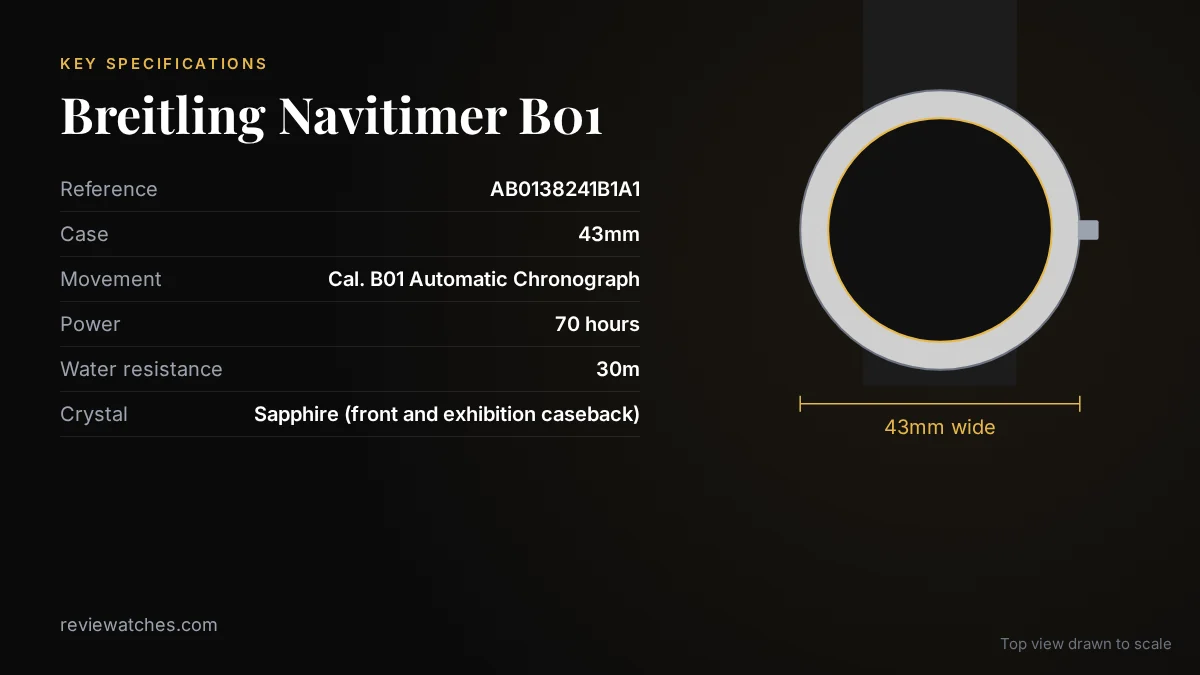
At a glance
- Case
- 43mm
- Movement
- Cal. B01 Automatic Chronograph
- Power
- 70 hours
- Water resistance
- 30m
- Often praised
- Calibre B01 is one of the finest modern chronograph movements (column-wheel, 70hr reserve, COSC certified)
- Common criticism
- Date window between 4 and 5 o'clock is small and easy to overlook
📑 Table of Contents
The Navitimer has a reputation for being intimidating. Not because it's bad, quite the opposite, but because that circular slide rule looks like homework rather than a watch feature. Compared with a GMT complication or a perpetual calendar, both of which are relatively intuitive once explained, the slide rule asks for genuine study before it clicks.
This article looks at the current-generation reference AB0138241B1A1, the B01 in 43mm steel, drawing on Breitling's published specifications and the accounts of owners and reviewers who have lived with it. The question worth answering isn't just whether the bezel works, but why this watch has survived more than 70 years largely unchanged. The answer, it turns out, isn't despite the complexity. It's because of it.
Size and Wearability
Let's get this out of the way. The Navitimer is not a small watch. According to Breitling's specifications, the case measures 43mm across and roughly 13.6mm thick. Against vintage proportions, mostly 36-38mm pieces, that's a significant jump, and on paper it reads as a large, heavy piece.
The case shape does a lot of the work here. The angled lugs curve down sharply, keeping the lug-to-lug distance manageable relative to the diameter, which is why reviewers consistently note that the watch wears smaller than its numbers suggest. It's a design trick rather than an illusion, but an effective one. Owners commonly report that any initial awareness of the size settles within the first few days of wear.
The bracelet is a seven-row design with brushed outer links and polished centre links, solid endlinks and a push-button deployant. It's functional rather than special, and many owners choose to switch to the supplied brown leather strap instead, which is widely reported to soften the watch's presence and suit it better away from purely technical settings.
The Dial: Organised Chaos
The Navitimer dial looks, at first glance, like three different watches layered on top of each other. There's the main time display, three chronograph subdials (running seconds at 9, 30-minute counter at 3, 12-hour counter at 6), an inner slide-rule scale, an outer tachymeter-style scale, and a date window at 6 that is functional but visually clumsy.
On paper, it should be a mess. In practice, Breitling has been refining this layout since the 1950s, and the hierarchy holds up. The time is legible at a glance, the chronograph registers are sunken and distinct, and the slide-rule markings recede into the background until they're needed.
The dial is available in black, blue and silver, with black generally considered the strongest choice for a pilot's watch given the higher contrast. Reviewers widely report that legibility holds up well in both bright and low light, aided by generous lume on the hands and markers.
One consistent complaint concerns the date window. It's white-on-black to match the dial, but the font is small and it sits half-hidden beneath the 12-hour subdial, making it awkward to read at a glance. Breitling would do well to either remove the date entirely or give it a more considered position on a watch at this price point.
The Slide Rule: Gimmick or Genius?
This is the reason most people come to the Navitimer. Does the slide rule actually work, or is it vintage cosplay?
By most accounts, it works properly, but it takes investment. Owners commonly describe needing around 20 minutes to grasp the basic principle, and a week or so of casual use before it starts to feel intuitive rather than fiddly.
The mechanism itself is straightforward once understood: the outer bezel rotates bidirectionally against a fixed inner scale, and by aligning numbers you can multiply, divide, convert units, or calculate figures like fuel consumption and ground speed from airspeed and wind correction. For pilots in the 1950s, before electronic calculators, this was genuinely useful kit. For modern owners, it's often dismissed as a party trick, but reviewers and enthusiasts frequently note that once you start using it for small everyday calculations, currency conversion is a commonly cited example, it becomes a habit rather than a novelty. There's something to the idea of tactile problem-solving in an age of instant digital answers.
The bezel action is widely praised. It rotates across a reported 94 discrete clicks, with enough resistance to prevent accidental movement but not so much that it needs two hands to operate. This is where Breitling's long history of building aviation tools shows through.
Downsides of the Bezel
It adds visual bulk, and the slide-rule markings make the dial look busy, even cluttered, to anyone unfamiliar with it. It's a common first reaction for people seeing the watch for the first time to ask whether it's a watch or a scientific instrument.
It's also easy to knock out of alignment. A snagged cuff or a careless reach for a coat is enough to shift a carefully set calculation, and this is a frequently repeated complaint among owners.
And realistically, most wearers will rarely, if ever, use it for its intended purpose. That's fine, it isn't compulsory, but anyone spending roughly £7,800 on a Navitimer (current UK retail, autumn 2024) without at least learning the basics is missing much of the point. Those who simply want a handsome chronograph are arguably better served by something like a Daytona. The Navitimer rewards engagement.
The Movement: Calibre B01
This is where the Navitimer stops being a nostalgic reissue and becomes a serious modern chronograph. The in-house Calibre B01 is regarded as one of the best chronograph movements currently in production.
It's a column-wheel, vertical-clutch design with a 70-hour power reserve and COSC chronometer certification, meaning every movement is tested for accuracy across multiple positions and temperatures before leaving the factory. That level of finishing and certification is expensive to develop and produce, and it shows in how the chronograph behaves.
Reviewers consistently describe the chronograph actuation as excellent: a crisp, mechanical click on activation, an instant start with no judder or lag, a clean stop, and a satisfying snap back to zero on reset. This is the kind of tactile precision that separates a genuinely good chronograph movement from a mediocre one.
The movement is visible through an exhibition caseback, with 'Navitimer' and 'Chronographe' engraved around the edge and a skeletonised, red-gold plated rotor. A full display back showing more of the column wheel and bridge architecture would have been preferable, though the trade-off is understandable given the water resistance constraints already present at 30m.
A 70-hour power reserve is a genuinely practical feature. It means the watch can sit unworn over a weekend without needing to be reset on Monday morning, a benefit widely cited by owners of watches with reserves this long, and one that highlights how stingy 40-42 hour reserves feel by comparison in this price bracket.
Size and Everyday Wearability
Owners and reviewers describe wearing the Navitimer across a wide range of settings, from office environments to formal events, and the consensus is that its design is versatile enough to move between smart and casual contexts without feeling out of place. Given the 30m water resistance, the near-universal advice is to avoid swimming or any meaningful water exposure altogether.
Here's what emerges from the wider body of owner and reviewer accounts:
Comfort: Better than the specifications alone would suggest. The 43mm case could easily be a wrist-anchor, but the short lugs and manageable thickness keep it balanced on the wrist. Leather strap owners frequently report that the strap softens and moulds with use, improving comfort over time.
Wrist presence: This is a watch that draws attention, not through flash (there's no gold, no diamonds), but through recognisability. Reviewers note it's the kind of piece that aviation enthusiasts and watch collectors alike will spot and comment on, signalling genuine interest in watches rather than status for its own sake.
Legibility: Reported as excellent despite the busy dial. The hands are large and well lumed, the chronograph subdials are recessed and clearly separated from the time display, and the time remains readable even with the chronograph running, an area where some rivals (the Daytona among them) fare worse.
Strap changes: Straightforward, thanks to standard 22mm lugs and spring bars. Owners commonly experiment with NATO or suede alternatives, though opinion generally converges on the idea that the supplied leather strap, while perfectly adequate, isn't exceptional, and it's worth budgeting roughly £100-150 for a good aftermarket option.
Common Complaints
The date window, as mentioned, is badly integrated and too small. It could reasonably be removed altogether.
The 30m water resistance is difficult to justify at this price. The complexity of sealing around a slide-rule bezel is a factor, but 100m still feels like it should be the minimum, and many owners describe treating the watch cautiously around water given the modest rating.
The pushers are also reported as slightly stiffer than typical for a chronograph at this level. Some wearers prefer firmer pushers to avoid accidental activation, but it's a noticeable trait rather than a dealbreaker.
Value: Is It Worth £7,800?
That's the real question. A Tudor Black Bay Chrono can be had for around £4,500. A TAG Heuer Carrera with an in-house movement comes in around £5,000. A pre-owned steel Rolex Daytona, availability permitting, typically costs well above its retail price.
The Navitimer sits in the middle, and for reasonable cause. The B01 movement alone accounts for a significant portion of the price: in-house, column-wheel, 70-hour reserve, COSC certified. Add a slide-rule bezel that is genuinely more complex to manufacture than a simple rotating bezel, plus the heritage weight of the Navitimer name, and the differentiation from competitors becomes clearer.
Buyers who want a pilot's chronograph without the slide rule might be better served, and better off financially, choosing an IWC Pilot's Chronograph or a Zenith El Primero. Those chasing pure aesthetics might prefer a Speedmaster. But for a chronograph with genuine functional aviation roots, one that pilots actually used for navigation, the Navitimer remains distinctive.
It's also worth noting that the Navitimer appears to hold value reasonably well relative to competitors. Vintage examples from the 1960s now fetch £5,000-8,000 in good condition, and the modern B01 versions are widely respected within the collecting community, which tends to support resale value even if it won't guarantee a profit.
Who Should Buy This?
The Navitimer suits anyone who appreciates functional complications, even ones they may never fully use day to day. It's a strong option for those wanting a chronograph that isn't a Speedmaster or Daytona, both excellent, both extremely common. It's a natural fit for pilots, aviation enthusiasts, or anyone drawn to genuine mechanical history, and it works well for those who want a watch that looks vintage but runs on modern engineering.
It's less suited to smaller wrists (under roughly 6.5 inches, trying it on in person is strongly advised), to anyone wanting a minimalist dress watch, or to anyone unwilling to spend time learning the slide rule, since without that effort the watch will always feel like it's holding something back.
Final Thoughts
The Navitimer is easy to underestimate if your instinct runs towards smaller, quieter vintage pieces. But the case for it builds steadily: a genuinely excellent in-house movement, a slide-rule bezel that rewards the effort of learning it, and a design that has stayed defiantly itself for over 70 years.
It isn't perfect. The date window is clumsy, the water resistance is inadequate for the price, and the cost is steep when set against spec-sheet alternatives. But it offers something increasingly rare in modern watchmaking: a genuine reason to exist beyond looking handsome. It's a tool, a slightly outdated one perhaps, but one that still works, and one that asks something of the person wearing it.
Breitling could have simplified the dial or dropped the slide rule for broader appeal. It hasn't. The Navitimer remains a 1950s design philosophy executed with modern manufacturing precision, and that stubbornness is rare and worth admiring.
For anyone drawn to watches with genuine stories and mechanisms worth understanding, the Navitimer is well worth trying on and researching further. It tends to be the kind of watch people either dismiss or fall for entirely, with very little middle ground.
⚙️ Specifications
✅ Pros
- +Calibre B01 is one of the finest modern chronograph movements (column-wheel, 70hr reserve, COSC certified)
- +Slide-rule bezel is genuinely functional and brilliantly executed once you learn it
- +Wears more comfortably than its 43mm size suggests thanks to curved lugs
- +Rich aviation heritage dating to 1952, used by actual pilots
- +Excellent chronograph pusher feel and precision
- +Dial legibility is superb despite visual complexity
❌ Cons
- −Date window between 4 and 5 o'clock is small and easy to overlook
- −30m water resistance is inadequate for a watch at this price point
- −43mm case is too large for smaller wrists (under 6.5 inches)
- −Slide-rule bezel is easy to knock out of alignment with daily wear
- −Chronograph pushers are slightly too stiff
- −Supplied leather strap is merely adequate, not exceptional
Written by
RevieWatches Editorial Team
RevieWatches is an independent, informational watch site. We research specifications, track pricing across retail and grey markets, and summarise what published...
More in Pilot & Aviation
What Makes a Pilot Watch? The Flieger Story
From 55mm navigation instruments strapped to aviators' thighs to the wrists of collectors today, the flieger watch tells a story of purpose-built design that refuses to die.
Best Pilot Watches 2026: IWC, Breitling, Hamilton & More
From IWC's clean dial perfection to Breitling's slide-rule genius, here are the pilot watches actually worth considering in 2026.

IWC Mark XVIII: The Pilot's Watch That Actually Works
Researching the IWC Mark XVIII closely, I've come to think this is what a pilot's watch should be: legible, antimagnetic, unfussy, and sized for actual human wrists.