GMT vs Worldtimer vs Dual Time: Which Travel Watch Do You Actually Need?
Three complications, three very different jobs. Here's how to work out whether you need a GMT, a worldtimer, or a simple dual time watch, and how much each one actually costs to get right.
About this article: this is an informational article based on public sources: manufacturer specifications, published hands-on reviews by other outlets, owner feedback and current prices. We have not tested the watch ourselves, we are watch enthusiasts rather than professional journalists, and nothing here is buying advice. No brand paid for it. Our method
📑 Table of Contents
People throw the word "GMT" around like it means any watch with an extra hand, and that's where most of the confusion starts. The GMT vs worldtimer vs dual time question really comes down to this: a true GMT, a worldtimer and a dual time watch all solve the same basic problem, knowing what time it is somewhere else, but they solve it in different ways, for different kinds of traveller, at wildly different price points. Pick the wrong one and you'll either overpay for a party trick you never use, or underbuy and end up doing mental arithmetic at 2am in a hotel room anyway.
So let's sort out what each complication actually does, because the marketing copy rarely bothers to explain it properly.
Dual Time: the simple one
A dual time watch is exactly what it sounds like. You get a second, independent hour hand (sometimes a small sub-dial instead) set to a different time zone from the main display. That's it. No fancy bezel, no 24-hour scale to decode, just a second hour hand you set once and largely ignore.
The appeal here is simplicity. If you live in London and your partner, your office, or your favourite football team's kick-off times are all in New York, you set the second hand to Eastern Time and never think about it again. No bezel to rotate, no risk of misreading a 24-hour track at a glance.
The limitation is equally obvious. A basic dual time only tracks two zones. Fly somewhere else and you're back to doing sums, or resetting a hand that's genuinely awkward to adjust on plenty of movements because it's not designed for quick, frequent changes. It's a watch for people who commute mentally between two specific places, not people who actually hop across the planet every few weeks.
GMT: the traveller's tool, if you use it properly
This is the one everyone's heard of, largely thanks to Rolex, and it's also the most misunderstood. A proper GMT watch has three things working together: a normal hour and minute hand, a fourth hand that completes one full rotation every 24 hours, and a rotating bezel marked with a 24-hour scale.
Here's where it gets genuinely useful, and also where most owners never bother learning the trick. On a true GMT with an independently adjustable hour hand, you can set your local hour hand to whatever time zone you've just landed in without touching the minute hand or the 24-hour hand at all. The 24-hour hand still points at home time (or a third zone, via the bezel), the local hour hand jumps forward or back in one-hour clicks. Land in Tokyo after a flight from London, spin the hour hand forward eight or nine hours, depending on the season, and you're done. No stopping the watch, no resetting the date awkwardly at midnight.
This independently-adjustable hour hand is sometimes called a "true GMT", "flyer" or "traveller" GMT, as opposed to an "office" or "caller" GMT, where the 24-hour hand is the one that moves independently and the main hands stay locked together. Office GMTs are cheaper to produce and still show a second time zone, but they don't offer that painless jump-hour trick, so you're stuck doing more manual adjustment when you actually change zones.
Rolex popularised the format decades ago for airline pilots, and it's why the GMT-Master line still trades at a premium over an equivalent Submariner despite sharing so much of the same case and bracelet architecture. But GMTs aren't a Rolex exclusive by any means. You'll find genuine, well-executed GMT movements from Tudor's Black Bay GMT, various Seiko and Grand Seiko references, and increasingly in the budget space too. A Seiko 5 Sports GMT, for instance, brings the complication down to a price bracket that would have been unthinkable a decade ago, even if the finishing and bezel action naturally can't match a Swiss movement three or four times the cost.
The real-world limit of a GMT is that it comfortably handles two zones (home and local) with a third loosely trackable via the bezel if you do the maths yourself. Fine for someone who splits their life between two or three specific places. Less elegant if you're the sort who lands in a different country every other week and wants an instant global picture.
Worldtimer: showing off all 24 zones at once
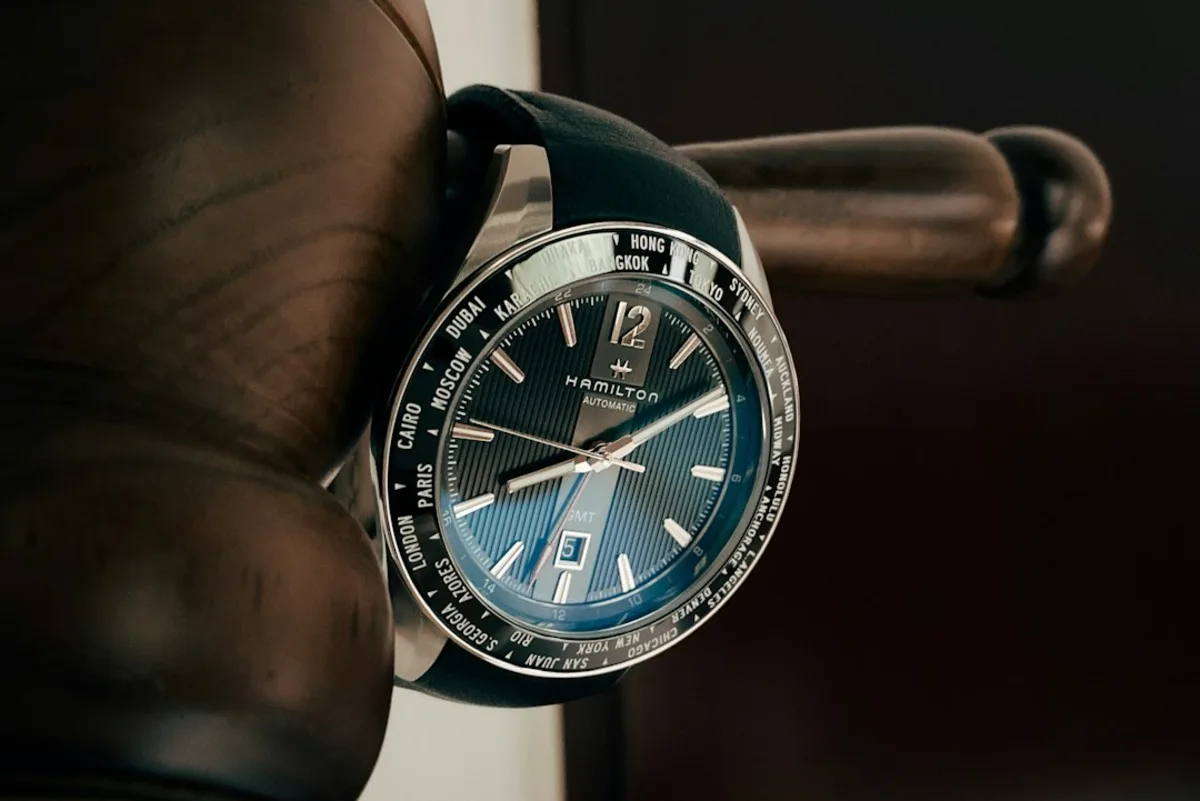
A worldtimer takes the opposite approach. Rather than tracking one extra zone precisely, it displays all 24 roughly simultaneously, usually via a rotating 24-hour ring around the dial's edge paired with a fixed or rotating city ring naming major reference cities for each zone. Look at the dial, find your city, read off the hour.
It's a genuinely lovely complication to look at, and there's a reason worldtimers from the big Genevan houses (Patek Philippe's version is the one collectors talk about most reverently) command serious money and even more serious waiting lists. There's something satisfying about a dial that maps the entire globe's time zones in one glance, and it photographs beautifully, which is partly why it's become such a favourite for watch coverage generally.
But practically speaking, it's the least precise of the three for actual travel use. Most worldtimers only adjust in one-hour increments tied to a fixed set of reference cities, they don't always account for half-hour offset zones (India, parts of Australia) or daylight saving shifts cleanly, and setting one correctly after a long flight, lining up the city ring, the 24-hour ring and the date, can take a genuinely fiddly few minutes with the crown compared to a GMT's quick hour-hand jump. It's a complication built more for the pleasure of owning something that visualises the whole world than for a road warrior who needs to know Singapore time in three seconds flat.
So which one do you actually need?
Be honest with yourself about how you actually travel, because the three complications reward genuinely different habits.
- You commute between two fixed places (family abroad, a remote team, a partner in another country): a dual time watch does the job with the least fuss and usually the lowest price tag of the three.
- You fly reasonably often and want to check the second time zone at a glance without fiddling: a true GMT with an independent hour hand is the sensible buy. It's the complication engineers actually designed for jet lag, and it's why it's stuck around since the jet age began.
- You want a conversation piece and you genuinely enjoy the ritual of setting a watch: a worldtimer is the one to fall for. Just don't buy it thinking it'll be faster to read at passport control than a GMT bezel, because it won't be.
What it costs to get each one right
Dual time watches start relatively low. You can find a competent quartz or basic automatic dual time for a modest sum, often in the same rough bracket as a well-specced dive watch like an Orient Mako II, though the mechanical, jump-hour versions from bigger names climb well into four figures.
GMTs span an enormous range. Budget mechanical GMTs from Seiko's 5 Sports line sit at the affordable end, genuinely usable and shockingly cheap for what they do. Move up to Tudor's Black Bay GMT and you're paying roughly the same order of magnitude as a Black Bay diver with a genuine in-house-adjacent movement and proper bezel action. Go further up to Rolex's GMT-Master II and you're in territory where waiting lists and grey-market premiums matter as much as the sticker price, often trading well above list on the secondary market the same way a steel Submariner does.
Worldtimers are almost always the priciest of the three for equivalent brand tiers, because the movement and dial construction is more complex to execute cleanly, and because the complication has historically been marketed as a prestige piece rather than a working tool. Entry points from smaller independent or Japanese brands exist, but the complication most people picture, that clean, multi-ring Genevan dial, tends to sit firmly in luxury pricing, several multiples above an equivalent GMT from the same house.
The Bottom Line
If I'm being straight about it, most people who think they want a worldtimer actually want a GMT. The worldtimer wins on looks and on the dinner-party story. The GMT wins on being genuinely faster and more intuitive to use at 6am in an airport, which, if you travel enough to justify the complication in the first place, is surely the point. A dual time is the quiet, sensible option nobody boasts about, and honestly, for a huge number of people splitting time between two specific places, it's the correct answer and the one that costs the least to get right.
None of this is about spec-sheet bragging rights. It's about which watch you'll actually use without thinking twice, whether that's an Omega Speedmaster owner adding a GMT to the collection for the first time, or someone buying their first proper watch and wondering whether the extra hand is worth the extra cost. Work out how you actually travel first. The complication should follow from that, not the other way round.
Written by
RevieWatches Editorial Team
RevieWatches is an independent, informational watch site. We research specifications, track pricing across retail and grey markets, and summarise what published...
More in Editor's Choice

Sapphire vs Mineral vs Acrylic Watch Crystal: A Practical Guide
The crystal is the one bit of your watch you touch every single day without noticing. Here's what actually separates sapphire, mineral and acrylic, and which one you should want.
Why Is My Automatic Watch Losing Time? Causes and Fixes
Your automatic watch running fast or slow isn't necessarily broken. Here's what actually causes time drift, what's normal, and when it's worth a trip to the watchmaker.
What Is a COSC Chronometer and Does It Matter?
COSC certification gets printed on dials and shouted about in marketing copy, but what does it actually test, and should it change what you buy? Here's the honest breakdown.