Grand Seiko Spring Drive Explained: How It Actually Works
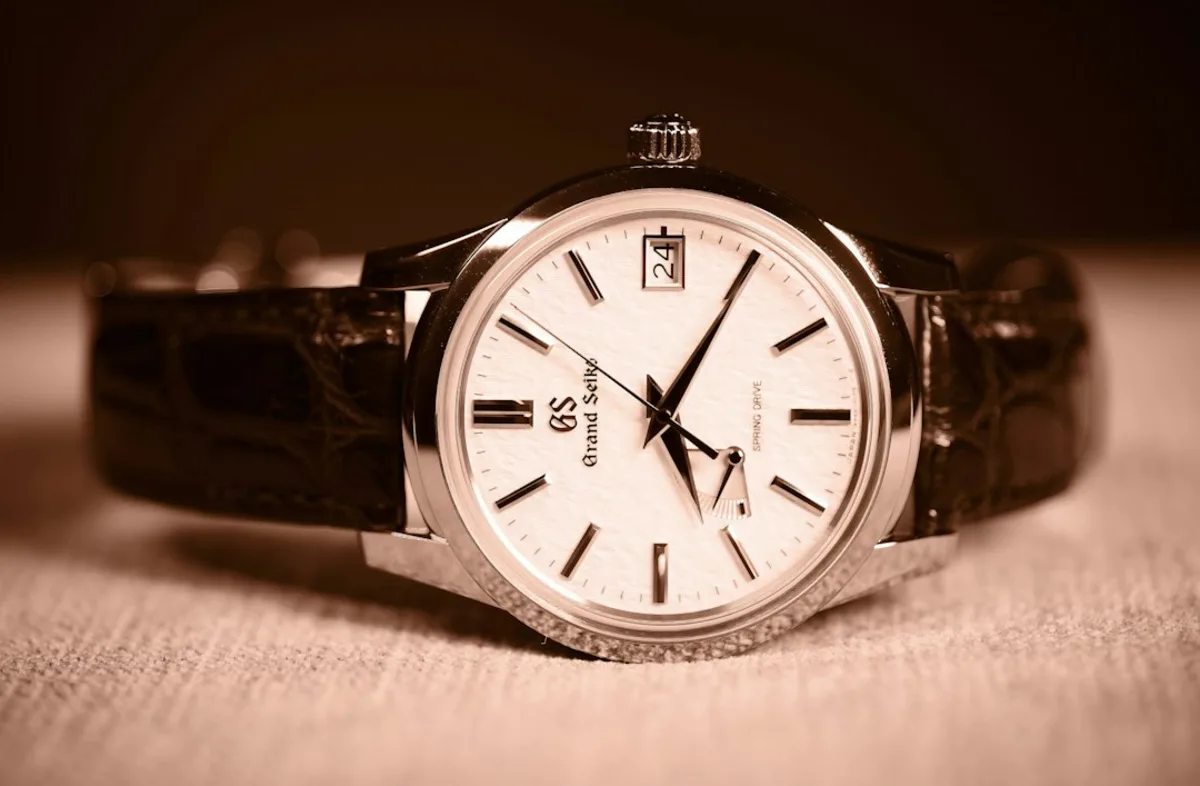
Spring Drive is neither a mechanical nor a quartz watch in the usual sense. It is a mainspring-powered movement regulated by quartz, and it produces one of the smoothest seconds hands in watchmaking.
About this article: this is an informational article based on public sources: manufacturer specifications, published hands-on reviews by other outlets, owner feedback and current prices. We have not tested the watch ourselves, we are watch enthusiasts rather than professional journalists, and nothing here is buying advice. No brand paid for it. Our method
📑 Table of Contents
Spring Drive is one of the most interesting ideas in modern watchmaking, and one of the most misunderstood. It is often described as a hybrid, which is true but not very helpful. This guide to Spring Drive explained in plain English covers what it is, how it works, and why people who love mechanical watches often end up loving it too.
What Spring Drive Is
A Spring Drive movement is powered like a mechanical automatic watch: a rotor winds a mainspring, and the mainspring drives a gear train. The difference is in how that energy is regulated. A traditional mechanical watch uses an escapement and a balance wheel, which stop and start the gear train several times a second. Spring Drive replaces them with a device Seiko calls the Tri-synchro Regulator.
There is no battery. The watch runs entirely on the energy stored in its mainspring.
How the Tri-synchro Regulator Works
The name refers to three forms of energy working together: mechanical, electrical and electromagnetic.
- As the mainspring unwinds, it turns a wheel called the glide wheel.
- The glide wheel spins past a coil, generating a tiny amount of electricity, just as a dynamo does.
- That electricity powers a quartz oscillator vibrating at 32,768 times per second, the same frequency used in quartz watches, and a small integrated circuit.
- The circuit compares the speed of the glide wheel with the quartz reference and applies an electromagnetic brake to keep the glide wheel turning at exactly the right speed.
In other words, the mainspring provides the power and quartz provides the timing reference, with no escapement ticking in between.
The Glide Motion Seconds Hand
Because the glide wheel turns continuously rather than stopping and starting, the seconds hand of a Spring Drive watch moves in a perfectly smooth sweep. A mechanical watch's seconds hand appears to sweep but actually moves in small steps, and a quartz watch's hand jumps once a second. Spring Drive's glide is its most recognisable signature and, for many owners, the reason they fall for it.
How Accurate Is Spring Drive?
Standard 9R Spring Drive calibres are rated to plus or minus 15 seconds a month, which works out at about one second a day. Some higher-grade calibres, including the 9RA2, 9RA5 and 9R01, are rated to plus or minus 10 seconds a month. That is far beyond what mechanical watches achieve, and close to a good quartz watch.
A Long Road to Production
The idea came from a Seiko engineer, Yoshikazu Akahane, in 1977. Turning it into a practical movement took decades and hundreds of prototypes. Spring Drive finally debuted in 1999, and the first Grand Seiko with a Spring Drive movement, the calibre 9R65, arrived in 2004. Today Spring Drive is a core part of the Grand Seiko range.
Is Spring Drive Mechanical or Quartz?
Strictly, neither. It has no battery and is powered by a mainspring, which is why many enthusiasts treat it as a mechanical watch at heart. But its timekeeping is governed by quartz, which is why purists sometimes resist it. I think the most useful way to see it is as a third category, one that takes the most appealing parts of each approach.
Things to Know Before Buying
- Servicing: Spring Drive movements are serviced by Grand Seiko's own service network, so check service availability where you live.
- Power reserve: as with any automatic, the watch stops if the mainspring runs down, and needs winding and setting again.
- Price: Spring Drive models generally sit above Grand Seiko's quartz models in the range, reflecting the complexity of the movement.
Who Is Spring Drive For?
Spring Drive suits people who love the idea of a self-powered mechanical watch but want near-quartz accuracy, and anyone who finds the smooth sweep of the seconds hand as mesmerising as most people do. It is also a genuine piece of engineering history, the result of one of the longest development projects in modern watchmaking.
Related reading
- What Is a COSC Chronometer and Does It Matter?
- Automatic vs Quartz vs Solar: Which Watch Movement Should You Buy?
- Why Is My Automatic Watch Losing Time? Causes and Fixes
Frequently Asked Questions
Does a Spring Drive watch have a battery?
No. It is powered entirely by a mainspring, wound automatically by a rotor. A tiny amount of electricity is generated internally by the glide wheel to run the quartz regulator.
How accurate is Spring Drive?
Standard 9R Spring Drive calibres are rated to plus or minus 15 seconds a month, about one second a day. Some higher-grade calibres are rated to plus or minus 10 seconds a month.
Why does the Spring Drive seconds hand move so smoothly?
Because the glide wheel turns continuously rather than stopping and starting like a mechanical escapement, so the seconds hand sweeps without any steps.
When was Spring Drive invented?
The idea dates from 1977. Spring Drive debuted in 1999, and the first Grand Seiko Spring Drive, the calibre 9R65, arrived in 2004.
⚙️ Specifications
Written by
RevieWatches Editorial Team
RevieWatches is an independent, informational watch site. We research specifications, track pricing across retail and grey markets, and summarise what published...
More in Editor's Choice
GMT vs Worldtimer vs Dual Time: Which Travel Watch Do You Actually Need?
Three complications, three very different jobs. Here's how to work out whether you need a GMT, a worldtimer, or a simple dual time watch, and how much each one actually costs to get right.

Sapphire vs Mineral vs Acrylic Watch Crystal: A Practical Guide
The crystal is the one bit of your watch you touch every single day without noticing. Here's what actually separates sapphire, mineral and acrylic, and which one you should want.
Why Is My Automatic Watch Losing Time? Causes and Fixes
Your automatic watch running fast or slow isn't necessarily broken. Here's what actually causes time drift, what's normal, and when it's worth a trip to the watchmaker.